

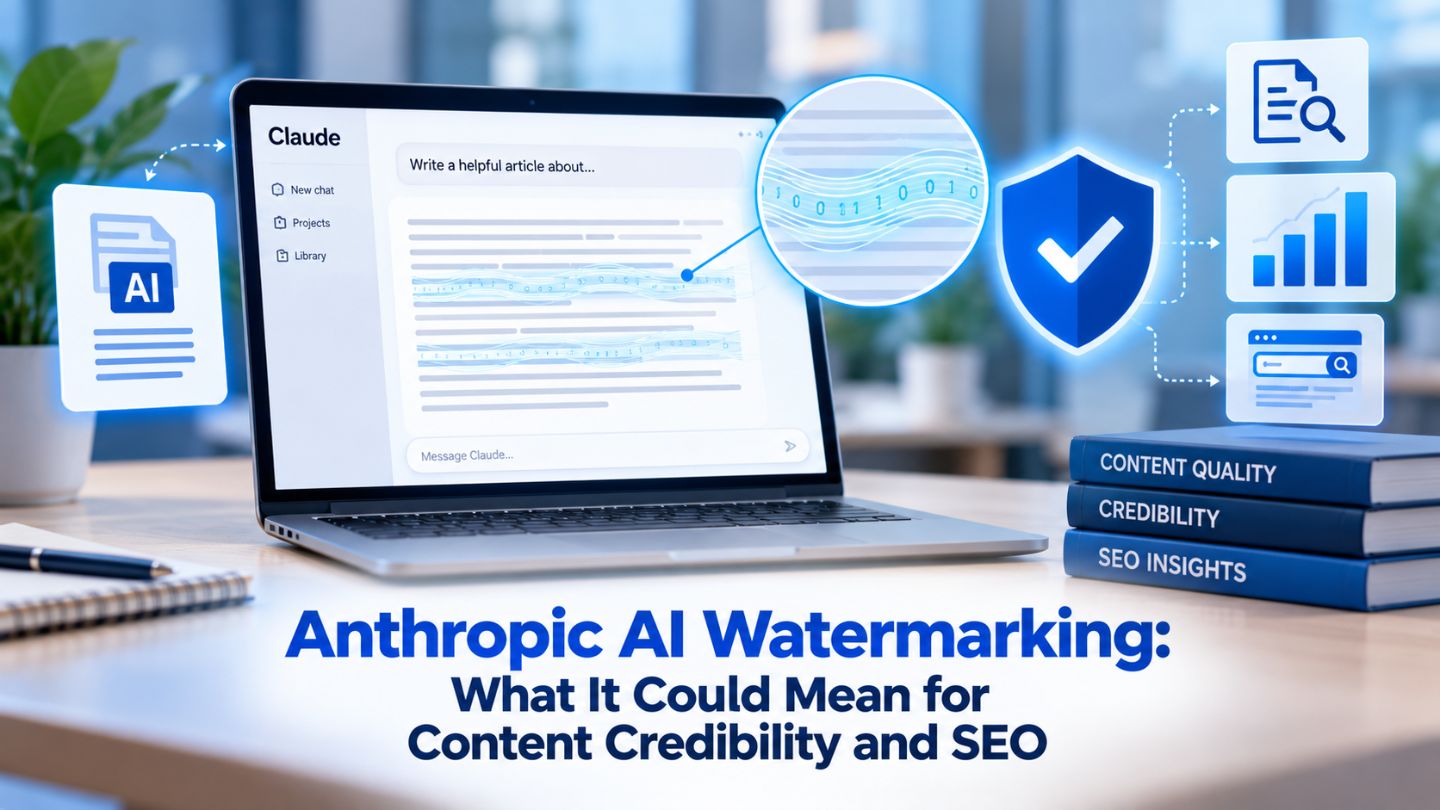
As AI writing tools begin watermarking their output, a question hangs over content teams: if it becomes possible to detect AI-generated text, does that change what you should publish, and does it affect how search engines treat your content? The honest answer is more measured than either the alarmist or the dismissive takes suggest. This blog covers what watermarking actually is, what it likely does and does not mean for SEO, and how to think about content credibility as detection becomes more feasible.
Key Takeaways
- Watermarking embeds a detectable signal in AI-generated text.
- Detection ability does not automatically mean search penalties.
- Search engines have consistently judged content by quality, not origin.
- Credibility concerns are more about trust than about ranking mechanics.
- The durable strategy is genuinely useful content regardless of how it was made.
What Watermarking Actually Is
Watermarking in this context means embedding a subtle, detectable pattern into AI-generated text, a signal that identifies the content as machine-produced without being visible to a normal reader. The intent is to make it possible to tell, after the fact, whether a given piece of text came from a particular AI system.
It is worth being precise about what this is and is not. It is a detection mechanism, not a quality judgment, and it says nothing about whether the content is good, accurate, or useful. A watermarked piece can be excellent, and an unwatermarked piece can be terrible. The watermark identifies origin, not value, and conflating those two is where most of the confusion starts. Examining the claim that Claude watermarks every word it writes helps ground the discussion in what is actually happening.
Why Detection Does Not Equal Penalty
The leap people make is from can be detected to will be penalized, and that leap is not supported by how search engines have actually behaved. Search engines have consistently stated and demonstrated that they judge content by whether it is helpful and high quality, not by the tool used to produce it. AI assistance is not against the rules; unhelpful content is.
So even if AI-generated text becomes reliably detectable, the more likely outcome is that quality remains the deciding factor, not origin. A useful, accurate, well-made page does not become less useful because a watermark reveals AI was involved. The thing search engines have always penalized, thin and unhelpful content, is penalized whether a human or a machine produced it.
Origin Is Not the Signal, Quality Is
Search systems care whether content helps the person who found it. How it was made has never been the thing that determines that, and watermarking does not change what actually helps a reader.
Read More: Is AI Content Bad for SEO? Reasons Why AI Content Can Support Rankings
Where Credibility Genuinely Comes In
The more real concern is not ranking mechanics but trust. If a reader, a journalist, or a potential customer can tell that your content was AI-generated, that may affect how much they trust it, particularly in fields where expertise and authenticity matter. This is a credibility question, and it is separate from whether the page ranks.
That distinction matters because the fix is different. A ranking concern would be addressed through SEO mechanics; a credibility concern is addressed through genuine expertise, accuracy, and adding something a purely generated page could not. In trust-dependent fields, the value of demonstrable human expertise goes up, not because of a penalty, but because credibility is part of what you are selling. This connects to broader entity SEO and how Google understands content context.
What This Changes About Strategy

In practice, watermarking reinforces a strategy that was already sound rather than demanding a new one. Content that is genuinely useful, accurate, and adds real expertise performs regardless of how detection evolves, because it succeeds on the dimension that actually matters. Content that relied on volume and generic output was always vulnerable, and detection just makes that vulnerability more visible.
The teams that will be unaffected are the ones already using AI as an assistant rather than a replacement, layering their own knowledge onto its output. The teams that should be concerned are the ones publishing unedited generated content at scale, and their problem was never really the watermark, it was that the content had nothing distinctive to offer in the first place. The practical defence is editing AI output properly so the page carries something a generated draft never would.
Avoiding the Overreaction
There is a temptation to respond to watermarking by either abandoning AI entirely or by hunting for ways to strip watermarks, and both miss the point. Abandoning a useful tool out of fear of a penalty that the evidence does not support is an overcorrection. Trying to defeat detection treats the symptom while ignoring that detectable or not, generic content underperforms.
The measured response is to keep using AI where it genuinely helps, keep human expertise and judgment central, and focus on whether your content is actually useful rather than whether its origin is detectable. That focus would serve you even if watermarking never existed, which is a good sign it is the right one. The same principle applies to any content that needs to earn its place as Google crawls high-quality content more frequently.
Disclosure as a Trust Choice
As detection becomes more feasible, some businesses are choosing to be transparent about their use of AI rather than risk it being discovered. Whether disclosure helps or hurts depends heavily on your audience and field, but the calculation is worth making deliberately rather than having the decision made for you by detection you did not anticipate.
In fields where authenticity and human expertise are central to the value, being upfront about where AI assisted and where genuine human expertise shaped the work can actually reinforce trust rather than undermine it. The point is that this is a strategic choice about credibility, separate from any ranking concern, and thinking it through beats being caught out by detection later.
Read More: E-E-A-T Optimization: How to Build Authority in Your Niche
Why the Panic Misreads the Situation
Much of the anxiety around watermarking comes from conflating detection with punishment, and that conflation misreads how search has always worked. Search engines have consistently rewarded content that helps people and penalized content that does not, regardless of how it was produced. Watermarking changes what can be detected, not what gets rewarded, and those are genuinely different things.
Seeing the situation clearly means separating the credibility question, which is real and worth addressing through genuine expertise, from the ranking question, which the evidence does not support. Businesses that panic tend to make one of two overcorrections, abandoning a useful tool or trying to defeat detection, and both waste energy on a threat that was misunderstood. The measured response holds up because it was aimed at the actual situation.
The Content That Was Always Going to Win

The businesses least affected by watermarking are the ones that were already producing genuinely useful, expert content, because their work succeeds on exactly the dimension that detection does not touch. Their content was never vulnerable to being revealed as low-effort, because it was not low-effort, and a watermark showing AI assistance changes nothing about whether it helps the reader.
This is the reassuring core of the whole issue: the content strategy that was always right, useful, accurate, genuinely expert, remains right regardless of how detection evolves. The businesses that should worry are the ones whose content had nothing distinctive to offer, and their problem was never really the watermark. It was that the content itself did not earn its place. That is the same standard behind why thin content gets penalized, watermark or not.
Focusing on What Actually Matters
AI watermarking makes it more possible to detect machine-generated text, and that is a smaller deal for SEO than it first appears. Detection is not a penalty, and search engines have consistently judged content by quality rather than origin. The genuine consideration is credibility and trust, particularly in fields where human expertise is part of the value, and that is addressed by adding real expertise rather than by hiding how content was made. The durable strategy, useful content that helps the reader, was the right strategy before watermarking and remains it after.
At The Ocean Marketing, we build SEO content strategies that hold up regardless of how detection and AI evolve. Whether you need help ensuring your content adds genuine value, building credibility in a trust-dependent field, or a free SEO audit to see where your site currently stands, our team can help. Contact us and let's focus on what actually moves your rankings.