

Topical authority is well understood in traditional search: cover a subject deeply and thoroughly, and you become a source search engines trust for it. What is less understood is how that authority behaves inside AI assistants, where it can spread across related topics in useful ways and also hit limits that do not exist in traditional search. Understanding where it travels, and where it stops, changes how you build content meant to be surfaced in AI answers.
Key Takeaways
- Topical authority influences whether AI assistants treat you as a source worth citing.
- Authority on a core topic can extend to its closely related neighbors.
- The spread stops where the connection between topics becomes weak.
- Depth and genuine expertise build authority; volume alone does not.
- Being a recognized source across the wider web reinforces the effect.
How Does Authority Work Inside AI Assistants?
Authority works inside AI assistants through selection rather than ranking. When an assistant assembles an answer, it draws on sources it effectively treats as more or less trustworthy for a given subject, so a business recognized as a genuine authority on a topic is more likely to be the source it pulls from or points to. That is the AI equivalent of the trust that drives traditional rankings, expressed through being chosen rather than through a position on a page.
This means topical authority is not only a traditional search concept; it shapes whether you get surfaced in AI answers at all. Understanding how topical authority differs from keyword authority is the foundation, since the same depth that builds ranking authority builds the source-worthiness these systems respond to.
Where Does Authority Spread?
Authority spreads outward from a core topic to its closely related neighbors. If you are a recognized source on a subject, AI systems are more likely to treat you as credible on its adjacent topics too, because genuine expertise in an area usually implies some command of the surrounding territory. The authority radiates along real connections between topics.
This is why building genuine depth in a focused area pays off beyond that exact area. The spread follows real relationships between subjects, which is the same principle behind how entity SEO helps Google understand content context.
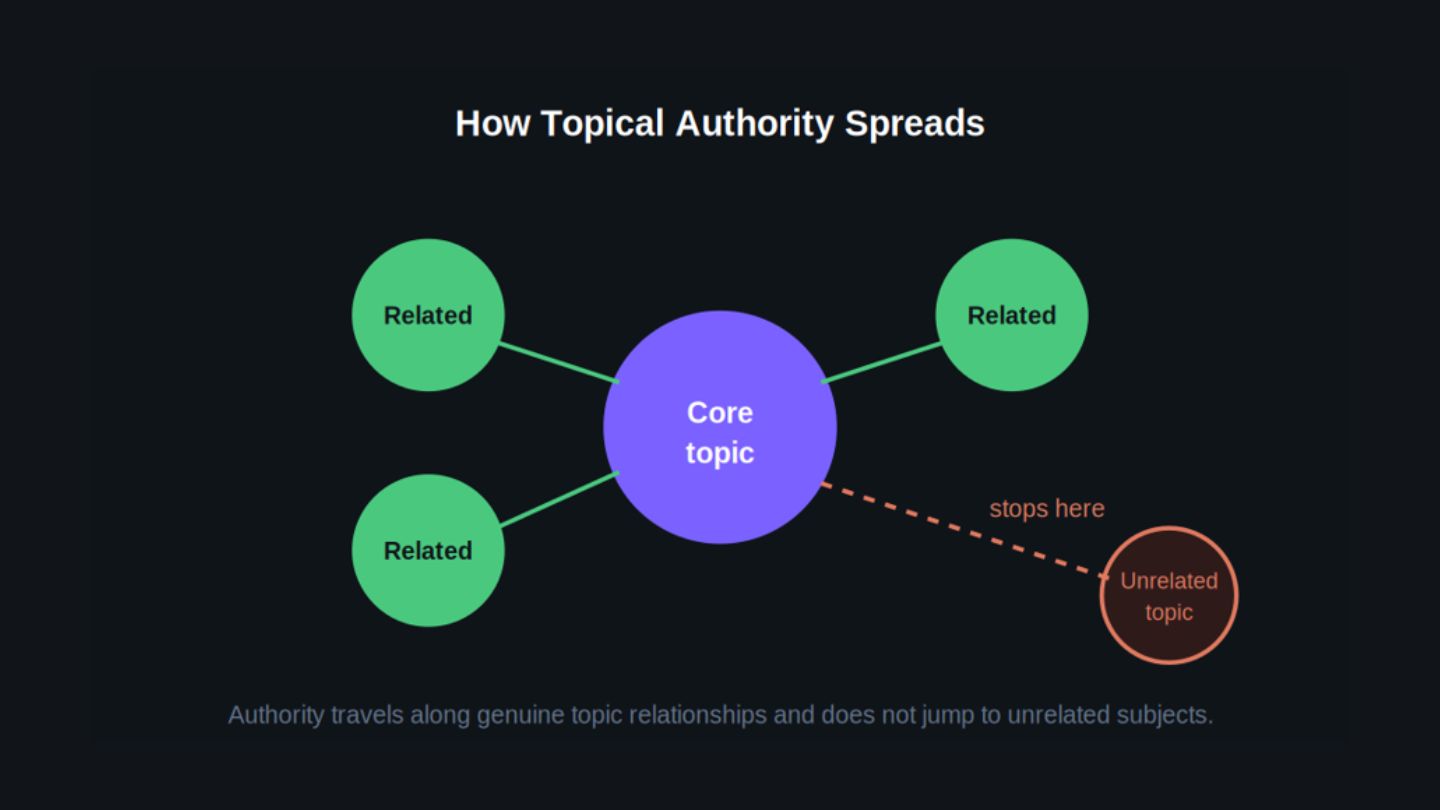
Deep authority on a core topic extends to its genuine neighbors and stops where the connection becomes weak.
Depth Radiates, Breadth Does Not
Deep authority on one topic extends to its neighbors. Shallow coverage of many topics establishes authority on none, so it has nothing to spread.
Where Does the Spread Stop?
The spread stops where the topic connection becomes weak or nonexistent. Being a trusted source on one subject does not make you credible on an unrelated one, and AI systems are reasonably good at not over-extending that trust across genuine topical gaps. You cannot build authority in one area and expect it to carry you into a field with no real connection to it.
This means the radiating effect is real within a coherent topical neighborhood and does not jump across to subjects that share no genuine relationship, which is why organizing coverage so those connections are explicit- the idea behind topical gravity and how topic relationships shape visibility- helps authority travel where it legitimately can. Trying to stretch authority too far produces content the systems have no reason to treat as credible, because the connection that would justify the trust is not there.
Why Does Depth Beat Volume Here?

Depth beats volume because what establishes authority is genuine expertise, not sheer output. A large volume of shallow content on a topic does not make you a source, because there is nothing in it that demonstrates real command, while a smaller body of genuinely deep, expert content, structured around the real questions people ask with something like query templates that expand topical authority, does far more.
This matters especially for AI systems, which assemble answers from the most credible-seeming sources rather than the most prolific ones. Content that genuinely demonstrates expertise, with substance a shallow page could not replicate, is what earns source status, which is exactly where a content quality checklist editors should actually use earns its place, since depth and accuracy are what separate authoritative content from filler.
How Do You Reinforce Authority Beyond Your Own Site?
You reinforce it by being recognized as a source across the wider web, not just on your own pages when your business is referenced, cited, and discussed in the context of a topic across many places, that accumulated recognition strengthens the signal that you are a genuine authority on it.
This makes building topical authority for AI partly an off-site effort, earning mentions and references where your topic is discussed. The more the web associates you with a subject, the more reason AI systems have to treat you as a source for it, which is the core idea behind earning AI search mentions and building citation authority.
Building Authority That Travels
Topical authority shapes whether AI assistants treat you as a source, and inside these systems it spreads from a core topic to its genuine neighbors while stopping where the connection becomes weak. Depth and real expertise build it; volume alone does not, because shallow content demonstrates nothing worth trusting. Recognition across the wider web reinforces the effect. The practical path is concentrating on focused areas, covering them with genuine depth, and connecting them along real relationships.
At The Ocean Marketing, we combine SEO strategy with Content Writing that builds genuine authority that both AI systems and search engines recognize. Whether you need help concentrating your content where it will build authority, extending into the right adjacent topics, or a free SEO audit to see where your site currently stands, our team can help. Contact us and let's build authority that actually travels.
Frequently Asked Questions
Does topical authority work the same way in ChatGPT as in Google?
The underlying idea is the same: genuine depth on a subject makes you a trusted source, but the expression differs. Google ranks you in a list; an AI assistant selects you as a source for an assembled answer. Both reward real command of a topic, and in AI systems that authority can extend to closely related topics.
Can I build authority in one niche and rank for an unrelated one?
Not through topical authority alone. The authority from a core topic spreads to its genuine neighbors and stops where the connection becomes weak. Building credibility in an unrelated field requires genuine depth in that field, not a spillover from somewhere else.
Is more content always better for topical authority?
No. Depth and genuine expertise build authority, while a large volume of shallow content establishes none. A focused body of deep, expert content outperforms a larger library of thin pages, because the systems respond to demonstrated command rather than sheer output.