
Search engines have evolved beyond simple keyword matching to focus on understanding meaning, intent, and context. Today, Google analyzes how different concepts connect within content to deliver more accurate and relevant results. This shift has made entity SEO an essential part of modern optimization strategies. Instead of relying only on keywords, businesses must create content that reflects clear relationships between topics. This blog outlines how entity SEO works, how Google interprets content context, and what steps you can take to improve your content strategy for better visibility and long-term success.
Key Takeaways
- Entity SEO helps Google understand meaning beyond keywords.
- Google studies relationships between people, places, brands, topics, and concepts.
- Context helps search engines decide what your content is truly about.
- Structured data and internal linking can improve entity understanding.
- Content should focus on depth, relevance, and user intent.
- A strong entity SEO strategy supports better visibility and long-term ranking growth.
What Is Entity SEO?
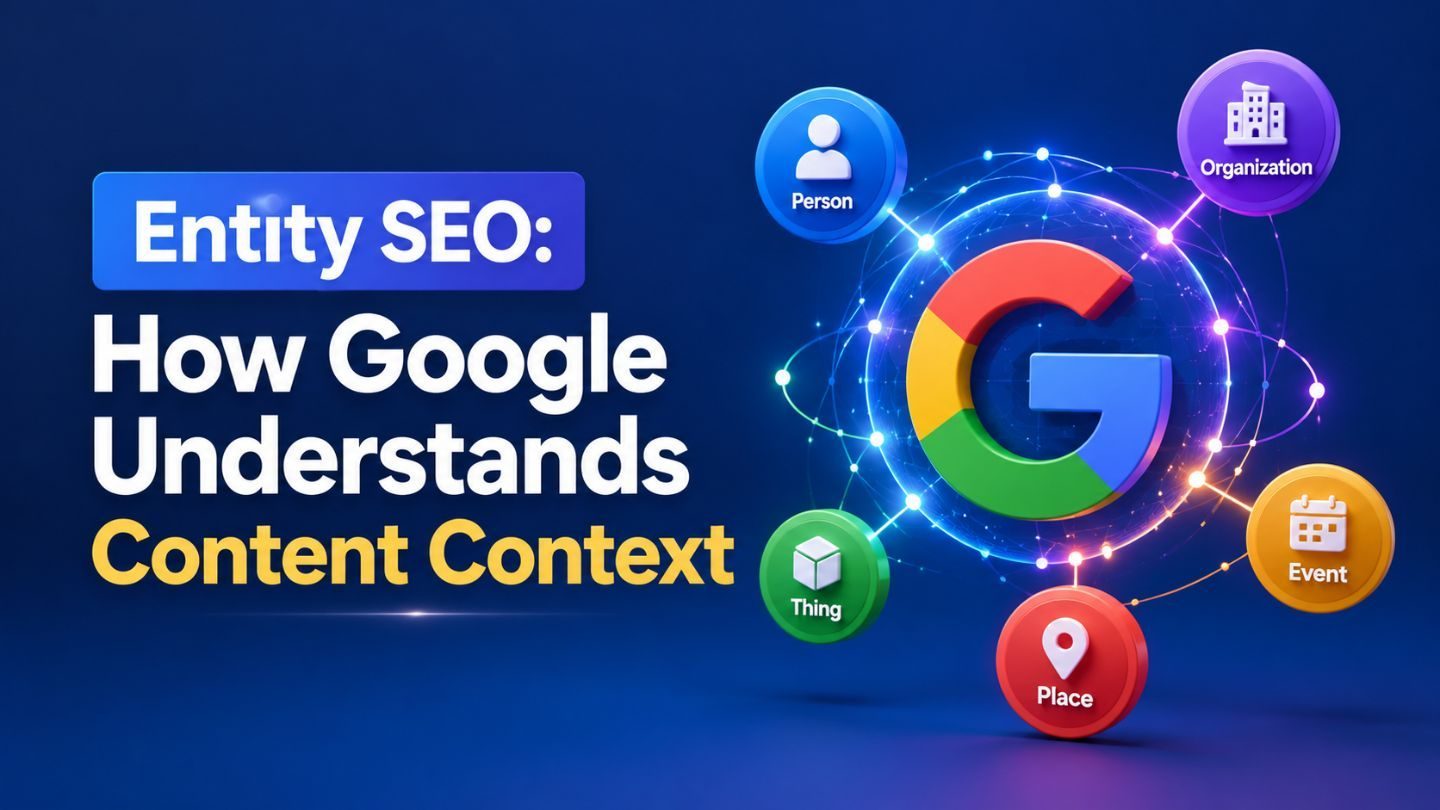
Entity SEO is the process of optimizing content around clear concepts that Google can recognize and connect with other related ideas. An entity can be a person, place, business, product, service, event, or topic that has a specific meaning. Instead of looking only at repeated keywords, Google uses entities to understand what a page is discussing and how that topic fits into a larger subject area. This makes entity SEO different from older keyword-focused methods. While keywords still matter, they are no longer enough on their own. A page about digital marketing, for example, may also mention search engines, content strategy, backlinks, technical optimization, and user intent. These related ideas help Google understand that the page is not just using one keyword but explaining a complete topic.
Why Entities Matter in Search
Entities matter because they help Google reduce confusion. Many words have more than one meaning, and search engines need context to understand the correct one. For example, the word “Apple” could refer to a fruit or a technology company. Google studies the surrounding words, page structure, and related topics to decide which meaning is intended. This is why context has become such an important part of modern SEO. When your content includes relevant terms, clear explanations, and connected ideas, Google can interpret it more accurately. That stronger understanding can help your page appear for more relevant searches, even when the search query does not exactly match the words used in your content.
How Google Understands Content Context

Google understands content context by analyzing how words and topics relate to each other. It does not simply count how many times a keyword appears on a page. Instead, it looks at the overall meaning of the content, the intent behind the search, and whether the page provides useful information that matches what the user wants. For example, if a page discusses entity SEO, it may naturally include terms such as knowledge graph, semantic search, structured data, topical authority, content relevance, and search intent. These supporting terms help Google understand that the page covers the topic in depth. When these ideas are used naturally, they strengthen the page without making the content sound forced or repetitive.
Read More: Content Depth vs Clarity: Which Drives Better Rankings?
The Role of Google’s Knowledge Graph
Google’s Knowledge Graph is one of the major systems that helps search engines understand entities and their relationships. The idea of maximizing brand mentions across the search universe also supports entity recognition because Google can connect a brand with relevant topics, services, and repeated online references. It connects information about people, places, organizations, products, and concepts so Google can deliver more accurate results.
When Google recognizes an entity, it can connect that entity to related information across the web. For content creators, this means accuracy and clarity are extremely important. If your website consistently explains topics in a clear and connected way, it becomes easier for Google to understand your area of expertise. This does not happen through keyword stuffing. It happens by creating helpful content that explains the main topic, includes related concepts, and builds trust through relevance.
Entity SEO vs Traditional SEO
Traditional SEO often focuses on keyword placement, meta tags, headings, backlinks, and technical improvements. These elements are still important, but entity SEO adds another layer by focusing on meaning and relationships. It asks whether the content explains the subject properly and whether the page fits into a larger topical structure. Entity SEO does not replace traditional SEO. Instead, it improves it. A strong strategy still needs optimized titles, clean URLs, proper headings, fast loading speed, and high-quality links. However, when those elements are supported by entity-based content, the page becomes more useful and easier for Google to understand.
Why Keyword Repetition Is Not Enough
Repeating the same keyword too many times can make content feel unnatural. It may also fail to explain the topic properly. Google has become much better at recognizing whether a page is genuinely helpful or simply written to include a keyword many times. This is why content should focus on meaning first and keyword usage second. A better approach is to use the main keyword naturally while also including related phrases and concepts. For example, a page targeting SEO can discuss search intent, rankings, organic traffic, website authority, content optimization, and technical performance. These connected terms make the content richer and more useful without relying on repetition.
How Semantic Search Supports Entity SEO
Semantic search allows Google to understand the meaning behind a search query rather than only matching exact words. When someone searches for a question, Google tries to understand what they are really asking. It then looks for pages that answer the intent behind the query, even if the exact wording is different. This is where entity SEO becomes powerful. If your content explains a topic clearly and includes relevant supporting entities, it has a better chance of matching different types of searches. A well-written page can appear for informational, comparison-based, and problem-solving queries because Google understands the broader context of the content.
Read More: Tips to Write Good, High-Quality Content
Building Topical Authority With Entities
Topical authority means your website is seen as a reliable source for a specific subject area. Entity SEO supports this by helping you create connected content around a main topic. Instead of publishing random articles, you build a structured content network that covers important subtopics in a clear and organized way. Understanding the difference between keyword authority and topical authority helps explain why entity SEO focuses on both relevant search terms and broader subject expertise
For example, a website focused on SEO may publish content about keyword research, technical SEO, local SEO, on-page optimization, content strategy, backlinks, and analytics. When these pages are internally linked and written with strong context, they support each other. This helps Google understand that the website has depth and relevance in that subject area.
The Importance of Internal Linking
Internal linking helps Google discover relationships between pages on your website. Understanding link equity distribution is important because it helps Google evaluate relationships, authority, and how value flows between pages across the web. When you link related pages together, you show search engines how different topics connect. This makes it easier for Google to understand your site structure and identify which pages are most important. Internal links also help users move through your website more easily. If someone reads a blog about entity SEO, they may also want to learn about content strategy, keyword research, or technical optimization. Linking to those pages creates a better experience while strengthening topical connections across your site.
Structured Data and Entity Recognition
Structured data is a form of code that helps search engines understand the information on a page more clearly. It can identify details such as business names, reviews, FAQs, products, services, authors, and articles. When used correctly, structured data gives Google more direct information about your content. This does not guarantee higher rankings, but it can improve how search engines interpret your pages. It may also increase the chances of rich results in search. For entity SEO, structured data is useful because it clearly defines important details and reduces uncertainty about what the page represents.
How to Write Content for Entity SEO
Writing for entity SEO starts with understanding the main topic deeply. Before creating content, identify the primary entity and the related concepts that should naturally appear around it. This helps you build a complete outline that covers the topic from different angles without repeating the same points. The goal is to write content that answers the reader’s question fully. Use clear headings, explain related ideas, and avoid adding terms only for the sake of optimization. When the content flows naturally and covers the subject well, it becomes easier for both users and search engines to understand its value.
Common Entity SEO Mistakes
One common mistake is treating entity SEO as another form of keyword stuffing. Adding many related terms without proper explanation does not improve content quality. Google looks for meaning, not just word presence. Every concept included in the content should support the main topic and add value for the reader. Another mistake is ignoring website structure. Even strong content can underperform if related pages are not linked properly. Entity SEO works best when your website has organized content clusters, logical internal links, clear headings, and consistent messaging across pages.
The Future of Entity SEO
The future of search will continue moving toward context, meaning, and intent. As Google improves its ability to understand language, content that only depends on exact-match keywords will become less effective. Businesses will need to focus on building authority around topics, not just chasing individual search terms. Voice search, AI-driven search results, and personalized experiences also depend heavily on entity understanding. Users now search in more natural ways, often asking full questions instead of typing short phrases. Entity SEO helps websites prepare for this shift by making content more meaningful, connected, and useful.
Final Thoughts
Entity SEO has transformed how Google understands and ranks content by focusing on meaning, relationships, and user intent rather than just keyword placement. Throughout this blog, we explored how entities help search engines interpret context, the role of the Knowledge Graph, and why creating content with depth and relevance is essential. By structuring content around connected ideas, using internal linking, and maintaining semantic clarity, businesses can improve visibility and build stronger authority in their niche. This approach ensures content is not only optimized for search engines but also valuable and engaging for users.
At The Ocean Marketing, we specialize in SEO strategies that align with modern search engine behavior. Our team focuses on creating context-driven content that improves rankings while delivering real value to your audience. We also offer a free SEO audit to help identify gaps and opportunities in your current strategy. Contact us today, and let’s build a smarter digital presence together.