
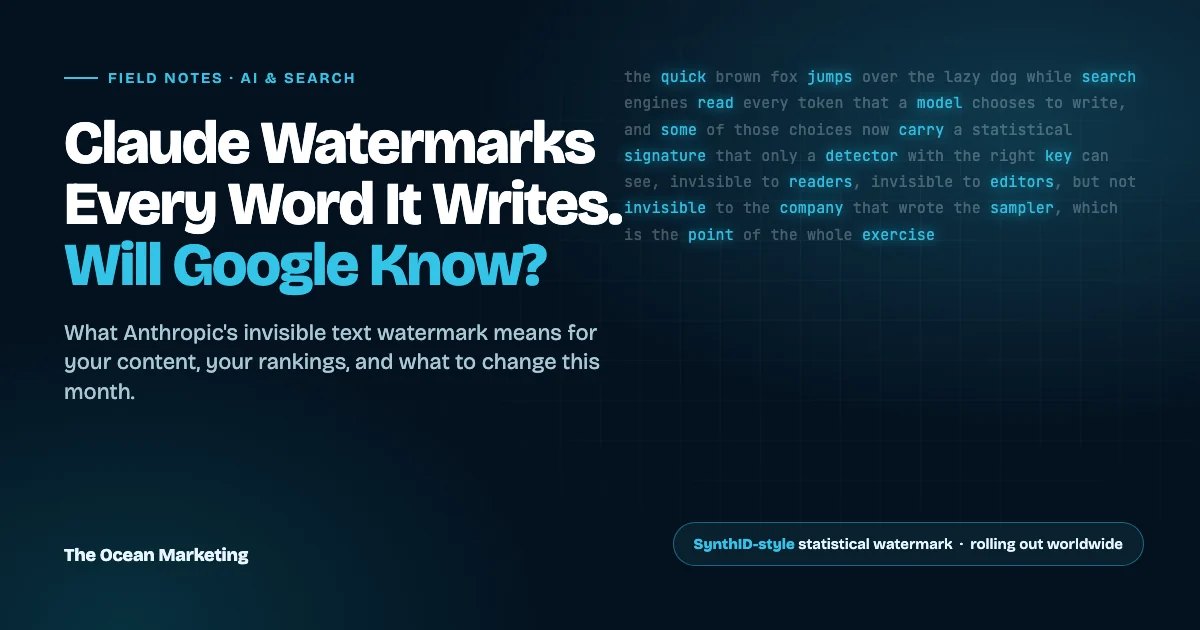
Eighty percent of marketers now use AI for content creation, according to HubSpot's 2026 State of Marketing report. As of August 2026, any of that text drafted with Claude's current models carries something new: an invisible, machine-readable signature that says a Claude model helped write it.
Anthropic's announcement landed on August 11 and the reaction from content teams split fast. Some heard "Google will finally catch AI content." Others shrugged, since nothing on the page visibly changed. Both reactions miss what the watermark is, who can read it, and where the real risk to your rankings sits.
This post covers what Anthropic shipped and how the watermark hides in ordinary word choice. It lays out what Google has and hasn't said. Then it lists the changes worth making to an AI-assisted content workflow this month.
Key Takeaways
- Claude models released on or after August 2, 2026 carry a statistical text watermark worldwide, across the Claude app, API, Claude Code, Claude Cowork and Claude Tag. Older models get it "over the coming months," per Anthropic.
- The watermark lives in word choice, not hidden characters. Light edits usually don't remove it. A full rewrite or a translation by another tool usually does.
- Google Search has no text-watermark detector. Its SynthID checks (Google's own watermarking system) cover images, video and audio only. Google's published guidance still rewards helpful content "however it is produced."
- The detector is a private preview for regulators, newsrooms, researchers and qualifying enterprises. The near-term exposure is with clients, journalists and platforms, not the ranking algorithm.
- The right response is disclosure, editorial ownership and original evidence, not paraphrase tools.
How this post was made: it was researched from the primary sources listed at the end, drafted with AI assistance from Claude, then fact-checked, edited and published by the content team at The Ocean Marketing, which holds editorial responsibility for it. An editor on the team signs off on every post, and contact details are on that page. That is the disclosure-and-ownership standard the post argues for.
What Anthropic Actually Announced
On August 11, 2026, Anthropic said Claude's text output now carries an imperceptible watermark. Files it produces get signed provenance metadata (Anthropic Help Center, updated September 2026). The company followed with a technical explainer on August 14 and a detection-access update on September 1 (Anthropic).
The facts that matter for a content team:
- Which models. Fable 5.1 and Mythos 5.1 support marking at launch. Anthropic says it is "working to add marking support" to models released before August 2, 2026.
- Where. Everywhere Claude is sold, including the API, Claude Code, Claude Cowork and Claude Tag (Anthropic's coding, desktop-agent and Slack products), plus the AWS, Google Cloud and Microsoft Foundry marketplaces. That includes any third-party writing tool that calls the Claude API. Anthropic applied it globally because it "doesn't yet have a durable way to scope it by region."
- Text and files. Text gets the statistical watermark. SVG, PNG and JPG files get C2PA signed metadata, the same open standard camera makers and Adobe use (TechCrunch, August 11, 2026).
- Why now. The EU AI Act's Article 50 transparency duties took effect on August 2, 2026. Anthropic signed the EU's Code of Practice on marking and labelling of AI-generated content in July, alongside roughly 190 other organizations (European Commission).
- No documented opt-out. Neither Anthropic page mentions a way for API or enterprise customers to disable marking.
Anthropic was unusually direct about the limits. In its own words, the watermark "doesn't prove Claude created the original ideas or wrote the original text." It also says "the absence of a detectable watermark doesn't mean content wasn't AI-generated" (Anthropic Help Center; also reported by Search Engine Land, August 11, 2026).
| The watermark can | The watermark cannot |
|---|---|
| Show a Claude model had a hand in a passage | Identify which user, company or chat produced it |
| Survive copy-paste and light editing | Tell "Claude wrote this" apart from "Claude heavily edited this" |
| Persist through translation done by Claude | Detect human text or text from other AI systems |
| Strengthen as the passage gets longer | Give a reliable read on very short passages |
| Be read by anyone holding Anthropic's key | Be seen by readers, editors or style-based AI detectors |
One line in Anthropic's explainer deserves more attention than it got. If a human writes a draft and Claude only proofreads it, that "might not be enough to make Claude's involvement detectable." Flip it around, with Claude drafting and a human polishing, and the watermark most likely survives. The signal tracks who chose the words, not who touched the document last.
How an Invisible Text Watermark Works
SynthID-Text is the watermarking method Google DeepMind published in Nature in October 2024, and it is the method Anthropic adopted (Dathathri et al., Nature). A text watermark, in this sense, is a hidden bias in which words get picked when several would fit. There are no hidden characters and no metadata in the text.
Every time a language model writes the next word, it holds a shortlist of candidates with probabilities. SynthID-Text samples a few of those candidates and pairs them off in a tournament. Each pair is scored with random numbers derived from a secret key and the preceding words. The higher score advances. After a few rounds one word wins. Repeat that thousands of times across an article and the winners form a pattern. A detector holding the same key can measure it. A reader sees only fluent prose.
Google tested the cost of this on real traffic before publishing. In a live experiment across roughly 20 million Gemini responses, the watermarked model's thumbs-up rate was 0.01 percent higher than the unwatermarked model's. Its thumbs-down rate was 0.02 percent lower. Both gaps were statistically insignificant. Latency on a Gemma 7B model rose by 0.57 percent (Dathathri et al., Nature, 2024). Anthropic reports the same experience: "no impact of watermarking on the content, level of creativity, or readability of Claude's text" (Anthropic).
What survives editing is the question every content team asks first. Anthropic's guidance, DeepMind's own robustness notes and the reporting around the launch line up:
| What you do to Claude's text | Does the watermark survive? |
|---|---|
| Copy and paste it somewhere else | Yes |
| Fix typos, tighten a few sentences | Usually yes. Anthropic: light editing "probably won't remove the watermark completely" |
| Ask Claude to translate it | Yes. Claude chose every word of the translation |
| Rewrite it so every word changes | No |
| Paraphrase it with a different AI model | Largely no. DeepMind lists "LLM paraphrasing" as a known weakness |
| Quote facts, figures and names | Weak signal. Fewer word choices means fewer places to hide the pattern |
| Generate code | Weaker. Anthropic says code carries "generally less watermarking"; comments carry more |
Sources: Anthropic, Google DeepMind, Fortune.
Notice the pattern in that table. The watermark is weakest exactly where a page delivers value: specific figures, named sources, precise claims. It is strongest in the connective prose that fills space between them. A page that is mostly filler is both the easiest to detect and the one Google's quality systems already penalize. That overlap matters more than any detector.
Will Google Know? The Ranking Question
Nothing Google has published suggests Search can read Claude's text watermark today, and nothing says it plans to rank on it. Detection needs Anthropic's key, and the September 1 access update describes a private preview, not an open feed to search engines.
Google's own SynthID verification, announced for Search at I/O on May 19, 2026, covers "image, video and audio" content, with Google reporting more than 100 billion images and videos watermarked (Google). Text is not on that list. The Search Engine Land report on Anthropic's launch, written by a newsroom that covers Google daily, contains no Google comment and no ranking claim (Search Engine Land). Anyone telling you Google is already reading text watermarks in Search is guessing.
What Google has said is consistent and public. Its 2023 guidance is titled "rewarding high-quality content, however it is produced" (Google Search Central). The current helpful-content page, last updated December 2025, draws the line at intent. It says: "If you use automation, including AI-generation, to produce content for the primary purpose of manipulating search rankings, that's a violation of our spam policies" (Google Search Central). And the scaled content abuse policy, updated August 28, 2026, gives the example of "using generative AI tools or other similar tools to generate many pages without adding value" (Google spam policies).
There is a subtler link worth noticing. The same helpful-content page asks site owners two self-assessment questions. Is the use of AI "self-evident to visitors through disclosures or in other ways"? Are you "providing background about how automation or AI-generation was used"? The watermark doesn't feed the algorithm. It does make the honest answer to those questions checkable by a journalist, a client or a regulator with detector access. The risk moved from the ranking system to your reputation.
How much content could now be audited
The scale of what could now be audited is large, and the estimates depend heavily on what you count.
Ahrefs found AI text on 74.2 percent of 900,000 newly published English pages in April 2025, though only 2.5 percent were pure AI (Ahrefs). Graphite's May 2026 study of 55,400 articles put the share that are primarily AI-written at 49.9 percent for the first quarter of 2026, against 49.6 percent a year earlier (Graphite). Pew Research Center's August 2026 analysis of nearly 500,000 pages found 10 percent of all pages show significant signs of AI authorship. Among pages published after November 2022, the share is more than a third (Pew Research Center). All three depend on style-based detectors that the authors themselves caveat. A key-based watermark is a different class of evidence, and that is the change.
If your site has been quietly accumulating AI-assisted pages, this is a good moment to review them. Our guide to the four types of content decay and how to fix them covers how to triage pages that have stopped earning traffic.
Who Holds a Key to the Watermark
As of September 1, 2026, Anthropic's detection API is a private preview for "eligible organizations." That list covers regulators, law enforcement, media and fact-checkers, researchers, educational and civil-society groups, and enterprises that meet Anthropic's requirements. Access is by registration form. Anthropic says it plans to expand (Anthropic).
Read that list from a marketer's chair. The first people who can verify whether your "written by our in-house team" page was drafted by Claude are journalists, academics and compliance teams. Enterprise clients that qualify could check agency deliverables. Substack already runs a reader-facing AI scanner, and YouTube clarified its AI content policy in July (Fortune). Platforms have every incentive to plug in a key-based detector once it's offered.
Third-party detection tools are not in that group. They infer from style and get fooled both ways. The watermark is the first mechanism that answers "did Claude write this?" with evidence rather than a probability score.
What This Means for Content Teams and Agencies
For anyone producing content with AI, the immediate impact is on process and disclosure, not on rankings. Four changes follow.
Undisclosed AI content is now an accountability problem
"Human-written" claims in proposals, author bios and client reports become checkable by the people most likely to check them. Agencies that quietly ship Claude drafts under a staff byline carry contractual and reputational exposure they didn't have in July. The fix is cheap: state how AI is used, keep one accountable editor with a public contact route, and match the claim to the workflow.
Light-edit laundering is finished
A workflow of "generate, skim, publish" leaves the watermark intact. Anthropic has said so plainly. Teams that relied on a quick pass to make AI content "theirs" should assume the passage still reads as Claude-involved to a detector.
AI as polish on human drafts is the defensible model
Anthropic's own note that a Claude proofread "might not be enough to make Claude's involvement detectable" is the practical guide. Human-authored structure, evidence and opinion, with AI used for tightening and consistency, is the workflow that holds up under both a detector and Google's quality systems. It also happens to produce better pages. The query templates approach to topical authority is a useful way to plan that human layer before any drafting starts.
The moat moved to what the watermark can't mark
Original data, first-hand observations, named expert quotes and precise figures carry the weakest watermark signal. They also carry the strongest ranking value. Google's helpful-content questions and Anthropic's detector now point in the same direction. Invest there.
What to Do Now
Five steps, ordered by urgency.
- This week: audit your disclosure language. Search proposals, author pages, terms and client reports for "human-written," "hand-crafted" and similar claims. Rewrite anything the workflow can't back up.
- This week: document the workflow per content type. Which model, which stage, who edits, who signs off, and which vendor tools sit on the Claude API. Anthropic cannot identify your account from the watermark, but a client or regulator can ask you how a page was made.
- This month: move AI to the polish stage on money pages. Service pages, pillar content and anything with a named author should be human-drafted with AI used for editing. Treat Claude-drafted, human-polished text as detectable.
- This month: add evidence the watermark can't carry. Original numbers, screenshots, client results, quotes. Pair this with entity-clear schema for AI search so the page is unambiguous to machines as well as readers.
- This quarter: check EU exposure. If you publish AI-generated text on matters of public interest for EU audiences, the AI Act's Article 50 transparency duty expects disclosure. The exception is text under human review and editorial responsibility. Fines run up to EUR 15 million or 3 percent of global turnover, whichever is higher (EU AI Act, Article 99).
Do not:
- Buy a paraphrasing tool to strip the watermark. It may work technically. It also converts a disclosure question into a deliberate concealment, which is worse in front of every audience that matters, and it does nothing about scaled content abuse.
- Rip out AI-assisted pages in a panic. Google has not changed how it ranks AI content. Judge pages on whether they help, then fix or consolidate the ones that don't.
- Assume older Claude models are a loophole. Anthropic says marking is coming to earlier models, and its EU obligation to mark models already on the market runs to December 2, 2026 (Gibson Dunn).
The Bigger Picture
Anthropic is first, not alone. Google, Meta, Microsoft, OpenAI and Synthesia also signed the EU Code of Practice. OpenAI has said its goal is "to expand provenance signals to all modalities including text" (City AM, August 12, 2026). That is a notable turn from 2024. Back then the Wall Street Journal reported OpenAI had built a text watermark and shelved it, after a survey suggested almost 30 percent of ChatGPT users would use the product less (Search Engine Journal). Gemini already watermarks text with SynthID. xAI declined to sign.
Researchers are skeptical. Nature's coverage reported that the move "is likely to do little to tackle the rise of 'AI slop'" (Nature, August 13, 2026), and DeepMind itself lists paraphrasing as a known weakness. That is probably true for spammers. For legitimate businesses, the effect runs the other way. Provenance becomes ordinary and disclosure becomes expected. "We use AI, here's how" turns into a normal line on an about page rather than a confession.
The thing to watch is the detector access list. The day it includes search engines or major CMS platforms, the question in this post's title gets a different answer. Until then, Google's answer is the same one it has given since 2023: it ranks pages on whether they help people, however they were produced.
Watch: Sebastian Raschka's technical walkthrough, How Claude's Text Watermarking Works, goes deeper on tournament sampling and detection. For a short news explainer, see Dawn News, Anthropic Adds Invisible Watermarks to Claude AI Text.
Frequently Asked Questions
Can Google detect Claude's watermark and penalize my rankings?
There is no evidence it can. Detection requires Anthropic's key, and the detector is a private preview for regulators, media, researchers and qualifying enterprises. Google's SynthID checks in Search apply to images, video and audio. Google's published policy penalizes AI content only when it is produced at scale to manipulate rankings without adding value.
Does editing Claude's output remove the watermark?
Light editing usually does not. Anthropic says fixing typos and tightening sentences "probably won't remove the watermark completely." Rewriting every word, or paraphrasing with a different model, largely removes it. Translating with Claude keeps it, since Claude chooses every word of the translation.
Does the watermark affect the quality of the text?
Not measurably. Google's live test of roughly 20 million Gemini responses found feedback differences of 0.01 to 0.02 percent, both statistically insignificant, and Anthropic reports no effect on content, creativity or readability. Anthropic says there is no speed reduction and no extra token cost (Anthropic).
Is there a way to turn the watermark off for API customers?
Anthropic has not documented any opt-out for API or enterprise customers. The company applied marking worldwide because it does not yet have a reliable way to limit it by region.
Where This Leaves Your Content
Claude's watermark changes who can check your claims about how content is made. It does not change how Google ranks that content. Teams that already write for readers, disclose their process and back pages with real evidence have little to adjust. Teams that leaned on undisclosed, lightly edited AI drafts have a month or two to fix the process before someone with a key asks.
Want a second pair of eyes on an AI-assisted content operation? The content writing team at The Ocean Marketing builds human-led, evidence-first pages that hold up to both Google and a detector. Start a conversation and we'll review your current workflow and disclosure language.
Related Reading
- 4 Types of Content Decay and How to Fix Them for Better SEO Performance
- Schema for AI Search: How to Identify and Fix Entity Gaps
- Query Templates for Expanding Topical Authority and Covering Search Intent
References and Retrieval Notes
All sources retrieved September 4, 2026.
- Anthropic, "How Claude's text watermarking works," August 14, 2026, updated September 1, 2026. https://www.anthropic.com/news/claude-text-watermark
- Anthropic Help Center, "How Claude marks AI-generated content," updated September 2026. https://support.claude.com/en/articles/16266773-how-claude-marks-ai-generated-content
- TechCrunch, "Anthropic says it will watermark text generated by its AI models," August 11, 2026. https://techcrunch.com/2026/08/11/anthropic-says-it-will-watermark-text-generated-by-its-ai-models/
- Search Engine Land, "Anthropic adds AI text watermarking to Claude models worldwide," August 11, 2026. https://searchengineland.com/claude-ai-text-watermarking-484667
- Fortune, "Anthropic plans to add an invisible mark to AI text," August 11, 2026. https://fortune.com/2026/08/11/anthropic-claude-watermark-ai-text-police-ai-slop/
- Nature, "Can Anthropic's invisible watermarks curb 'AI slop'?" August 13, 2026. https://www.nature.com/articles/d41586-026-02503-7
- Dathathri, S. et al., "Scalable watermarking for identifying large language model outputs," Nature 634, October 23, 2024. https://www.nature.com/articles/s41586-024-08025-4
- Google DeepMind, "Watermarking AI-generated text and video with SynthID," May 14, 2024. https://deepmind.google/blog/watermarking-ai-generated-text-and-video-with-synthid/
- Google, "Identifying AI-generated media online," May 19, 2026. https://blog.google/innovation-and-ai/products/identifying-ai-generated-media-online/
- Google Search Central, "Google Search's guidance about AI-generated content," February 8, 2023. https://developers.google.com/search/blog/2023/02/google-search-and-ai-content
- Google Search Central, "Creating helpful, reliable, people-first content," updated December 10, 2025. https://developers.google.com/search/docs/fundamentals/creating-helpful-content
- Google Search Central, "Spam policies for Google web search," updated August 28, 2026. https://developers.google.com/search/docs/essentials/spam-policies
- European Commission, "Code of Practice on marking and labelling of AI-generated content," final code published June 10, 2026. https://digital-strategy.ec.europa.eu/en/policies/code-practice-ai-generated-content
- EU Artificial Intelligence Act, Article 99, Penalties. https://artificialintelligenceact.eu/article/99/
- Gibson Dunn, "EU AI Act Omnibus Agreement," May 27, 2026. https://www.gibsondunn.com/eu-ai-act-omnibus-agreement-postponed-high-risk-deadlines-and-other-key-changes/
- City AM, "ChatGPT might follow Claude's watermark pledge, but Grok to swerve it," August 12, 2026. https://www.cityam.com/chatgpt-might-follow-claudes-watermark-pledge-but-grok-to-swerve-it/
- Search Engine Journal, "OpenAI scraps ChatGPT watermarking plans," August 2024. https://www.searchenginejournal.com/openai-scraps-chatgpt-watermarking-plans/523780/
- Ahrefs, "What percentage of new content is AI-generated?" May 19, 2025. https://ahrefs.com/blog/what-percentage-of-new-content-is-ai-generated/
- Graphite, "AI now writes as many online articles as humans do," May 2026. https://graphite.io/five-percent/research/ai-now-writes-as-many-online-articles-as-humans-do
- Pew Research Center, "How much of the internet is written with AI?" August 20, 2026. https://www.pewresearch.org/data-labs/2026/08/20/how-much-of-the-internet-is-written-with-ai/
- HubSpot, "2026 State of Marketing," 2026 (survey of more than 1,500 marketers). https://www.hubspot.com/state-of-marketing