


Enterprise SEO is not just SEO at a bigger scale; it is a different problem. When a site has tens of thousands of pages, multiple teams touching it, and layers of approval between a decision and its execution, the tactics that work for a small site stop being enough. Success depends more on systems, process, and prioritization than on any individual optimization, and the framework below is built around that shift.
Key Takeaways
- Enterprise SEO is a different problem, not simply a larger version of small-site SEO.
- The leverage lives in architecture, templates, and automated patterns, not individual pages.
- Crawl efficiency becomes a genuine constraint once a site is large enough.
- Cross-team coordination is often the real bottleneck rather than anything technical.
- A prioritization framework keeps limited resources pointed at what moves the most value.
Why Does Scale Change the SEO Problem?

Scale changes the problem because individual page optimization stops working as a method. On a small site, you can hand-tune pages and see results. On an enterprise site with tens of thousands of pages, you cannot touch them all, and the ones you do touch are a rounding error against the whole, so the problem shifts from optimizing pages to optimizing the systems that generate and manage pages.
This is the core mental shift. A single page fix helps one page; a template fix helps every page using that template. At enterprise scale, the leverage sits in the patterns, the templates, the architecture, and the automated rules, because those are what actually operate across the volume involved. Thinking in systems rather than pages is what separates enterprise SEO from scaled-up small-site SEO.
How Do Architecture and Templates Do the Heavy Lifting?
Architecture and templates do the heavy lifting because they apply across thousands of pages at once. How pages are structured, how they link to each other, and how templates handle metadata and headings determine SEO outcomes at scale, so a flaw in a template is a flaw repeated everywhere, and a strength is a strength everywhere, which is why the deliberate use of internal linking to boost SEO and site authority matters more at this scale than almost anything done to a single page.
This makes architectural decisions high-stakes and worth getting right deliberately. The internal linking structure in particular becomes critical, since it shapes how authority flows across a huge number of pages, and the choice between an SEO silo structure and topic clusters is an enterprise-level decision with effects across the entire site.
Fix the Template, Not the Page
At enterprise scale, the question to ask of any issue is whether it lives in a template or a single page. Template-level fixes are where the leverage is.
Why Crawl Efficiency Becomes a Real Constraint
Crawl efficiency becomes a constraint because large sites have more pages than get crawled frequently, so wasted crawl attention on low-value or duplicate pages means important pages get crawled less. On a small site, this is rarely a limiting factor; at enterprise scale, managing what search engines spend their crawling on becomes part of the strategy itself.
This involves reducing the low-value pages competing for attention, consolidating duplicates, and making sure the pages that matter are easy to reach and clearly signaled. Understanding crawl budget versus rendering budget and what to optimize first matters far more here than it ever does on a small site, where crawl budget almost never bites.
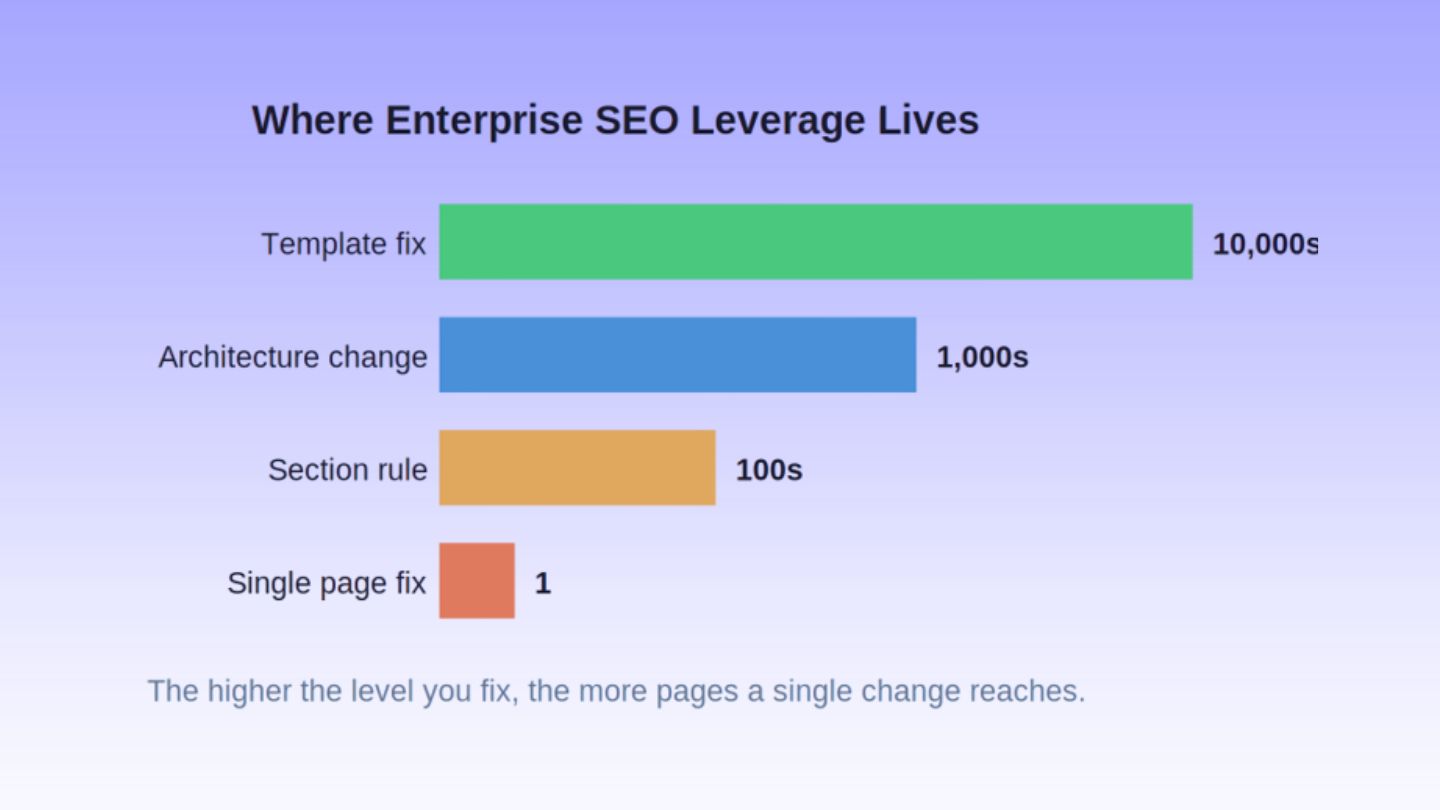
At enterprise scale, the value of a change scales with how many pages it reaches, so templates and architecture outweigh individual pages.
Why Is Coordination Often the Real Bottleneck?
Coordination is often the real bottleneck because an enterprise change that is simple in principle may require buy-in from product, engineering, content, and legal, each with their own priorities and timelines. The constraint is frequently not knowing what to do but getting it done across teams that do not report to you.
This makes enterprise SEO partly a communication and influence discipline. Building relationships, demonstrating impact in terms each team cares about, and integrating SEO into existing workflows rather than fighting them is what actually ships changes, and giving those teams a shared map such as a deliberate topic cluster strategy makes the coordination far easier. The best technical strategy fails if it cannot move through the organization, which is why coordination deserves as much attention as the SEO itself.
How Do You Prioritize at Scale?
You prioritize at scale with a framework, because with a huge site and limited resources you cannot do everything. The question is always which changes, applied where, will move the most value, and answering it means weighing scale of impact, effort required, and the strategic importance of the pages involved rather than treating all issues equally.
A template issue affecting thousands of high-value pages outranks a perfect fix on one minor page every time, and a framework keeps that focus explicit rather than letting effort scatter toward whatever is noticed first. Building genuine topical authority rather than chasing individual keywords is the kind of strategic lens that guides where to concentrate.
Building a Framework That Scales
Enterprise SEO is a systems problem, not a bigger version of small-site SEO. The leverage lives in architecture, templates, and automated patterns that operate across thousands of pages at once; crawl efficiency becomes a real constraint, and the coordination challenge across teams is often harder than anything technical. A prioritization framework keeps limited resources focused on the changes that move the most value, and measurement by segment rather than by page is what makes the whole thing manageable.
At The Ocean Marketing, we help organizations build SEO programs that scale through systems and processes rather than page-by-page effort. Whether you need a scalable framework designed, the coordination that is slowing you down untangled, or a free SEO audit to see where your site currently stands, our team can help. Contact us and let's build an approach that works at your scale.
Frequently Asked Questions
How is enterprise SEO different from regular SEO?
Enterprise SEO is a systems problem rather than a page-by-page one. On a large site, you cannot optimize every page individually, so the work moves to templates, architecture, crawl efficiency, and cross-team coordination. The fundamentals are the same; the scale changes which methods actually work.
What is the biggest challenge in enterprise SEO?
Often it is organizational rather than technical. A change may be simple to specify and hard to ship because it requires agreement across product, engineering, content, and legal. Getting changes through the organization is frequently the real constraint, which is why communication and prioritization matter so much.
Does crawl budget matter for every site?
No. For small sites, search engines crawl everything easily and crawl budget is rarely a limiting factor. It becomes a genuine constraint on large sites, where there are more pages than get crawled frequently, and wasted crawl attention on low-value pages costs the important ones.