
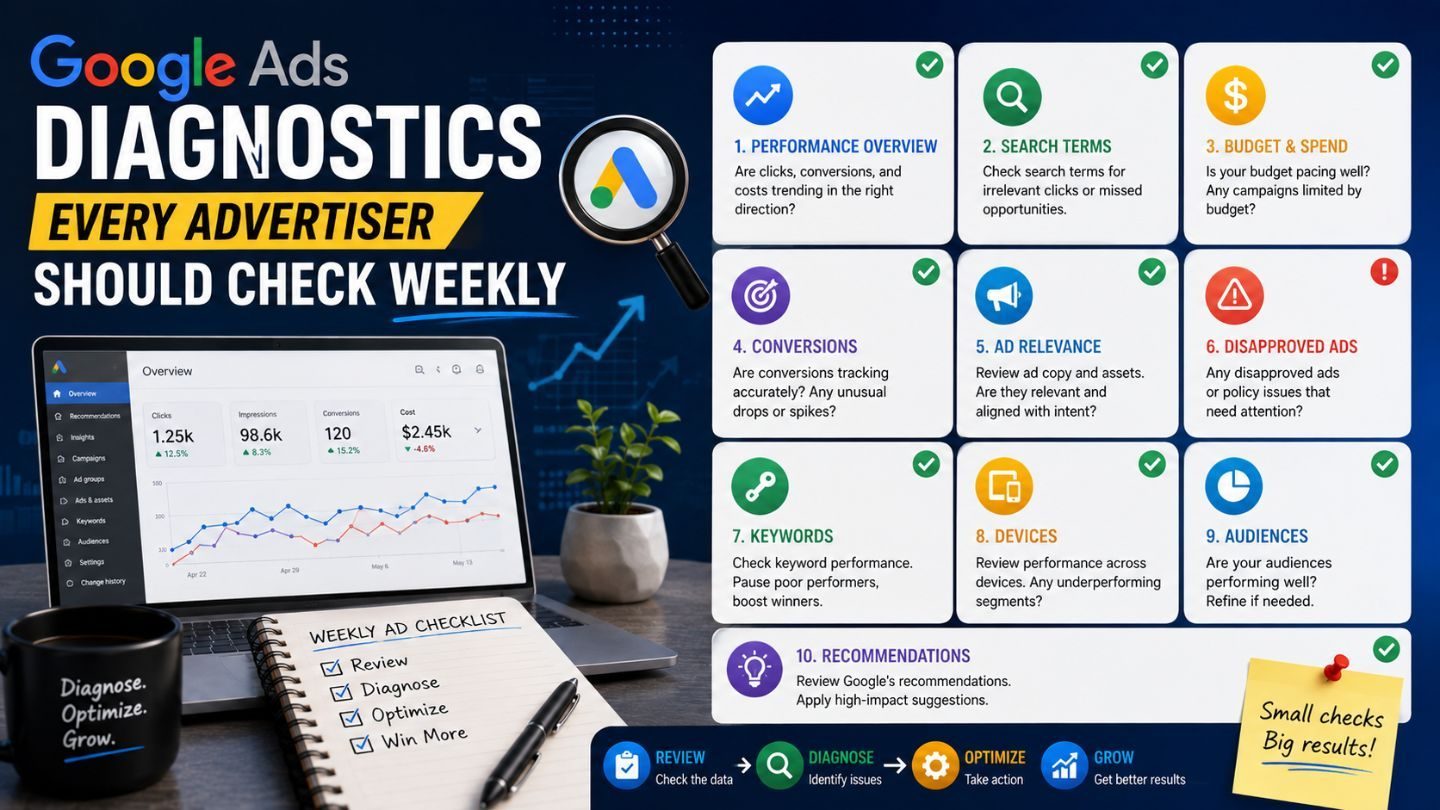
Google Ads accounts don’t fail dramatically. They drift. A match type starts pulling irrelevant traffic, a disapproved ad quietly stops serving, a landing page breaks, and by the time the monthly report lands, you’ve burned three weeks of budget on something that was fixable on day two. A short weekly check catches almost all of it. This blog outlines the diagnostics worth running every week, why each one matters, and how to build a routine that takes twenty minutes rather than an afternoon.
Key Takeaways
- Most account problems are cheap to fix early and expensive to ignore.
- Search terms reports reveal wasted spend faster than any other check.
- Disapprovals and policy flags can silently halt delivery.
- Conversion tracking breaks quietly and invalidates every decision.
- A short weekly routine beats an exhaustive monthly audit.
Why Weekly Beats Monthly
The economics here are simple. A problem caught on day three costs you three days of misspent budget. The same problem caught in a monthly review costs you a month. For an account spending meaningfully, that difference is real money, and it recurs every time something drifts, which is constantly.
There’s a compounding effect too. Automated bidding learns from whatever data it receives, so a week of bad signal doesn’t just waste that week’s spend; it teaches the algorithm the wrong lesson and degrades performance afterward. Catching issues early limits both the direct loss and the downstream damage, which is why frequency matters more than depth in ongoing account management.
Search Terms Are the First Stop
Nothing surfaces waste faster than the search terms report. It shows what people actually typed, as opposed to the keywords you thought you were bidding on, and the gap between those two is where budget disappears. Broad and phrase match will find creative interpretations of your intent that you’d never have predicted.
Scan the last seven days for terms that clearly don’t match your offer, add them as negatives, and look for patterns rather than one-offs. If three terms this week all contain the same irrelevant modifier, that modifier belongs in a shared negative list. Doing this consistently is what turns a negative keywords strategy into something that scales campaigns rather than a one-time cleanup you did last year.
Look for Near-Misses Too
Terms that are relevant but not quite your keywords are opportunities, not a waste. If people keep finding you through a phrasing you never targeted, it deserves its own ad group.
Read More: Exact Match Keywords vs Broad Match in Modern Google Ads
Disapprovals and Delivery Problems
Ads get disapproved for reasons that are frequently opaque and occasionally wrong. When it happens, that ad stops serving, and if it was your best performer in a small ad group, your campaign is now running on your weakest creative without anyone noticing. Google notifies you, but those notifications live in an interface most people check monthly.
The weekly check is quick: look for any disapproved or limited status, any campaign flagged as limited by budget when it shouldn’t be, and any ad group with only one active ad. That last one is a fragility signal; if the single ad gets flagged, you have nothing serving. Two minutes here prevent the kind of failure that only becomes visible when the numbers collapse.
Conversion Tracking, the Silent Failure
This is the one that invalidates everything else. A site update changes a thank-you page URL, a tag manager container gets republished, a form plugin updates, and conversions stop recording. The campaign keeps spending, the reports show zero conversions or wildly wrong numbers, and every bidding decision after that point is made on fiction.
Check that conversions are still recording at roughly the volume you’d expect. A sudden drop to zero is obvious. A quieter problem, double-counting, or a conversion firing on the wrong event, is harder to spot and just as damaging. Automated bidding will confidently optimize toward whatever you tell it success looks like, so a broken definition doesn’t produce no results; it produces bad results efficiently.
Performance Drift Worth Noticing
Look at week-over-week movement in cost per conversion, impression share, and click-through rate. You’re not chasing daily noise; you’re watching for direction. A cost per conversion climbing steadily across three weeks is telling you something changed, whether that’s competition, seasonality, or a landing page problem.
Impression share lost to rank is particularly informative because it separates a budget problem from a quality problem. Losing share because you ran out of budget is a decision. Losing it because your ad rank slipped is a warning. That distinction determines whether the fix is more money or better relevance, and guessing wrong is expensive. Reviewing when to pause or optimize underperforming campaigns becomes much easier when you’ve been watching the trend rather than reacting to a snapshot.
The Checks People Skip
Landing pages break. Someone redesigns a page, changes a URL, and the ad now points at a 404 that’s been eating budget for a fortnight. Clicking through your own ads once a week sounds primitive and catches this immediately, along with slow loads, broken forms, and messaging that no longer matches the ad.
Budget pacing is the other one. An account spending too fast will exhaust itself before month-end; one spending too slowly is leaving volume on the table. Both are easy to see and easy to ignore. And it’s worth spot-checking your competitors’ ads occasionally, since a new entrant with aggressive bidding explains a lot of otherwise mysterious cost increases. Sorting out what factors influence paid campaign success usually starts with realizing the answer isn’t always inside your own account.
What Not to Touch Every Week

There’s a failure mode on the other side of this: the manager who checks weekly and therefore changes something weekly. Bids adjusted every Monday, ad copy swapped before it gathered data, campaigns paused on a bad week and restarted on a good one. Automated bidding, in particular, punishes this, since every significant change restarts the learning.
Diagnostics and intervention are different activities. The weekly check is for spotting problems, not for demonstrating activity. If nothing is broken and the trend is stable, the correct action is none. Let tests run to significance, let bidding strategies settle, and resist the urge to justify the twenty minutes by touching something. The account you check often and change rarely will outperform the one you fiddle with constantly. That restraint matters most on automated bid strategies, which need stable data more than they need supervision.
Building a Routine That Survives
The reason weekly checks fail isn’t that people don’t understand their value; it’s that they turn into hour-long audits nobody has time for. Keep the list short: search terms, disapprovals, conversion tracking, week-over-week trend, click your own ad. That’s twenty minutes, and it catches the overwhelming majority of what goes wrong.
Write it down and assign it to a person and a day. A routine that lives in someone’s head gets skipped the first busy week and never resumes. A checklist someone owns gets done, and the value of these diagnostics comes almost entirely from consistency rather than thoroughness. A shallow check every week beats a deep audit twice a year, every time.
Read More: Google Ads Account Audits: What to Check Every Month
Auction Insights: Explain the Mysteries
When costs rise and nothing in your account has changed, the answer is usually outside your account. Auction insights show who else is bidding on your terms, how often they appear, and whether someone new arrived. That single report explains a large share of otherwise inexplicable performance shifts.
It’s worth a weekly glance rather than a deep study. What you’re watching for is a new name appearing with high impression share, or an existing competitor suddenly bidding harder. Either changes what your bids need to do, and knowing it happened is the difference between adjusting deliberately and panicking at a cost-per-conversion number you can’t explain. Running a proper competitor analysis once a quarter puts those names in context before they show up in your costs.
Automated Rules and Alerts Do the Boring Part
Some of this checking can be delegated to the platform. Alerts for conversion volume dropping below a threshold, for campaigns becoming limited by budget, for cost per conversion exceeding a ceiling. None of them replace looking, and all of them catch the acute failures faster than a weekly cadence would.
The caution is not to over-automate. Rules that pause campaigns automatically will eventually pause something they shouldn’t, usually on a day with unusual data. Use automation to notify rather than to act, at least until you’ve watched a rule behave for a few months. The goal is a faster warning, not an unsupervised account.
Documenting Changes Saves You Later

Six weeks from now, performance will shift, and someone will ask what changed. Without a record, the answer is guesswork, and the account gets adjusted based on a theory nobody can test. Google’s change history helps but doesn’t capture the reasoning.
A simple log, date, what changed, why, works better than any tool. It takes seconds per change, and it turns performance analysis from speculation into cause and effect. It also protects you when a change made three months ago turns out to be the cause of something surfacing now, which is more common than most advertisers would like to admit.
Catching Problems Before They Cost You
Google Ads accounts degrade quietly, and the difference between a healthy account and a wasteful one is usually not strategy; it’s attention. Twenty minutes a week spent on search terms, disapprovals, conversion tracking, performance direction, and actually clicking your own ads will catch nearly everything that matters while it’s still cheap to fix. It’s the least glamorous work in paid search and reliably the highest return, because the alternative is discovering the problem in a monthly report after the money is already gone.
At The Ocean Marketing, we manage PPC accounts with the kind of ongoing attention that prevents small issues from becoming expensive ones. Whether you want help building a diagnostic routine, auditing an account that’s drifted, or starting with a free SEO audit to see how your paid and organic efforts fit together, our team can help. Contact us, and let’s make sure nothing’s quietly leaking.