
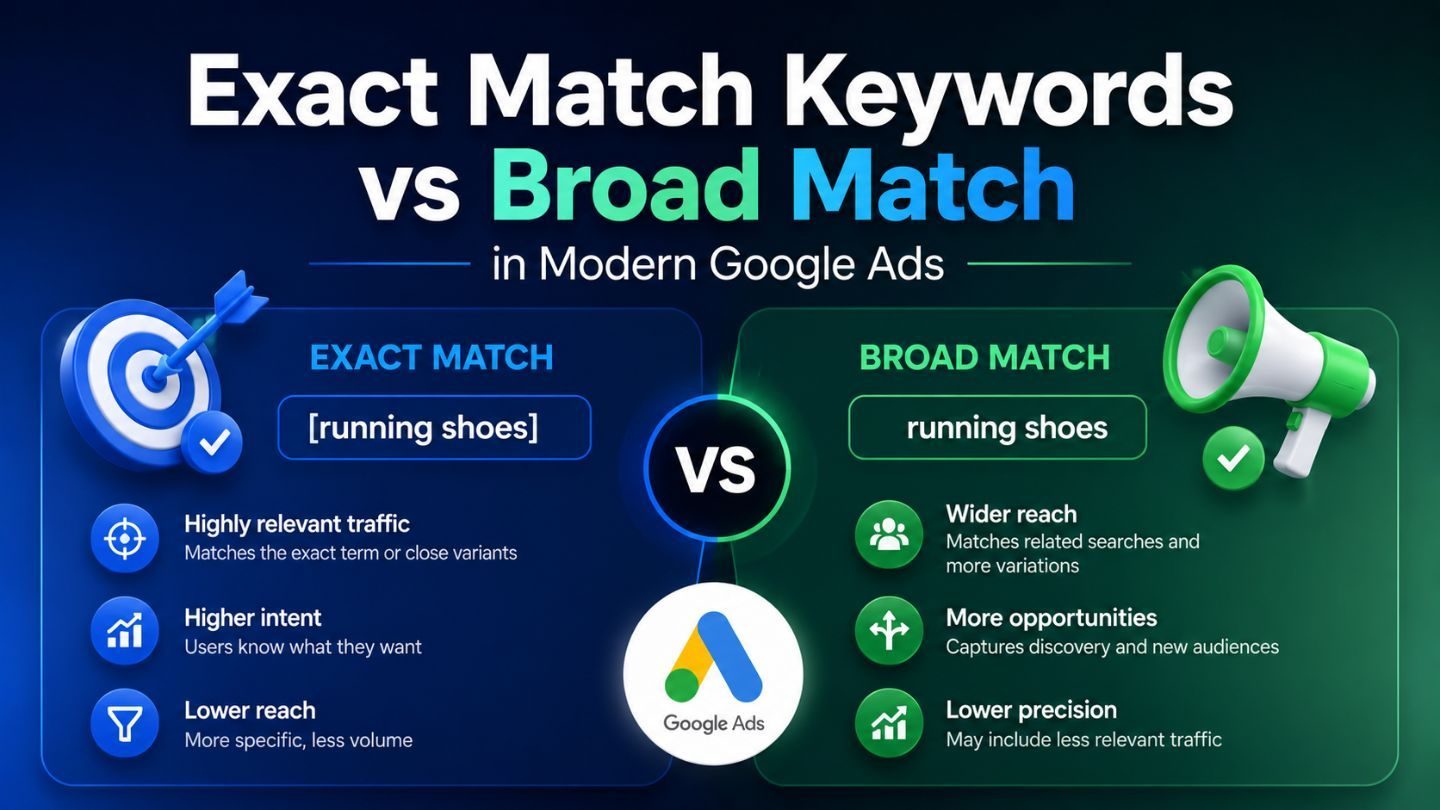
Google Ads has evolved far beyond simple keyword targeting, making it essential for businesses to understand how different match types impact campaign performance. Exact match and broad match keywords each play a unique role in reaching the right audience, controlling ad spend, and improving conversions. This blog outlines the key differences between these keyword match types, how Google’s machine learning influences modern targeting, and when advertisers should use each strategy for better results. By understanding how these match types work in today’s advertising landscape, businesses can create smarter campaigns that balance precision, reach, and long-term PPC growth.
Key Takeaways
- Exact match keywords provide greater control over search intent and audience targeting.
- Broad match keywords help advertisers reach a wider audience using Google’s AI-driven targeting.
- Modern Google Ads relies heavily on machine learning and contextual signals.
- Exact match is ideal for high-converting and niche search queries.
- Broad match works well for discovery campaigns and scaling reach.
- Combining both match types often creates the strongest PPC strategy.
- Smart bidding strategies improve the effectiveness of broad match campaigns.
- Choosing the right keyword match type depends on campaign goals and budget.
Understanding Keyword Match Types in Google Ads
Keyword match types determine how closely a user’s search query must match your chosen keyword before your ad appears. Google Ads currently offers several keyword match options, but exact match and broad match remain the most widely discussed because of their direct impact on campaign targeting and performance. Advertisers use these match types to control how much flexibility Google has when matching searches to their ads.
Modern Google Ads has evolved beyond simple keyword matching. Google now analyzes search intent, user behavior, location, device usage, and historical search patterns before displaying an ad. Because of this shift, even exact match keywords can trigger close variations, while broad match keywords have become more intelligent and intent-focused. This transformation has changed how marketers structure campaigns and optimize ad performance.
What Are Exact Match Keywords?
Exact match keywords are designed to show ads for searches that closely align with the advertiser’s selected keyword phrase. Traditionally, exact match only displayed ads when the user typed the precise keyword. However, Google has expanded exact match functionality to include similar meanings, reordered words, plurals, and implied intent. This makes the match type more flexible than it was in earlier years.
Despite these updates, exact match still offers the highest level of targeting precision available in Google Ads. Businesses often use exact match keywords for high-converting search terms where purchase intent is strong and predictable. Since the audience is more refined, advertisers usually experience stronger click-through rates, better conversion quality, and improved cost efficiency when campaigns are properly optimized.
What Are Broad Match Keywords?
Broad match keywords allow Google Ads to display ads for a wide range of related searches, even when the exact keyword phrase is not used. Google’s algorithm evaluates search intent, synonyms, related topics, and user behavior to determine whether the ad should appear. This gives advertisers access to a significantly larger audience and helps uncover valuable keyword opportunities that may not have been considered manually.
Broad match has improved substantially with machine learning integration. Earlier versions of broad match often produced irrelevant traffic, but modern Google Ads uses advanced intent analysis to improve targeting quality. When paired with smart bidding strategies, broad match can help businesses generate conversions at scale while reducing the need for extensive keyword management and manual optimization.
How Google’s AI Changed Keyword Targeting

Machine learning has become the foundation of modern Google Ads campaigns. Instead of relying only on keyword phrases, Google now evaluates context and user intent to predict which ads are most relevant. This means keyword match types no longer function in the rigid way they once did, and advertisers must adapt their strategies to align with automation-driven advertising systems.
Google’s AI also considers audience signals, browsing behavior, search history, location data, and device preferences when deciding which ads to show. Because of this, broad match keywords can now perform surprisingly well in campaigns using automated bidding strategies. At the same time, exact match keywords continue to offer valuable precision for businesses that require tighter budget control and consistent lead quality.
Advantages of Using Exact Match Keywords
One of the biggest advantages of exact match keywords is targeting accuracy. Advertisers can focus on highly relevant searches that are closely connected to their products or services. This typically results in better lead quality, improved conversion rates, and more efficient spending. Businesses with limited budgets often prefer exact match because it minimizes wasted clicks from irrelevant searches. Exact match also supports campaigns focused on lead quality because it helps advertisers prioritize searches with stronger intent.
When businesses want to optimize PPC campaigns for higher-quality leads, precise keyword targeting can help reduce wasted clicks and improve the chances of reaching users who are ready to take action. Exact match keywords also provide stronger campaign insights because search intent is easier to analyze. Advertisers can monitor performance data more effectively and optimize landing pages based on clear audience expectations. This level of precision is especially useful in competitive industries where every advertising dollar matters and businesses need predictable campaign performance.
Read More: Types of Landing Pages: Examples & When to Use Each
Advantages of Using Broad Match Keywords
Broad match keywords help advertisers reach users earlier in the buying journey. Since Google can match ads with related searches and intent variations, businesses gain access to a wider audience that may still convert. This makes broad match highly effective for expanding visibility, discovering new keyword opportunities, and increasing brand awareness in competitive markets.
Broad match campaigns also reduce the need for managing large keyword lists. Instead of creating endless keyword variations, advertisers can rely on Google’s automation to identify relevant search traffic. When combined with smart bidding and strong conversion tracking, broad match keywords can scale campaigns more efficiently and help businesses uncover profitable search trends that manual targeting may overlook.
Challenges of Exact Match Keywords
While exact match keywords offer precision, they can also limit campaign reach. Businesses that rely too heavily on exact match may miss valuable traffic opportunities because ads only appear for closely related searches. This restriction can slow campaign growth, especially in industries where user search behavior changes frequently or includes multiple search variations.
Exact match campaigns also require continuous keyword research and optimization. Advertisers must regularly analyze search trends, add new keywords, and monitor performance to maintain strong results. Without consistent management, campaigns can become too narrow, reducing visibility and making it difficult to compete against advertisers using broader targeting strategies.
Challenges of Broad Match Keywords
Broad match keywords can sometimes attract irrelevant traffic if campaigns are not optimized correctly. Although Google’s machine learning has improved targeting accuracy, broad match still requires careful monitoring to prevent wasted ad spend. Businesses without proper conversion tracking may struggle to identify which searches are driving meaningful results. Broad match becomes more effective when advertisers actively filter out irrelevant traffic. A strong negative keywords strategy to scale campaigns helps prevent low-quality searches from consuming the budget while keeping broader targeting focused on users with real conversion potential.
Another challenge is maintaining budget control. Since broad match expands audience reach significantly, campaigns can spend quickly if bidding strategies are not configured properly. Advertisers often need strong negative keyword lists and smart bidding systems to maintain efficiency. Without these safeguards, broad match campaigns may generate clicks that do not contribute to actual business goals.
Which Match Type Delivers Better Conversions?
The answer depends largely on campaign objectives and audience behavior. Exact match keywords typically deliver higher conversion rates because the search intent is more targeted and specific. Users searching for exact terms often know what they want, making them more likely to complete an action such as making a purchase, submitting a form, or contacting a business.
Broad match, however, can produce higher overall conversion volume by exposing ads to a larger audience. While individual conversion rates may sometimes be lower, the increased reach can generate substantial growth when campaigns are optimized effectively. Businesses focused on scaling visibility and customer acquisition often benefit from using broad match alongside automated bidding systems.
Read More: What Factors Influence PPC Campaign Success?
The Best Strategy Is Often a Combination

Many successful advertisers combine exact match and broad match keywords within the same campaign structure. Exact match keywords provide stable performance and reliable conversions, while broad match keywords uncover new opportunities and expand audience reach. This balanced approach allows businesses to maintain control while still benefiting from Google’s machine learning capabilities.
A hybrid strategy also improves campaign testing and optimization. Advertisers can identify high-performing search terms through broad match campaigns and later move those terms into exact match groups for tighter targeting. This process creates a continuous optimization cycle that strengthens campaign efficiency over time while supporting long-term advertising growth.
How Smart Bidding Supports Broad Match Success
Smart bidding strategies such as Target CPA and Maximize Conversions play a major role in broad match performance. These automated systems use historical conversion data and real-time signals to adjust bids for users most likely to convert. As Google’s AI gathers more campaign data, bidding accuracy improves, and campaign efficiency becomes stronger.
Businesses using broad match without smart bidding often struggle to maintain consistent results. Automated bidding helps Google filter low-value traffic and prioritize searches with stronger conversion potential. This partnership between automation and broad targeting is one reason why modern PPC campaigns increasingly rely on machine learning-driven strategies for growth and scalability.
Choosing the Right Match Type for Your Business
Selecting between exact match and broad match depends on advertising goals, budget size, and campaign maturity. Businesses seeking precise targeting, lower risk, and high-intent traffic may benefit more from exact match campaigns. On the other hand, businesses focused on scaling reach, increasing visibility, and discovering new opportunities may achieve stronger results with a broad match. Match type decisions should also reflect where users are in the buying journey.
When advertisers align ads with funnel stages, they can use broad match for discovery-focused searches and exact match for high-intent users closer to conversion. The ideal approach often evolves as campaigns grow. New advertisers may begin with an exact match for greater control, then gradually introduce broad match as conversion data improves. Understanding audience behavior, tracking performance accurately, and adapting strategies based on campaign results are essential for long-term advertising success in Google Ads.
Final Thoughts
Understanding the difference between exact match keywords and broad match keywords is essential for building effective Google Ads campaigns in today’s AI-driven advertising environment. Exact match offers stronger control and high-intent targeting, while broad match helps businesses expand reach and discover new conversion opportunities. The right approach often involves combining both strategies to balance precision, scalability, and campaign efficiency. By continuously testing keyword performance, refining targeting, and using smart bidding strategies, businesses can improve ad relevance, maximize conversions, and achieve stronger long-term advertising results.
At The Ocean Marketing, we help businesses build data-driven PPC strategies that align with modern Google Ads best practices while also improving overall online visibility through services like a free SEO audit. Our team focuses on creating targeted campaigns that support sustainable business growth, stronger lead generation, and improved return on investment across digital marketing channels. Contact us today to discover how we can help your business achieve better online performance and measurable marketing success.