
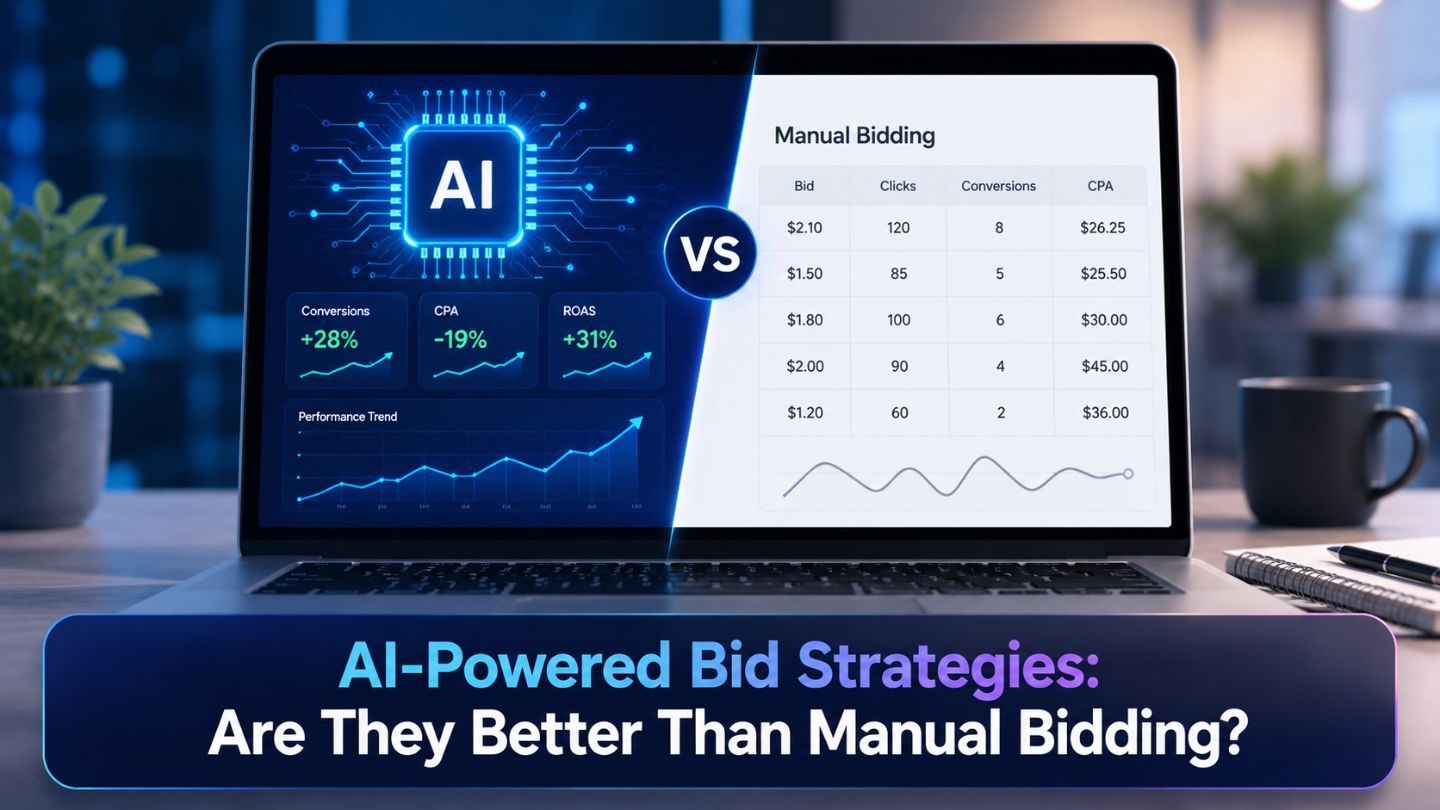
Managing PPC campaigns has become more complex as advertising platforms continue to evolve. Choosing the right bidding strategy can directly influence your ad visibility, conversions, and overall return on investment. While manual bidding gives advertisers greater control, AI-powered bid strategies promise smarter, faster decisions based on real-time data. In this blog, we'll discuss how both approaches work, where each one performs best, and how to decide which strategy fits your business goals and marketing budget.
Key Takeaways
- AI-powered bidding uses machine learning to optimize bids automatically.
- Manual bidding offers greater control but requires constant monitoring.
- The best choice depends on campaign goals, budget, and available data.
- AI performs well for large, data-rich campaigns, while manual bidding suits niche situations.
- Many successful advertisers combine both strategies for better results.
Understanding How Manual Bidding Works
Manual bidding gives advertisers full control over how much they're willing to pay for individual clicks or keywords. Every bid adjustment is made by the campaign manager based on performance data, competitor activity, seasonality, and business priorities. This hands-on approach allows experienced marketers to react strategically rather than relying on automated systems.
However, manual bidding demands ongoing attention. Campaigns need regular analysis, bid adjustments, keyword reviews, and performance tracking. As campaigns grow larger, keeping up with these tasks becomes increasingly time-consuming, making it harder to maintain peak performance across every keyword and audience segment.
What Are AI-Powered Bid Strategies?
AI-powered bidding uses machine learning algorithms to adjust bids automatically during each auction. Instead of relying on fixed bid amounts, the system evaluates countless signals such as user location, device type, browsing behavior, search intent, time of day, previous interactions, and historical conversion data before deciding how much to bid. These strategies continuously learn from campaign performance. As more data becomes available, the algorithm refines its bidding decisions to improve results.
Popular options include Target CPA, Target ROAS, Maximize Conversions, and Maximize Conversion Value, all designed to align bidding with specific business objectives rather than simply generating clicks. These automated strategies often work best when supported by strong keyword targeting, especially when advertisers understand how exact-match and broad-match keywords in modern Google Ads influence campaign reach and conversion quality.
Comparing AI and Manual Bidding Side by Side
Although both methods aim to improve campaign performance, they operate very differently. Understanding these differences helps advertisers select the right strategy for each campaign.
Feature | AI-Powered Bidding | Manual Bidding |
Bid Adjustments | Automatic | Manual |
Speed | Real-time | Depends on the manager |
Data Usage | Analyzes thousands of signals | Based on available reports |
Time Investment | Low | High |
Scalability | Excellent | Limited |
Control | Less direct | Full control |
Learning Ability | Continuously improves | Depends on human analysis |
Neither option is universally better. Their effectiveness depends on campaign size, business goals, available data, and management resources.
Where AI Bidding Really Shines
AI performs exceptionally well in campaigns that generate consistent traffic and conversion data. Because machine learning depends on patterns, larger campaigns provide the information needed for smarter bid decisions. E-commerce businesses, lead generation campaigns, and nationwide advertisers often benefit significantly from automated bidding. For lead-focused campaigns, AI bidding can also support better results when paired with tactics designed to optimize PPC campaigns for higher-quality leads.
Another advantage is speed. AI evaluates every auction individually, making adjustments within milliseconds. A human simply cannot process thousands of real-time variables across hundreds of auctions every minute. This responsiveness helps maximize opportunities that would otherwise be impossible to capture manually.
Read More: Google Ads: Ad Scheduling Strategies for Maximum ROI
Real-Time Optimization Makes a Difference
Unlike scheduled bid adjustments, AI constantly adapts to changing market conditions. If user behavior shifts during the day or competition suddenly increases, automated bidding responds immediately without requiring manual intervention.
Situations Where Manual Bidding Still Makes Sense
Despite rapid advancements in automation, manual bidding hasn't become obsolete. Smaller campaigns with limited conversion history often don't provide enough data for AI to make accurate predictions. In these situations, experienced marketers can often outperform automation using industry knowledge and careful monitoring.
Manual bidding is also valuable when testing new products, entering unfamiliar markets, or running highly specialized campaigns. Since campaign managers understand unique business priorities, they can make strategic decisions that automated systems may not recognize during the early stages of a campaign.
Common Myths About AI Bidding
Many advertisers hesitate to adopt AI because of common misconceptions. Separating fact from fiction helps make more informed decisions.
- Myth: AI always produces better results immediately.
Reality: It usually requires a learning period before performance stabilizes.
- Myth: Manual bidding gives better control over spending.
Reality: AI still operates within budgets and bidding targets you define.
- Myth: AI eliminates the need for campaign management.
Reality: Human oversight remains essential for strategy, creative testing, audience targeting, and performance analysis.
- Myth: AI works for every campaign.
Reality: Campaigns with insufficient data may perform better using manual bidding initially.
Factors to Consider Before Choosing a Strategy
Choosing between AI and manual bidding isn't about following industry trends. It should align with your campaign objectives and available resources. Several important factors influence which method will deliver better results. Consider your campaign size, conversion volume, advertising budget, internal expertise, reporting needs, and growth plans.
Businesses running hundreds of campaigns often benefit from automation because managing every bid manually becomes impractical. Meanwhile, local businesses with highly focused campaigns may appreciate the flexibility that manual bidding provides. Before choosing between automation and manual control, advertisers should also understand what factors influence PPC campaign success beyond bidding alone.
Can AI and Manual Bidding Work Together?
Many successful advertisers don't view this as an either-or decision. Instead, they combine both approaches depending on campaign objectives. Established campaigns with strong conversion history may use AI bidding, while newly launched campaigns remain on manual bidding until enough performance data is collected.
This hybrid strategy allows businesses to benefit from automation without sacrificing strategic control. It also creates opportunities to compare performance across different bidding methods and adjust based on measurable results rather than assumptions.
Read More: PPC Funnel Mapping: How to Align Ads With Funnel Stages
Monitor Performance Regularly
Regardless of the bidding strategy, continuous optimization remains essential. Reviewing search terms, refining audiences, testing ad copy, improving landing pages, and analyzing conversion quality all contribute to better campaign performance beyond bidding alone.
Signs It May Be Time to Switch Strategies
Campaign performance isn't static, and your bidding approach shouldn't be either. If manual bidding consumes too much time without delivering proportional improvements, automation may help improve efficiency. On the other hand, if automated bidding struggles after an extended learning period or produces inconsistent results, returning to manual control could provide better stability.
Regular performance reviews help identify when it's time to adapt. Rather than remaining committed to one approach indefinitely, successful advertisers evaluate performance objectively and make adjustments based on changing business goals.
Final Thoughts
AI-powered bid strategies have transformed PPC advertising by making real-time optimization possible on a massive scale. However, manual bidding continues to offer valuable flexibility for businesses that need greater control or are managing smaller campaigns. Instead of asking which strategy is universally better, the more important question is which one best supports your current goals, available data, and long-term growth plans. The strongest PPC strategies often combine automation with human expertise to create consistently better outcomes.
At The Ocean Marketing, we help businesses build smarter PPC campaigns backed by strategy, data, and continuous optimization. Whether you're exploring AI bidding, refining manual campaigns, or looking for a free SEO audit to strengthen your overall digital marketing performance, our team is here to help. Contact us to discover the approach that best fits your business and growth objectives.