

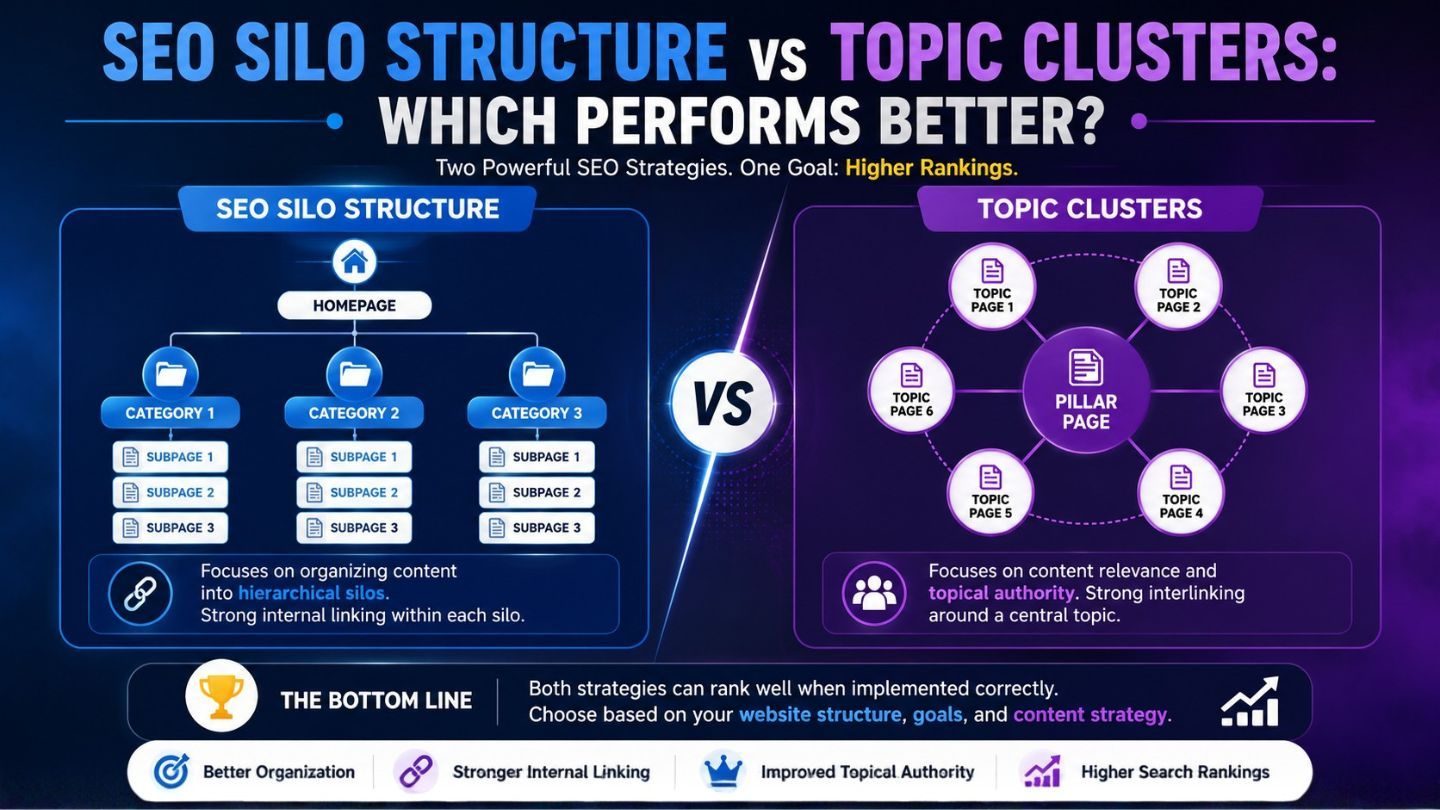
A well-organized website helps both users and search engines understand your content more effectively. As SEO strategies continue to evolve, many businesses find themselves choosing between two popular content organization methods: SEO silo structures and topic clusters. Both aim to improve rankings, strengthen authority, and create a better user experience, but they work in different ways. In this blog, we’ll discuss how each approach functions, its advantages and limitations, and which one may deliver better results depending on your website goals and content strategy.
Key Takeaways
- SEO silos focus on strict content categorization and hierarchy.
- Topic clusters rely heavily on internal linking and content relationships.
- Both structures can improve rankings when implemented correctly.
- Topic clusters often offer greater flexibility for growing websites.
- SEO silos can work well for highly structured industries and large websites.
- The best choice depends on your content strategy, audience, and growth plans.
Understanding the Basics of SEO Silo Structures
An SEO silo structure organizes website content into clearly defined categories, with each category focusing on a specific topic area. Think of it as creating separate sections within your website where all related pages are grouped together. The goal is to establish strong topical relevance and make it easier for search engines to understand the relationship between pages. Within a silo, pages link primarily to other pages in the same category. This controlled linking strategy helps reinforce topic authority and keeps related content tightly connected. Many large websites with extensive service pages, product categories, or specialized content libraries use silo structures to maintain organization and clarity.
What Are Topic Clusters and Why Have They Become Popular?
Topic clusters take a different approach to content organization. Instead of focusing solely on categories, they revolve around a central pillar page that covers a broad topic. Supporting content pieces, then explore related subtopics in greater detail, all linking back to the pillar page and often to one another. This model became increasingly popular as search engines improved their ability to understand context and user intent.
Rather than optimizing individual pages for isolated keywords, topic clusters help demonstrate expertise across an entire subject area. They create a network of related content that strengthens authority while helping users navigate deeper into a topic. For websites comparing content structures, understanding how topic clusters support stronger SEO performance can make the difference between scattered content and a connected authority-building strategy.
How SEO Silos Help Search Engines Understand Your Website

One of the biggest strengths of silo structures is their ability to create clear topical boundaries. Search engines can easily recognize which pages belong together because content is grouped logically, and internal linking remains highly focused. This often helps reinforce relevance for specific keyword themes. For websites operating in industries with numerous services, products, or informational categories, silos can simplify content management. When every page fits neatly into a designated category, both users and search engines can move through the site with greater confidence and consistency.
Benefits of SEO Silos
- Strong topical relevance within categories
- Clear website hierarchy
- Easier navigation for structured websites
- Better organization for large content libraries
- Reduced risk of content overlap
Why Topic Clusters Align With Modern Search Behavior
Search engines today evaluate more than just keywords. They aim to understand topics, context, and user intent. Topic clusters support this shift by connecting related pieces of content through strategic internal linking. Instead of treating pages as isolated resources, clusters show how they contribute to a broader subject. Users also benefit from this structure. After reading a pillar page, visitors can easily explore supporting articles that answer specific questions or provide additional details. This encourages longer site engagement and creates a more comprehensive learning experience.
Read More: Content Gap Analysis: A Complete Step-by-Step Guide
Benefits of Topic Clusters
- Supports semantic SEO strategies
- Improves internal linking opportunities
- Enhances user engagement
- Strengthens topical authority
- Allows easier content expansion
Comparing Internal Linking Strategies
Internal linking is where these two approaches differ most significantly. In a silo structure, links generally stay within the same category. Cross-linking between silos is often limited to preserve topical separation and maintain a strict hierarchy. Topic clusters encourage broader internal linking. Supporting content links back to the pillar page, while related articles may also link to one another when relevant.
This interconnected structure helps distribute authority across multiple pages and creates stronger content relationships throughout the website. This is why knowing how internal linking helps connect related SEO content is important when deciding whether a silo structure or topic cluster model fits your website best.
Which Structure Is Better for Content Growth?
As websites grow, content management becomes increasingly important. SEO silos provide strong organization, but can become restrictive when new topics emerge that do not fit neatly into existing categories. Expanding a siloed website sometimes requires restructuring navigation or creating entirely new sections. Topic clusters generally offer more flexibility. New supporting content can be added whenever relevant opportunities arise, allowing businesses to expand topic coverage without significantly altering site architecture. For content-driven websites that publish regularly, this adaptability can be a major advantage.
User Experience Matters More Than Ever
SEO success is no longer solely about search engines. User experience plays a significant role in determining how visitors interact with content and whether they continue exploring your website. A structure that helps users quickly find relevant information often contributes to better engagement metrics. Silo structures create clear navigation paths and work well when visitors know what category they want to explore. Topic clusters, however, often encourage discovery by guiding users through related content naturally. This can increase page views, time on site, and overall content consumption.
Performance Differences in Real-World SEO
There is no universal winner because performance depends on the website's goals, industry, and content strategy. SEO silos can perform exceptionally well for websites with clearly defined services, products, or categories where maintaining strict topical separation makes sense. Topic clusters tend to excel for websites focused on thought leadership, educational content, blogging, and long-term authority building. Their emphasis on comprehensive topic coverage aligns closely with how modern search engines evaluate expertise and content depth. This is also where understanding how topical authority compares with keyword authority can help shape smarter content planning decisions.
Situations Where SEO Silos May Work Best
- Enterprise websites with extensive category structures
- E-commerce stores with multiple product groups
- Service-based businesses with distinct service categories
- Websites requiring strict navigation organization
Situations Where Topic Clusters May Work Best
- Content marketing campaigns
- Blogs and resource centers
- Educational websites
- Industry authority-building strategies
- Businesses focused on organic traffic growth
Can You Combine Both Approaches?

Interestingly, many successful websites do not choose one method exclusively. Instead, they combine elements of both structures. A website may use silo architecture for its primary navigation while implementing topic clusters within individual categories to strengthen content relationships. This hybrid approach often provides the best of both worlds. The website maintains organizational clarity through silos while benefiting from the flexibility and authority-building advantages of topic clusters. As SEO continues to evolve, this balanced strategy has become increasingly common among high-performing websites.
Read More: Entity SEO: How Google Understands Content Context
Common Mistakes to Avoid
Regardless of the structure you choose, poor implementation can limit results. Some websites create silos that are too rigid, preventing valuable internal linking opportunities. Others build topic clusters without a clear content strategy, resulting in overlapping articles and weak pillar pages. Focus on user needs first. Your content structure should make sense to visitors while supporting search engine understanding. Consistent planning, thoughtful internal linking, and regular content audits are often more important than choosing one framework over another.
Final Thoughts
Both SEO silo structures and topic clusters can contribute to stronger search performance when implemented correctly. Silos provide excellent organization and clear topical separation, while topic clusters offer flexibility, stronger content relationships, and alignment with modern search behavior. The right choice depends on your website's purpose, content strategy, and long-term growth goals. In many cases, a combination of both approaches can create the strongest foundation for sustainable SEO success.
At The Ocean Marketing, we help businesses develop effective SEO strategies that match their goals and audience. Whether you need expert content writing, website architecture planning, or a free SEO audit, our team can help identify the best approach for your website. Contact us today to learn how we can strengthen your online visibility and support your long-term growth.