
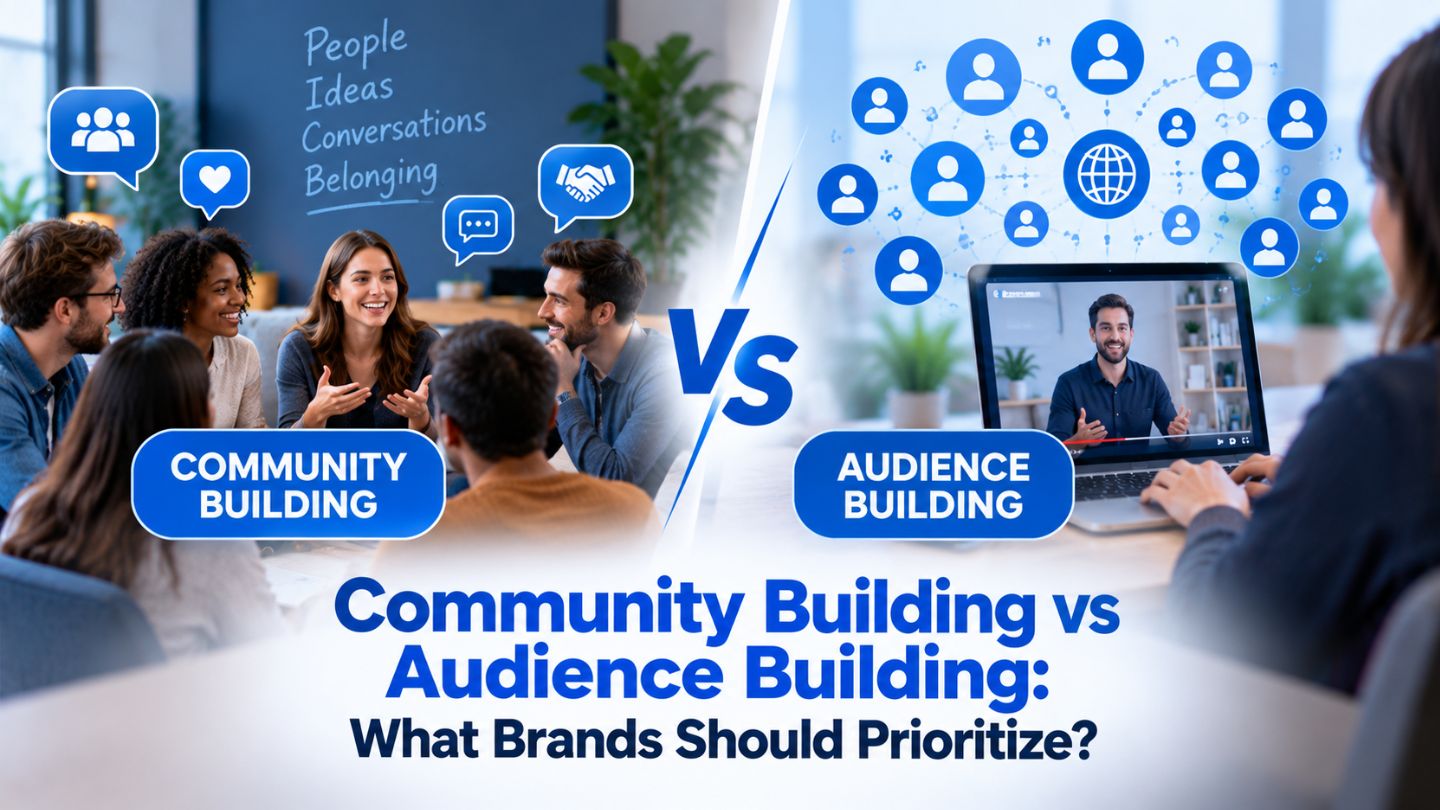
A large audience and a real community look similar in a follower count and behave nothing alike. One is people who follow you; the other is people who talk to each other because of you. Both have value, they cost different things to build, and pursuing the wrong one for your business wastes years. This blog covers what actually separates the two, which one suits which kind of business, and why chasing audience size when you needed community is such a common and expensive mistake.
Key Takeaways
- Audience is people who follow you; community is people who connect through you.
- Audience scales reach; community scales loyalty and retention.
- Community costs more to build and returns more per member.
- The right choice depends on your business model, not on follower goals.
- Vanity metrics reward audience and hide whether community exists.
The Actual Difference
An audience is a broadcast relationship. You publish, they consume, and the connection runs one way from you to them. It can be enormous and still be shallow, because size and depth are independent. A million followers who scroll past your content is a large audience and not much else.
A community is a network. People participate, talk to each other, and stay because of the connections they have formed, not just because of what you publish. It is harder to build, usually smaller, and far more durable, because the value lives in the relationships rather than in your content alone. When people stay for each other, they stay through anything.
What Each One Is Good For
Audience is the right goal when your business runs on reach. If you monetize through volume, advertising, broad awareness, or a product that needs to be in front of as many people as possible, then a large audience directly serves that, and the shallowness matters less because the model depends on scale rather than depth.
Community is the right goal when your business runs on loyalty, retention, and advocacy. Higher-value products, services with long relationships, anything where a customer's lifetime value and their willingness to recommend you matter more than raw numbers, all benefit more from a committed community than a large passive following. Understanding why Facebook community posts get more organic reach hints at why the platforms themselves increasingly reward genuine connection.
Size Is Not the Scoreboard
A small community that buys, stays, and refers is worth more than a large audience that does none of those things. Judge by behaviour, not headcount.
Read More: Instagram Likes, Saves, Shares & Watch Time: Which One Matters Most?
Why Community Costs More

Building an audience is largely a publishing exercise: produce good content consistently and the following grows. Building a community requires facilitating connection, responding, creating spaces for people to interact, and sustaining that over a long period. It is relationship work, and relationship work does not scale the way content does.
That higher cost is exactly why community returns more per member. The effort that goes into genuine connection produces loyalty that a broadcast relationship cannot, and that loyalty shows up as retention, repeat purchases, and advocacy. You are trading breadth for depth, and paying for it in time and attention rather than reach, which is worth weighing against creating a social media budget that delivers results across competing priorities.
The Vanity Metric Trap
The metrics platforms show most prominently- followers, likes, impressions- all reward audience and reveal almost nothing about community. A business optimizing for those numbers will naturally drift toward building an audience, because that is what the visible scoreboard measures, even if community was what the business actually needed.
This is how businesses spend years growing a following that never converts. The numbers looked like progress, so nobody questioned the strategy, while the deeper signals- whether people engage with each other, whether they return, whether they advocate- went unmeasured. Reviewing why Instagram Reels engagement drops and how to fix it helps separate genuine connection from surface activity.
You Can Have Both, In Order
These are not mutually exclusive, and the sequence usually matters. A common and workable pattern is building an audience first for reach, then converting the most engaged portion of that audience into a genuine community. The audience becomes the top of the funnel, and the community becomes the part that retains and advocates.
What does not work is assuming a large audience automatically becomes a community, or that community will emerge on its own from broadcasting. The conversion from one to the other takes deliberate effort, creating reasons and spaces for people to connect rather than just consume. Skipping that step leaves you with size and no depth, which is where a lot of large accounts quietly sit.
Read More: Social Media Funnel Strategy: Turning Views into Leads
Choosing Deliberately
The decision should start from your business model rather than from a follower target. Ask what actually drives your revenue, reach or loyalty, volume or relationships, and let that determine whether you are building an audience, a community, or an audience you intend to convert into one. That question is more useful than any growth tactic, because it decides what growth even means for you.
It also changes what you measure. A community-focused business tracking only follower count is flying blind, and an audience-focused business over-investing in deep engagement is spending effort its model does not reward. Matching the metric to the goal, and the goal to the model, is most of getting this right.
Why Community Retains Better
The durability difference between audience and community shows up most clearly in retention. An audience follows you as long as your content is worth following, and drifts away when it is not or when something more interesting appears. A community stays because of the connections its members have with each other, which are far stickier than a connection to your content alone.
This is why community is worth its higher cost for businesses that depend on retention and lifetime value. People who stay for each other stay through the inevitable periods when your content is less compelling, and they advocate for you in ways a passive audience never will. The relationships do work that content cannot, which is exactly why they are harder to build and more valuable once built. It is the same reason creator content often out-trusts brand content: people believe people.
The Trap of Measuring the Wrong Thing
A recurring problem is that businesses building community keep measuring audience, because audience metrics are what the platforms show. They track follower growth and reach while the thing they actually need, genuine connection and retention, goes unmeasured, which makes it impossible to tell whether the community strategy is working at all.
Measuring community requires different signals: whether members interact with each other, whether they return, whether they advocate, whether they stay through quiet periods. These are harder to track than a follower count and they are the ones that actually reflect whether a community exists. A business serious about building community has to build the measurement to match, or it will keep optimizing for an audience it did not want. Knowing what a figure like accounts reached actually counts is part of not being misled by the default dashboard.
The Slow Payoff of Community

Community rewards patience in a way audience does not, because relationships take time to form and deepen while a following can grow quickly. A business expecting community to pay off on the same timeline as audience growth will be frustrated, since the connections that make community valuable accumulate gradually rather than spiking.
This slower payoff is exactly why community is more durable once built, the same patience that makes it hard to establish makes it hard for competitors to replicate. Businesses that commit to the longer timeline end up with something a fast-grown audience cannot match, while those that abandon it early for quicker audience metrics never get to the payoff at all.
Building the Right Thing for Your Business
Audience and community are different assets that serve different business models, and the expensive mistake is building one while needing the other. Audience scales reach and suits volume-driven businesses; community scales loyalty and suits relationship-driven ones. Community costs more and returns more per member, and the vanity metrics platforms show will quietly push you toward audience whether or not that is what you need. Decide from your business model, measure what actually matters for it, and if you want both, build the audience first and convert its most engaged part deliberately.
At The Ocean Marketing, we build Social Media Marketing around what your business actually runs on rather than whichever number is easiest to grow. Whether you need help deciding between reach and loyalty, converting a following into a genuine community, or a free SEO audit to see how your wider presence performs, our team can help. Contact us and let's work out what you should actually be building.