
You update a page, change a claim, or rebrand, and search results catch up within days. AI assistants can keep repeating the old version of you for weeks or months. That gap, between what is true now and what the models still say, is positioning lag, and it is becoming a real problem for any business whose information has changed. The good news is that while you cannot fully control the timing, you can influence it, and the steps that help are concrete.
Key Takeaways
- AI assistants can repeat outdated information long after every page on your site says otherwise.
- The lag comes from two sources: how models are trained and how they retrieve live information.
- It does the most damage right after a rebrand, pivot, or pricing change.
- Keeping current information crawlable and consistent is the main lever you control.
- You cannot force the training side, and you can shorten the practical lag considerably.
What Is LLM Positioning Lag?
Positioning lag is the delay between your information changing and AI assistants reflecting that change. You might update your services, your pricing, your name, or your core message, and for a period the models continue describing the previous version, because their picture of you was formed earlier and has not refreshed. The result is AI confidently telling people something about your business that is no longer true.
This is different from a traditional search lag, which tends to resolve quickly as pages are recrawled. AI systems draw on a combination of training data and live retrieval, and the training portion in particular can be months out of date, which means the old version of you can persist well after your site has moved on.
Why Does the Lag Happen?
The lag happens because of two separate mechanisms working on different timelines. The first is training cadence: models learn from a snapshot of the web taken at a point in time, and until that snapshot is refreshed, their baseline knowledge reflects when it was captured. Changes you made after that point are simply not in the model's foundational knowledge yet.
The second is retrieval. Many AI systems supplement their training with live information pulled at query time, and how reliably they find your current information depends on whether it is accessible and clear. Understanding how ChatGPT, Gemini, and Perplexity find and rank content clarifies why accessibility matters so much, since retrieval is the part you can actually influence.
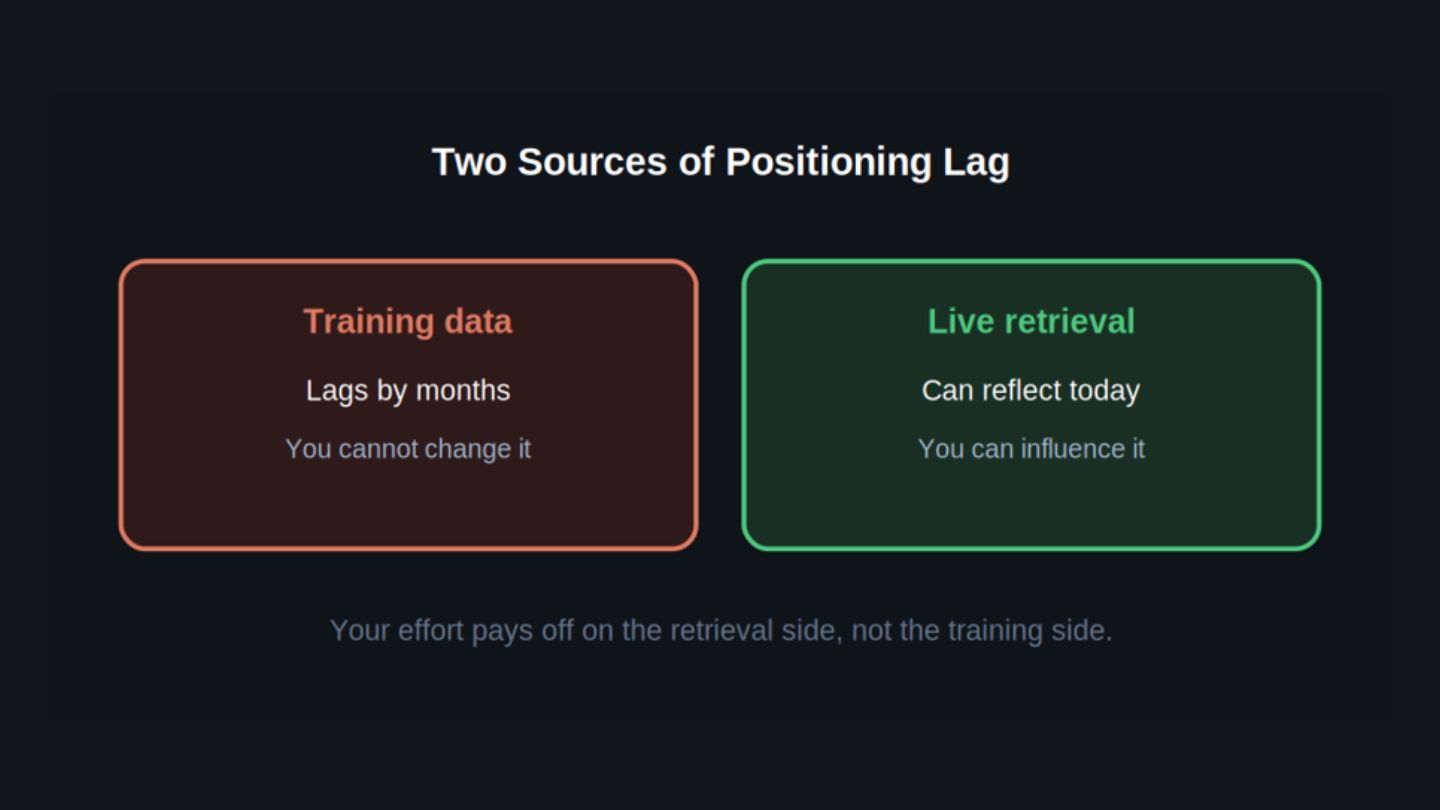
Training data lags by months and is out of your hands; live retrieval can reflect today if your current information is easy to find.
Two Sources, Two Lags
Training data lags by months, and you cannot change it. Retrieval can reflect today if your current information is easy to find. Influencing the second is where your effort pays off.
Where Does the Lag Do the Most Damage?
The lag does the most damage right after a significant change, when the stakes of an outdated narrative are highest. A rebrand is the clearest case: AI assistants may keep referring to your old name, sending people to look for a business that no longer presents itself that way. The same applies after a pivot in what you offer or a change in who you serve.
Pricing and service changes cause a subtler harm, where a prospect is told something outdated and arrives with the wrong expectations. In each case, the business has moved on, and the AI narrative has not, which is why managing your business reputation in AI search results matters, since what the models say about you shapes the first impression a potential customer forms.
How Do You Make Current Information Easy to Find?
You make it easy to find by keeping it prominent, crawlable, and unambiguous, which raises the chance that systems pulling live information find the truth rather than an echo of the past. Clear, accessible pages stating your current reality are the foundation, and making sure those pages are actually reachable is a prerequisite for getting your website indexed by ChatGPT search.
Consistency across every source matters just as much, because conflicting information slows correction. If your site says one thing while your profiles, directories, and other mentions still say the old thing, the models have no clear signal to update to. This is where auditing and improving your brand's visibility in AI search becomes practical, since it surfaces exactly which sources are still carrying the outdated version.
Why Cleaning Up Old Signals Matters

Updating your own site is necessary and not sufficient, because the outdated version of you may live in many other places. Old directory listings, outdated profiles, cached descriptions, and third-party mentions all reinforce the stale picture, and each one still saying the old thing is a vote against the correction you are trying to make.
Working through the places your business is described and bringing them into line with your current reality removes the conflicting signals that keep the lag alive. If your business details appear in official records, keeping those accurate matters too, since a listing like a state business registry such as USA.gov’s business resources is the kind of authoritative source both people and systems treat as reliable. This cleanup is tedious, and it is one of the few genuinely effective things you can do.
Shortening the Gap Between You and the AI Narrative
Positioning lag is the delay between your business changing and AI assistants reflecting it, caused by training cycles you cannot change and live retrieval you can influence. It does the most damage right after a rebrand, pivot, or pricing change, when the old narrative actively misleads. You shorten it by making your current information prominent and crawlable, keeping it consistent across every source, and cleaning up the outdated signals that keep the old version alive.
At The Ocean Marketing, we help businesses manage how they appear across SEO and AI-driven search as both keep changing. Whether you are navigating a rebrand, correcting outdated information the models still repeat, or want a free SEO audit to see where your site currently stands, our team can help. Contact us and let's get the current version of your business in front of people.
Frequently Asked Questions
Can I force AI assistants to update their information about my business?
Not entirely. The training portion of what a model knows updates on a schedule you do not control. What you can do is make your current information prominent and crawlable and remove conflicting signals, which shortens the practical lag for systems that pull live information and sets things up so the next training refresh reflects reality.
How long does LLM positioning lag last?
It varies, because it depends on both when the next training refresh happens and how quickly live retrieval picks up your current information. The retrieval side can correct in a much shorter window if your information is clear and consistent, while the training side resolves on its own timeline.
What should I do first after a rebrand?
Update your information everywhere as close to the change as possible, make the new reality prominent and crawlable on your own site, and reconcile every profile, listing, and mention to match. The faster and more consistently the new version appears across sources, the sooner retrieval reflects it.