
Search engine optimization has evolved far beyond simple keyword placement and outdated ranking tricks. Today, search engines focus more on understanding user intent, content relevance, and the overall context behind every query. This shift has made semantic SEO an essential strategy for businesses that want long-term online visibility and stronger audience engagement. This blog outlines why semantic SEO is replacing old SEO tactics, how modern search algorithms evaluate content, and why topic authority now matters more than keyword repetition. Understanding these changes can help businesses create more valuable content while improving their performance in increasingly competitive search results.
Key Takeaways
- Semantic SEO focuses on user intent rather than exact keyword repetition.
- Search engines now understand relationships between topics, phrases, and entities.
- Old SEO tactics like keyword stuffing and low-quality backlinks are becoming ineffective.
- Topic authority and content depth are more important than isolated keywords.
- Structured content improves visibility in featured snippets and voice search.
- User experience and content relevance now influence rankings significantly.
- Businesses using semantic SEO strategies can achieve more sustainable organic growth.
Understanding the Difference Between Traditional SEO and Semantic SEO
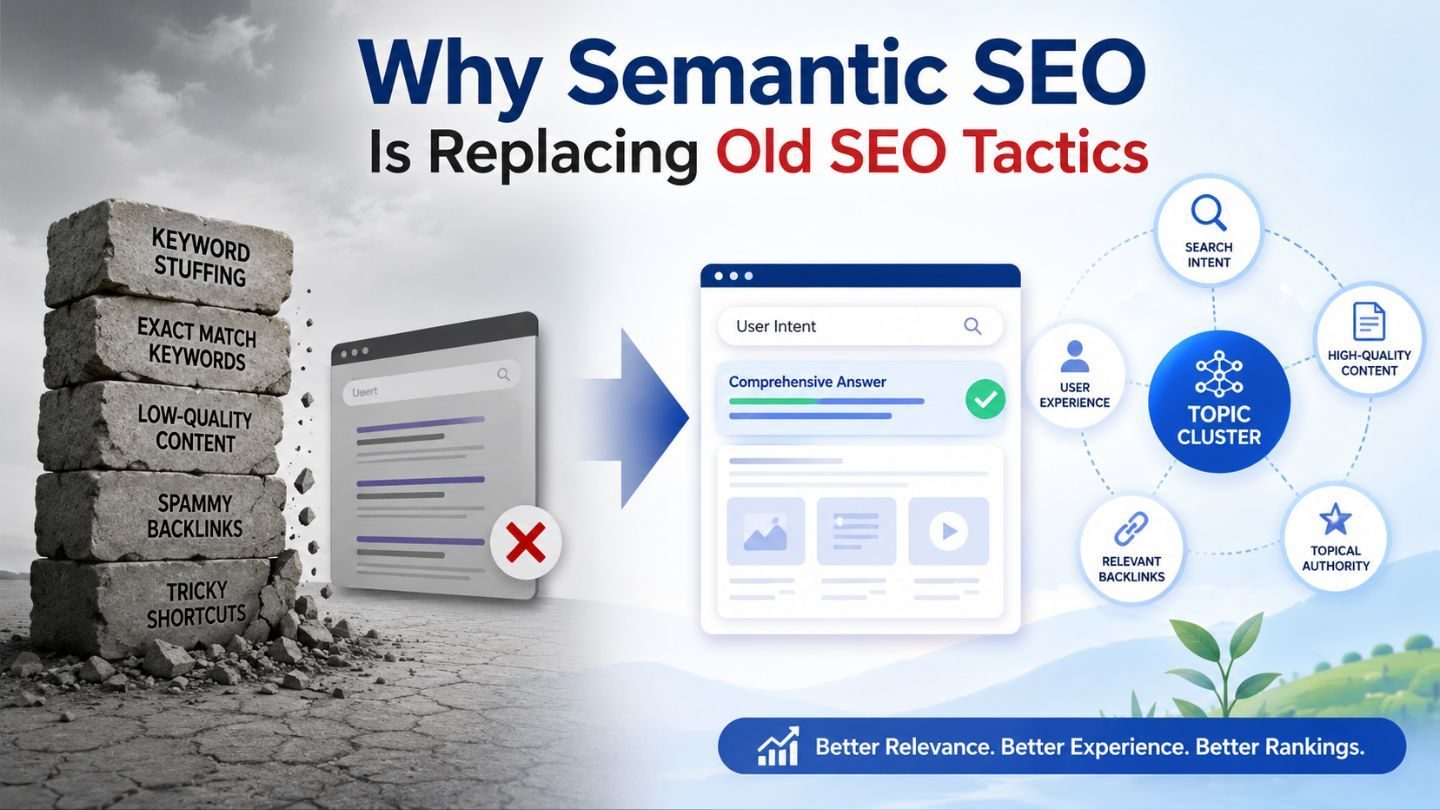
Traditional SEO strategies were heavily dependent on placing exact-match keywords throughout a webpage. Years ago, websites could rank well simply by repeating the same keyword multiple times, adding backlinks from almost any source, and creating separate pages targeting slight keyword variations. While these tactics worked temporarily, they often created poor-quality content that provided little real value to users. Search engines eventually recognized these loopholes and started prioritizing quality over manipulation.
Semantic SEO takes a completely different approach by focusing on meaning, context, and search intent. Instead of optimizing a page for one exact phrase repeatedly, semantic SEO encourages businesses to create comprehensive content that naturally covers related concepts, subtopics, and user questions. Modern search engines analyze how well a page answers a topic holistically rather than counting how many times a specific keyword appears. This evolution allows users to find more accurate and useful results, even when their search queries are conversational or complex.
Why Google’s Algorithms Are Becoming More Intelligent
Search engines have invested heavily in artificial intelligence and natural language processing to improve the quality of search results. Updates like RankBrain, BERT, and MUM have transformed Google from a keyword-matching engine into a system capable of understanding human language more effectively. These technologies help Google interpret the intent behind a search query rather than simply identifying identical words on a webpage.
For example, if someone searches for “best laptop for remote work,” Google understands that the user may also want information about battery life, portability, video conferencing capabilities, and performance. Pages that address these related needs are more likely to rank well compared to pages that only repeat the phrase “best laptop for remote work” excessively. This shift demonstrates why semantic relevance has become more important than outdated optimization tricks focused solely on keywords.
The Decline of Keyword Stuffing and Manipulative SEO Practices
Keyword stuffing was once one of the most common SEO practices because search engines relied heavily on exact keyword frequency to determine relevance. Websites overloaded their pages with repetitive terms in headings, paragraphs, and metadata to manipulate rankings. Although these methods occasionally delivered short-term gains, they created frustrating reading experiences and low-value content for users.
Modern algorithms are designed to detect unnatural optimization patterns. Excessive keyword repetition can now harm rankings rather than improve them. Google prioritizes content that reads naturally, answers user questions thoroughly, and demonstrates expertise. Similarly, manipulative link-building schemes and low-quality content farms have lost effectiveness because search engines evaluate authority and trustworthiness more carefully than before. Businesses that continue relying on outdated tactics often struggle to maintain visibility in competitive search environments.
Read More: Advanced Tactics to Maximize the SEO Value of User-Generated Content
How Semantic SEO Improves User Experience
One of the biggest reasons semantic SEO is replacing traditional tactics is that it aligns closely with user expectations. Internet users today expect search engines to deliver fast, accurate, and contextually relevant information. Semantic SEO helps achieve this by encouraging content creators to think about the broader needs of their audience instead of focusing only on single keywords.
Content built around semantic principles usually includes related questions, supporting information, practical examples, and logically connected topics. This creates a richer experience for readers while increasing the likelihood of ranking for multiple search variations. Instead of creating separate pages for every minor keyword variation, businesses can produce authoritative resources that cover a subject comprehensively. As a result, users spend more time engaging with the content, which can positively influence search performance over time.
The Role of Search Intent in Modern SEO
Search intent has become one of the most important ranking factors in modern optimization strategies. Every search query reflects a user goal, whether they want information, products, services, comparisons, or solutions to a problem. Semantic SEO helps businesses identify and satisfy these goals more effectively by structuring content around intent instead of isolated keywords, especially when they focus on understanding search intent for SEO and matching each page with the user’s real purpose.
For instance, someone searching for “how to improve website traffic” may be looking for actionable strategies, analytics tools, content marketing advice, or technical improvements. A semantically optimized article would naturally address these connected aspects instead of narrowly repeating one phrase throughout the page. This broader coverage increases the page’s usefulness while signaling topical authority to search engines. Businesses that understand user intent can create more relevant content that attracts qualified traffic and builds stronger engagement.
Why Topic Authority Matters More Than Individual Keywords
Search engines increasingly evaluate websites based on topical expertise rather than single-page optimization. A website that consistently publishes valuable, in-depth content about a subject is more likely to be viewed as authoritative compared to a site relying on scattered keyword-focused articles. Semantic SEO supports this by encouraging interconnected content structures and comprehensive topic coverage.
Using topic clusters to boost SEO performance, along with internal linking strategies and semantically related content, can contribute to stronger authority signals across the website. When multiple pages support a central subject area, search engines gain confidence that the website provides reliable information. This approach also improves navigation for users because they can explore related content naturally. Businesses investing in semantic SEO are not only improving rankings for one keyword but building long-term credibility across entire categories relevant to their industry.
Voice Search and Conversational Queries Are Changing SEO
The growth of voice assistants and conversational search has accelerated the need for semantic SEO. People speak differently than they type, often using complete questions or natural language phrases when performing voice searches. Traditional SEO methods focused on exact-match keywords are less effective in this environment because conversational queries require contextual understanding.
Semantic SEO allows content to align with these evolving search behaviors by covering topics naturally and answering real user questions. Search engines can identify the relationship between conversational phrases and relevant content even when the wording does not match exactly. Businesses that optimize for semantic relevance are therefore better positioned to capture traffic from voice search, mobile users, and AI-driven search experiences that depend heavily on contextual understanding.
Read More: Voice Search SEO: How to Rank for Conversational Queries
Structured Content and Contextual Relevance
Content organization has become increasingly important in semantic SEO strategies. Search engines favor content that is well-structured, easy to navigate, and logically connected. Clear headings, relevant subtopics, schema markup, FAQs, and concise explanations help algorithms understand the context of a page more accurately.
Structured content also improves opportunities for featured snippets, knowledge panels, and other enhanced search features. These visibility enhancements can significantly increase click-through rates and organic traffic. Rather than focusing purely on keyword density, semantic SEO prioritizes clarity, relevance, and content relationships. This creates a better experience for both search engines and users while improving the likelihood of ranking across diverse search variations.
The Future of SEO Is Context-Driven

SEO is moving toward a future where context, expertise, and user satisfaction matter more than technical loopholes, which is why the shift between topical authority and keyword authority in SEO has become so important for long-term rankings. Artificial intelligence continues to improve how search engines interpret content, making it increasingly difficult for outdated tactics to produce lasting results. Businesses that ignore these changes risk losing visibility as search platforms prioritize more meaningful and helpful content.
Semantic SEO represents a more sustainable and future-focused approach because it aligns with the direction search technology is evolving. Instead of chasing algorithm tricks, businesses can focus on creating valuable resources that genuinely help their audience. This strategy not only supports stronger rankings but also improves brand credibility, customer trust, and long-term digital growth in competitive industries.
Final Thoughts
Semantic SEO has transformed the way businesses approach digital visibility by shifting the focus from repetitive keyword tactics to meaningful, intent-driven content. Search engines now prioritize context, topical authority, user experience, and content relevance over outdated optimization methods like keyword stuffing and manipulative backlinks. Businesses that adapt to semantic SEO strategies can create more engaging content, improve search rankings across multiple related queries, and build long-term credibility in their industry. As search algorithms continue evolving with artificial intelligence and natural language processing, semantic SEO will remain essential for sustainable online growth and stronger audience engagement.
At The Ocean Marketing, we help businesses strengthen their online presence with advanced SEO strategies tailored to modern search engine standards. Our team focuses on creating high-quality, user-focused content solutions while offering a free SEO audit to identify opportunities for improving visibility, authority, and website performance. Contact us today to discover how we can help your business achieve stronger digital growth and long-term success.