
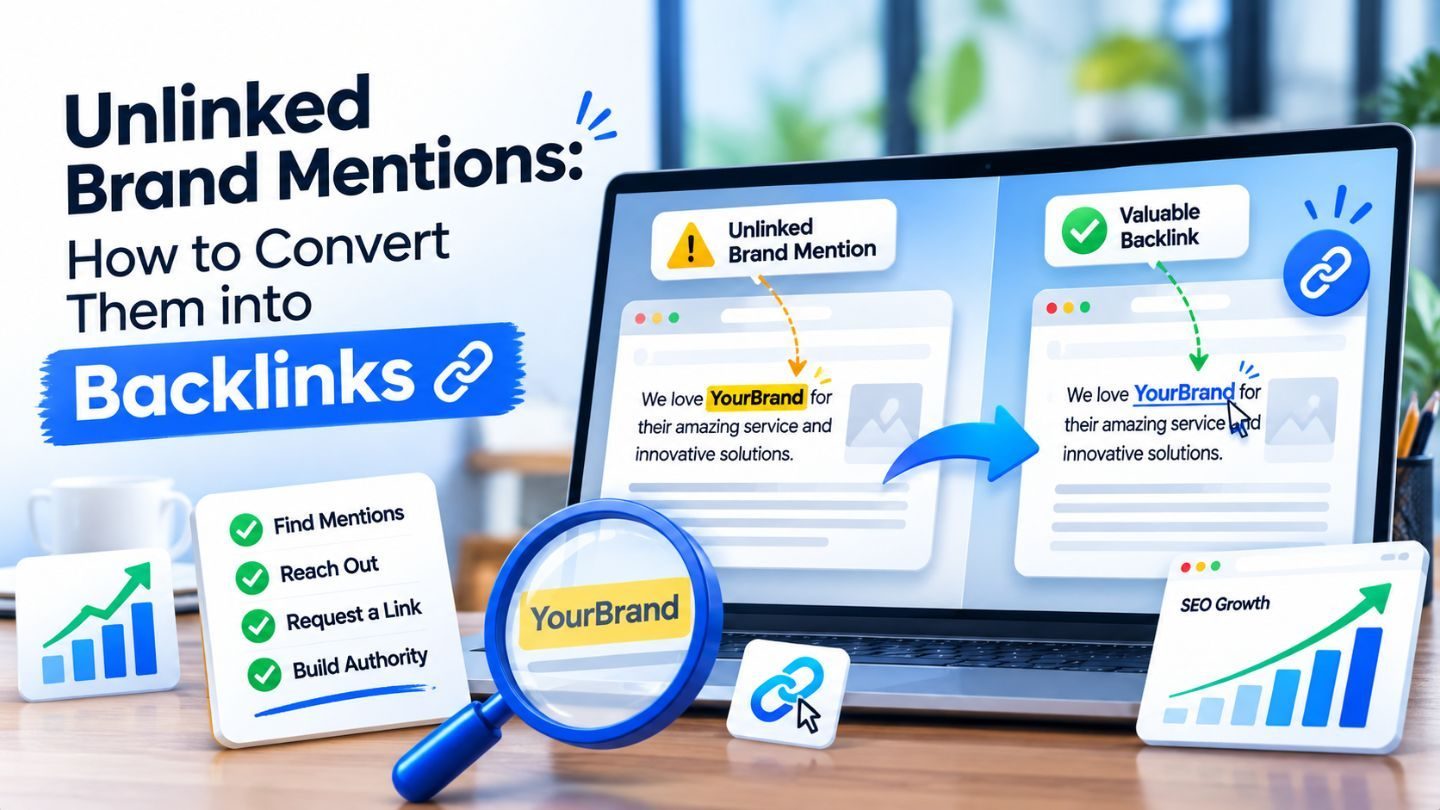
Somewhere out there, people are already talking about your business. A journalist referenced you in a roundup, a blogger name-dropped you in a tutorial, a forum thread recommended you to someone asking for options. In many of those cases, nobody bothered to link. Those unlinked mentions are the closest thing to free backlinks in existence, because the hard part, earning the mention, is already done. This blog covers how to find them, decide which ones are worth pursuing, and ask for the link without sounding like a template.
Key Takeaways
- Unlinked mentions are existing references to your brand without a hyperlink.
- They convert at far higher rates than cold outreach for links.
- Not every mention is worth chasing; relevance and authority decide.
- Personal, specific outreach dramatically outperforms templated requests.
- Mentions carry value even when the link never materializes.
Why Unlinked Mentions Are the Easiest Link Wins
Cold link outreach fails most of the time for an obvious reason: you're asking a stranger to vouch for something they've never considered. An unlinked mention flips that entirely. The writer already decided you were worth referencing. They already made the editorial judgment. All that's missing is a hyperlink they probably forgot rather than withheld.
That difference shows up in response rates. Cold outreach converting at two or three percent is normal. Unlinked mention outreach regularly clears thirty percent, and sometimes far more when the mention is recent and the site is actively maintained. You're not selling anything; you're pointing out an oversight and making it trivially easy to fix, which is a fundamentally different conversation.
How to Find Mentions You Don't Know About
Start with the obvious and work outward. Search your exact brand name in quotes, then repeat with common misspellings, your old business name if you rebranded, your founders' names, and any product names that are distinctive enough to be searchable. Each of those turns up references the others miss, and misspellings are consistently underexplored.
Beyond manual searching, set up alerts so new mentions surface as they happen rather than months later. Backlink tools will show you which sites already link, and the gap between mentions and links is your working list. It's worth understanding what a brand mention means for SEO before you start, because it shapes which mentions you prioritize and which you leave alone.
Recent Mentions Convert Best
A mention published last week has a writer who still remembers writing it and an editor who can still edit it easily. A mention from four years ago sits in an archive nobody touches. Sort your list by date and work from the top.
Read More: Link Reclamation: How to Find, Fix & Recover Lost Backlinks
Deciding Which Mentions Are Worth Your Time
Not every mention deserves an email. A reference on a scraped content farm adds nothing, and pursuing it wastes an hour you could spend elsewhere. The filter is straightforward: is the site relevant to your industry, does it have genuine authority, does it get real traffic, and is the mention in a context that makes a link natural?
That last point matters more than people expect. If your brand appears in a list of recommendations, a link is completely natural, and the writer will usually agree. If it appears in a passing aside inside an unrelated article, asking for a link looks opportunistic and may just annoy someone who might have written about you again later. Judging how to recognize high-quality backlinks applies here exactly; the same standards you'd use for any link apply to mentions you chase.
Writing Outreach That Doesn't Get Deleted

The email that works is short, specific, and clearly written by a person who has read the article. Name the piece, name the section, thank them genuinely if the mention was flattering, then note that a link would help readers find you and offer the exact URL. That's the whole message. Anything longer starts sounding like a pitch.
What fails is equally predictable. Templated openers that could apply to any article. Framing the request as though they made an error. Explaining SEO to a writer who doesn't care about your rankings and shouldn't. Attaching a document. Following up four times. Remember, the writer gets nothing from this except a slightly more useful article, so make that the frame and keep it effortless for them to say yes.
Mentions Have Value Without the Link
Worth saying plainly, because it changes how you treat the ones that don't convert. Search systems increasingly recognize brand references as signals of legitimacy, whether or not a hyperlink accompanies them. Being consistently named in relevant conversations builds a kind of recognized presence that pure link counting never captured, and AI-driven search leans on this heavily. That is the same mechanism behind citation SEO in AI search, where being named repeatedly is what earns the reference.
So a polite no isn't a wasted effort, and neither is a mention on a site where a link was never going to happen. The mention still contributes. This is also why the outreach should never turn adversarial; the relationship with a writer who covers your space is worth more than any single link, and burning it over one hyperlink is a bad trade. Pairing this work with a broader approach to building links without outreach emails tends to produce steadier results than chasing conversions alone.
Where Mentions Come From in the First Place
It's worth asking why some businesses accumulate mentions and others don't, because chasing links without addressing that is treating a symptom. Mentions happen when you're the obvious example someone reaches for, and that position is earned by being visible in the places writers look, publishing things worth citing, and being the business people already have an opinion about.
That reframes mention hunting as the back half of a longer process. Publish original data, and you get referenced. Say something specific enough to quote, and you get quoted. Show up in the communities your industry actually reads, and you become the name that comes to mind. The businesses with the most unlinked mentions to convert are usually the ones that stopped thinking about links entirely and got interesting instead.
Read More: Digital PR: What It Is and Why It Matters
Turning This Into a Repeatable Process
One-off mention hunts produce one-off results. The businesses that get real value from this treat it as a recurring cycle, alerts running continuously, a monthly review of new mentions, outreach on the ones worth pursuing, and a record of who was contacted so nobody gets emailed twice about the same article.
Tracking matters too. Log the mention URL, the date, whether you reached out, and the outcome. Over a few months, that log tells you which types of sites respond, which outreach angles work, and roughly what a mention is worth to you in conversion terms. Without it, you're repeating the same guesses indefinitely and calling it a strategy.
The Mentions Worth Leaving Alone

Restraint is part of this. A mention in a negative review roundup doesn't become better with a link pointing at you. A mention on a site with a questionable link profile is one you'd want to avoid, even if they offered. And a mention from a competitor comparing themselves favorably to you is not an outreach opportunity; it's a content problem.
There's also the matter of frequency. If a publication mentions you regularly without linking, that's a relationship worth nurturing rather than a series of transactions to chase. Emailing them every time they name you turns a useful ongoing connection into an irritation, and the link you extract is worth far less than the coverage you'd lose. Folding that log into a regular backlink audit keeps mention tracking and link tracking in one place.
Timing the Ask
The window matters more than the wording. A writer who published yesterday still has the piece open, remembers the research, and can make an edit in ninety seconds. The same writer, three months later, has moved on, doesn't remember why they mentioned you, and would have to reopen work they've mentally closed.
Which means the process is really about the speed of detection. Alerts that surface a mention within a day or two convert dramatically better than a quarterly sweep, not because the email is different but because the effort you're asking for is different. If you can only do one thing to improve results here, shorten the gap between publication and outreach.
What to Do When They Say No
Some won't link, and the reasons are usually legitimate. Editorial policy against outbound links. A publication that only links to primary sources. A writer who simply doesn't want to. None of that is personal, and none of it warrants a follow-up argument. The right response is a short thank-you and nothing else. You've now had a positive interaction with someone who writes about your industry, which is worth considerably more than the link you didn't get. People who handle a no gracefully get mentioned again. People who push get quietly excluded from future coverage, which is an expensive way to win a hyperlink you were never going to get anyway.
Getting Credit for the Reputation You Already Have
Unlinked brand mentions represent recognition you've already earned but aren't fully benefiting from. Finding them takes an afternoon, filtering them takes judgment, and converting them takes a short, human email that respects the writer's time. It's some of the highest-return link building available precisely because the persuasion already happened without you. And the mentions that never become links still count toward how established your brand looks.
At The Ocean Marketing, we help businesses turn existing recognition into measurable authority through link building that focuses on quality over volume. Whether you want help auditing your mention footprint, building a repeatable outreach process, or starting with a free SEO audit to see where your link profile stands, our team can help. Contact us, and let's find the links you've already earned.