
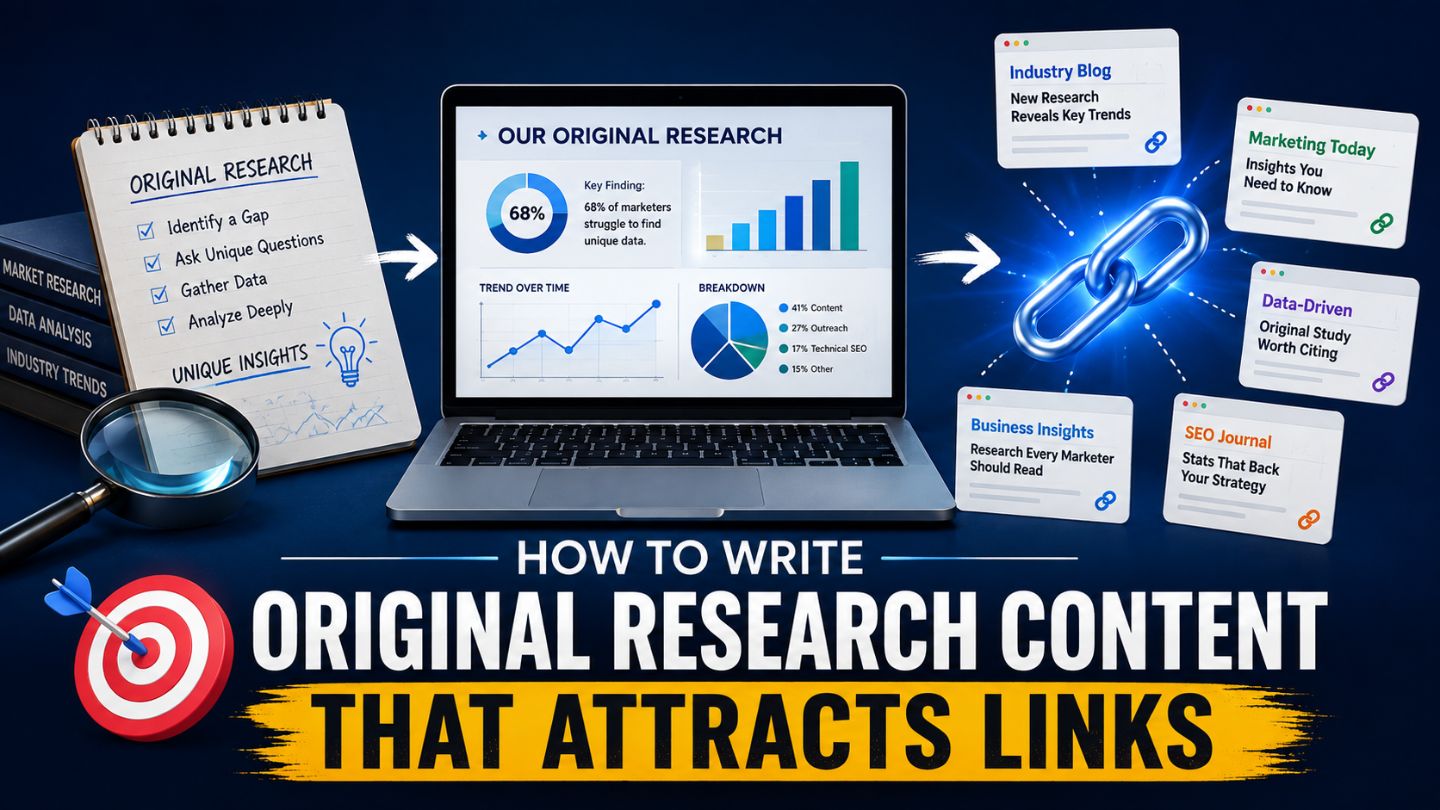
Most content earns nothing beyond the traffic it directly attracts, because it says nothing that couldn't be found in a dozen other places. Original research breaks that pattern; it gives other writers a genuine reason to cite you, because for once you're the actual source rather than another summary of someone else's summary. This blog covers what makes research content link-worthy, how to produce it without a data science team, and the mistakes that turn a promising dataset into a page nobody references.
Key Takeaways
- Original data gives writers a stronger reason to cite and link than content that simply restates information available elsewhere.
- Small, focused studies often outperform ambitious ones nobody finishes.
- The findings need to be surprising, specific, or both to earn citations.
- Presentation determines whether journalists can actually use your data.
- Promotion matters as much as the research itself.
How This Fits Into a Broader Content Calendar
Original research doesn't need to be the majority of a content program to be worth doing; even one well-executed study a year, planned deliberately rather than squeezed in opportunistically, can outperform the link-earning potential of dozens of standard articles combined. Treating it as a planned, recurring feature of the content calendar, rather than an occasional side project, ensures it actually gets the planning and promotion it needs to succeed rather than being rushed at the end of a quiet month.
Budgeting real time for both the research itself and, just as importantly, the promotion and pitching afterward prevents the common failure where a genuinely good study gets published quietly and never reaches the writers who would have cited it.
Why Original Data Earns Links Nothing Else Does
A writer covering a subject needs evidence to support their argument, and evidence has to come from somewhere. Most of the time it comes from whoever already published a number, which is why the same handful of statistics get recycled across hundreds of articles, all citing the same original source. Being that original source is the entire game, because every article that cites you links back, and that pattern compounds for years after publication.
This is fundamentally different from earning links through outreach or relationship-building, where you're asking someone to do something for you. Original research gives writers a natural reason to cite your work, and those citations can often result in editorial backlinks. That's a much more durable position to build from.
You Don't Need a Data Science Team
The instinct is to imagine original research as expensive, a large-scale survey, a proprietary dataset, months of analysis. Most of the research that actually earns citations is far smaller in scope. A survey of two hundred people in your industry, an analysis of your own customer data anonymized appropriately, or a systematic review of publicly available information nobody had bothered to compile, all count as original. Once a study is complete, presenting it properly connects to building links with infographics, since a visual summary of your findings is often what actually gets shared and cited.
What matters is that nobody else has published exactly this specific finding in exactly this specific form. A small, focused study you actually finish and publish beats an ambitious one that stays in planning for a year. Scope your first attempt small enough that you can execute it well, because a modest, well-presented dataset earns more citations than an ambitious one that never ships.
Choosing a Sample Size That's Defensible

There's no universal minimum sample size that makes research automatically credible, but there is a threshold below which writers and readers alike will reasonably question the finding. A survey of fifteen people, however interesting the result, invites skepticism that undermines the citation value you were trying to build. A larger, well-selected sample can strengthen credibility, but defensibility depends on the population being studied, the sampling method, and how narrowly the findings are framed.
If your available sample is genuinely small, framing the study honestly as exploratory or preliminary, rather than presenting it as definitive, actually protects its citability. Writers are more willing to reference a modest, honestly-scoped finding than one that oversells a small sample as though it were comprehensive, because the honest framing survives scrutiny in a way the inflated one doesn't.
Read More: How to Write Comparison Articles That Rank and Convert
What Makes Findings Actually Citable
A finding earns citations when it's surprising, specific, or ideally both. "Most businesses use social media" surprises nobody and cites nothing useful. "Businesses posting on weekday mornings saw forty percent higher engagement than those posting evenings, across our sample of three hundred accounts" gives a writer something concrete to reference and a specific number to quote.
Specificity matters more than most people expect. Vague directional findings, "engagement is trending up," get ignored. Precise numbers tied to a clear methodology, even from a modest sample, get cited repeatedly. Before running any study, ask what specific, quotable sentence you want to be able to write at the end, and design the research to actually produce that sentence rather than a vague general impression.
One Surprising Finding Beats Ten Predictable Ones
A study producing a single genuinely unexpected result will get cited more than a comprehensive report full of findings everyone already assumed. Lead with the surprise, don't bury it in the fifth section.
Presentation Determines Whether Anyone Can Use It
A finding buried in dense prose with no clear pull-quote or chart is a finding writers on deadline will skip past, even if it's genuinely interesting. Journalists and bloggers working quickly need to extract a fact fast, which means your data needs a clear headline number, a simple visual, and a methodology note they can reference without emailing you to ask how you got the result.
Build the page around extractability. State the key finding in the first paragraph, not the conclusion. Include a chart simple enough to screenshot and understand instantly. Provide the methodology transparently: sample size, timeframe, and how you defined your terms, because writers citing a stat get asked to defend it, and a page that makes their job easy gets used more than one that makes them dig.
Promotion Is Not Optional

Publishing original research and waiting for citations to arrive rarely works, because nobody knows the data exists until you tell them. Pitch relevant journalists and bloggers directly, referencing the specific finding rather than a generic "we published new research" note. A precise, quotable statistic in the first line of your pitch does more work than an attached PDF nobody has time to read.
This overlaps directly with converting attention into links, which connects to how to write content that attracts links more broadly; original data is simply the strongest version of content worth linking to, but it still benefits from being put in front of the people who'd actually use it rather than left to be discovered by chance.
Keeping It Honest and Repeatable
The credibility of research content depends entirely on the methodology holding up to scrutiny, and cutting corners here damages more than the single piece; it damages trust in anything you publish afterward. Be transparent about sample size and limitations rather than overselling a small study as more comprehensive than it was. A modest, honest finding cited accurately beats an inflated claim that gets challenged and retracted. Running a backlink audit checklist periodically helps confirm which citations from past research are actually holding up over time.
Treat original research as a repeatable content type rather than a one-off project. An annual version of the same study becomes progressively more valuable, both because it builds a trend line nobody else has and because past citations create an existing audience of writers who already know to check back when the new edition publishes. The second year is always easier than the first.
Read More: Evergreen vs Trending Content: How to Balance Both
What to Do When the Data Doesn't Show Anything Surprising

Sometimes a study runs, and the result confirms exactly what everyone already assumed, which feels like a failure but usually isn't one. A confirmed assumption backed by real numbers is still more citable than an unsupported assumption, because writers can now cite a specific figure rather than a vague general belief, even if the direction of the finding wasn't surprising.
In that situation, look for a secondary angle within the same dataset, a subgroup that behaved differently, a magnitude that was larger or smaller than expected, a trend visible when you segment by a variable nobody usually checks. The headline finding might be unsurprising while a detail buried in the same data turns out to be exactly the citable angle you were looking for.
Becoming a Source Worth Citing
Original research works because it flips the usual relationship: instead of asking for a link, you're offering evidence other writers genuinely need. Keep the scope achievable, aim for a specific and surprising finding rather than a vague comprehensive one, present it so a writer on deadline can actually use it, and promote it directly rather than hoping it gets found. Done consistently, this becomes one of the most durable link-earning assets a content program can build.
At The Ocean Marketing, we help businesses build Content Writing programs around research that earns citations rather than content that only earns a single read. Whether you need help scoping a study, presenting findings for maximum pickup, or a free SEO audit to see how your content is currently performing, our team can help. Contact us and let's find the data your industry doesn't have yet.