
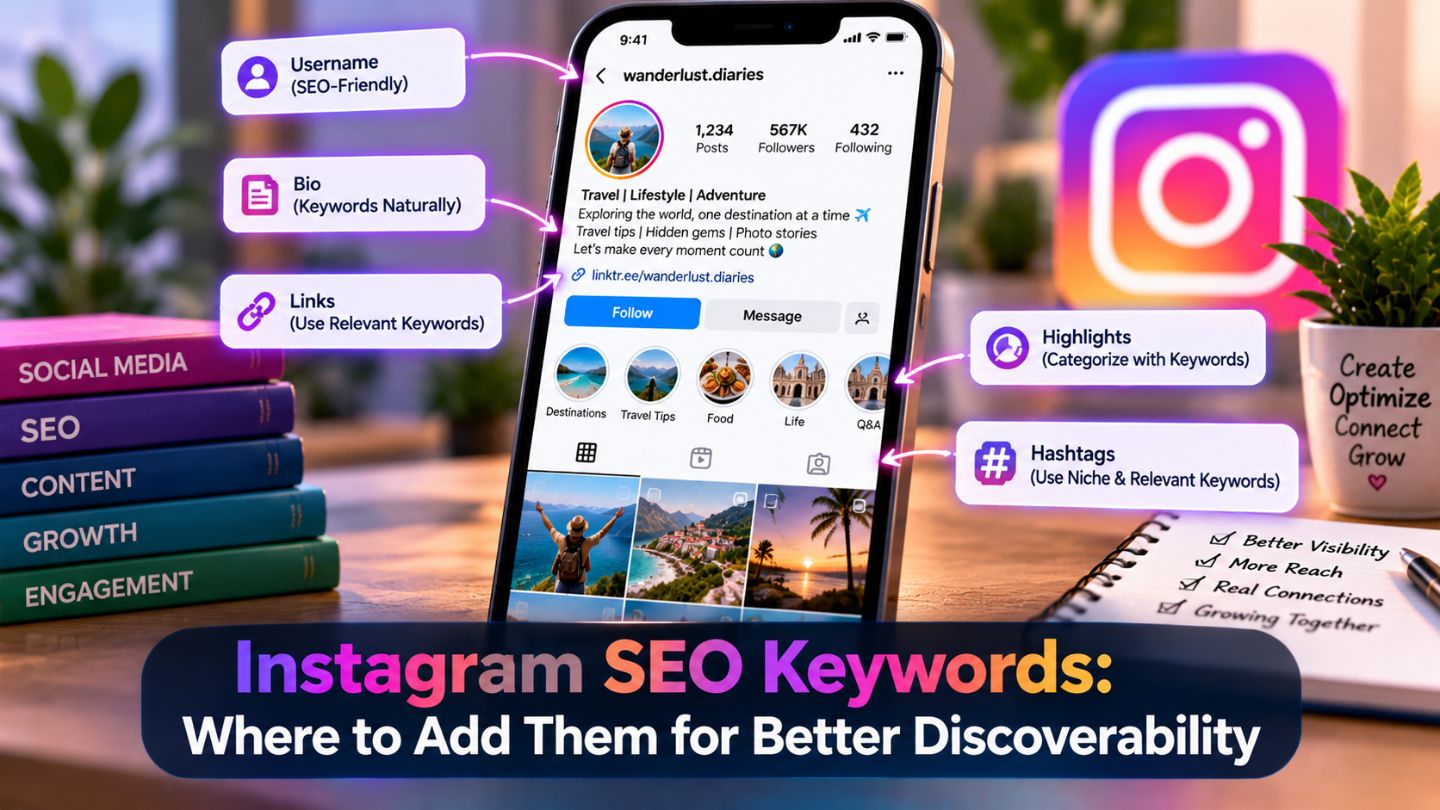
Instagram now behaves like a search engine for a large share of its users, and the fields that determine whether you surface are not the ones most businesses spend time on. Hashtags get the attention; the name field, the caption, and the alt text quietly do more of the work. This blog covers exactly where keywords belong on Instagram, which placements carry real weight, and the common mistakes that make a profile technically keyword-rich and practically invisible.
Key Takeaways
- The name field is indexed and is the single highest-impact placement.
- Captions influence search more than hashtags now do.
- Alt text is read by the platform, not just by screen readers.
- Consistent subject matter teaches the algorithm what you are about.
- Stuffing any field damages conversion without improving discovery.
The Name Field Does the Heavy Lifting
The display name beneath your handle is indexed, and most businesses fill it with their brand name and nothing else. That tells the platform what you are called and nothing about what you do, which means you are eligible for almost no searches beyond people already looking for you by name.
Adding a genuine descriptor changes that immediately. A profile name that includes a clear service term, such as “Family Dentist” or “Emergency Dentist,” gives Instagram more context about what the account offers and can improve relevance for related searches. Keep the wording natural and limited to one or two accurate descriptors rather than cramming the field with keywords. The field allows enough room for a brand plus one or two honest descriptors. Keep it readable rather than crammed, because a name field stuffed with terms surfaces occasionally and converts badly when it does. The wider mechanics of Instagram profile search visibility explain why this one field carries so much of the weight.
Your Handle Still Matters, Just Differently

The username itself is a weaker search signal than the display name, and it still does real work. It appears on every post, every mention, and every screenshot someone shares, so a handle that is short, spellable, and consistent with your other channels reduces friction every time someone tries to find you from memory or from a recommendation.
Where businesses go wrong is treating it as a keyword field. Handles crammed with underscores, numbers, and service terms are harder to type, harder to remember, and read as less established. Pick the cleanest version of your brand name available and put the descriptive work in the name field where it is actually indexed.
Captions Now Outweigh Hashtags
Hashtags used to be the primary discovery mechanism and have been steadily demoted to a supporting signal. What the platform reads more carefully is the caption itself, meaning natural language describing what the post actually covers does more for discoverability than a block of tags at the bottom.
That argues for writing captions as though a person might search the phrases in them. Describe the service, the problem, the location, the outcome, in sentences rather than keyword lists. This is a genuine shift in habit for teams who learned Instagram a few years ago, and it is closely related to how keywords function in captions and profile fields more broadly.
Video Captions and On-Screen Text
Text that appears within a video, and the captions attached to it, contribute to how the platform understands the content. A Reel with clear on-screen text describing what it covers gives more to work with than one relying entirely on spoken audio.
This is one of the few places where an accessibility practice and a discovery practice are identical. Captions serve the large share of viewers watching without sound, and they simultaneously give the platform readable text about a format that is otherwise opaque to it.
Alt Text Is a Search Field, Not Just an Accessibility One
Instagram allows custom alt text on posts, and most accounts never touch it. It exists primarily for accessibility, which is reason enough to use it, and the platform also reads it when working out what an image depicts. That makes it a genuine, underused placement for descriptive terms.
The rule is the same as everywhere else: describe the image accurately rather than listing terms. "Team member fitting a bathroom vanity in a Victorian terrace" is useful to a screen reader user and informative to the platform. A string of disconnected keywords serves neither, and it is immediately obvious to anyone actually relying on it.
Set Alt Text at Publish Time
It can be added later, but retrofitting it across a back catalog is tedious enough that it never happens. Making it part of the posting checklist is the only version of this that survives contact with a busy week.
Read More: Visual Search SEO: How to Optimize Images for Better Rankings
Consistency Teaches the Algorithm Your Subject
Individual field optimization only goes so far if the account itself has no discernible subject. Instagram builds an understanding of what you are about from the accumulated pattern of your captions, images, and the engagement around them. An account posting on one clear theme builds a strong signal; an account posting whatever came to mind builds none.
This is why scattered content strategies undercut keyword work that is otherwise correct. If your last twenty posts span six unrelated subjects, no amount of name-field tuning tells the platform what to surface you for. Businesses seeing weak reach despite decent posting frequency often find the cause here rather than in any individual field, which connects to why content sometimes stops reaching followers at all.
Location Tags Are a Separate Signal
For any business serving a defined area, tagging the actual location on posts contributes to whether you surface for people searching in that area. This is distinct from putting a city in your bio; it is a structured signal attached to individual posts rather than a line of text.
The useful habit is tagging the specific location rather than a broad city marker, since a neighborhood or venue tag carries more precision than a metropolitan one. It costs nothing at publish time, and it narrows your competition from everyone in your category to the businesses genuinely near the person searching. How tightly you draw that radius is the same judgment behind local versus hyperlocal targeting.
Where Hashtags Still Earn Their Place
They have not become useless; they have become narrow. A small number of specific, genuinely relevant hashtags still help categorize a post, particularly niche ones where the tag itself has a real community behind it. Thirty generic tags do close to nothing and make the caption look desperate.
A reasonable working rule is a handful of tags that a real person might actually browse, placed at the end of the caption or in the first comment, chosen per post rather than pasted from a saved block. The saved block is the tell that nobody is thinking about relevance, and relevance is the only thing tags still contribute.
Read More: Hashtags vs Keywords on Instagram: What Works Now?
Bio Keywords Versus Bio Persuasion
The bio is not weighted heavily for search, which surprises people who have just learned that other fields are. Its job is conversion: someone has arrived, and the bio decides whether they follow, click, or leave. Filling it with search terms sacrifices the one thing it does well for a benefit it does not deliver.
That means writing it for the person rather than the algorithm. State what you do, who it is for, and what to do next, in language a human would use. The discoverability work happens in the name field and captions; the bio closes.
The Stuffing Failure
Once people learn which fields are indexed, the instinct is to fill all of them with search terms. This reliably backfires. A bio reading like a keyword list, a name field crammed to the character limit, alt text that is a comma-separated dump, all of these make a profile look automated at exactly the moment a visitor is deciding whether you are credible.
Discoverability without credibility produces traffic that does not convert, which is a more expensive form of invisibility. Put the search terms where they are actually read, keep every field readable by a human, and let the bio do the persuading rather than the ranking. Reviewing common bio mistakes that reduce conversions is worth doing alongside any keyword work, since the two problems often coexist.
Checking Whether Any of This Worked
Instagram insights break profile visits down by source, and the search portion tells you directly whether keyword work is producing anything. Watch it across weeks rather than days, and compare movements against the specific changes you made rather than against a general sense that things feel better.
The faster test costs nothing: open the app, search the terms a customer would actually use to find a business like yours, and see whether you appear. If competitors surface and you do not, look at what their name fields say. Five minutes of that usually identifies the gap more precisely than any dashboard.
Keeping It Current
Profile fields get set once and then describe a business that has since changed. Services added, areas expanded, a specialization narrowed, none of which reaches the name field or bio unless someone deliberately revisits them.
A twice-yearly review takes minutes and catches the drift. It is also a reasonable moment to check whether the terms you chose still match how people search, since the common phrasing in a category does shift and a field optimized three years ago may be targeting language nobody uses now.
Getting Found by People Already Searching
Instagram keyword work is less about volume and more about placement. The name field carries the most weight and is the most neglected. Captions written in natural, descriptive language now outperform hashtag blocks. Alt text is a genuine search field that almost nobody uses. Underneath all of it, a consistent subject is what lets the platform understand you at all. Do those four things with restraint, and the people searching for what you offer can actually find you.
At The Ocean Marketing, we build social media marketing that gets found by the right people rather than simply seen by more of them. Whether you need help auditing your profile fields, building a content approach with a clear subject, or a free SEO audit to see how your wider presence performs, our team can help. Contact us and let's make your profile findable.