
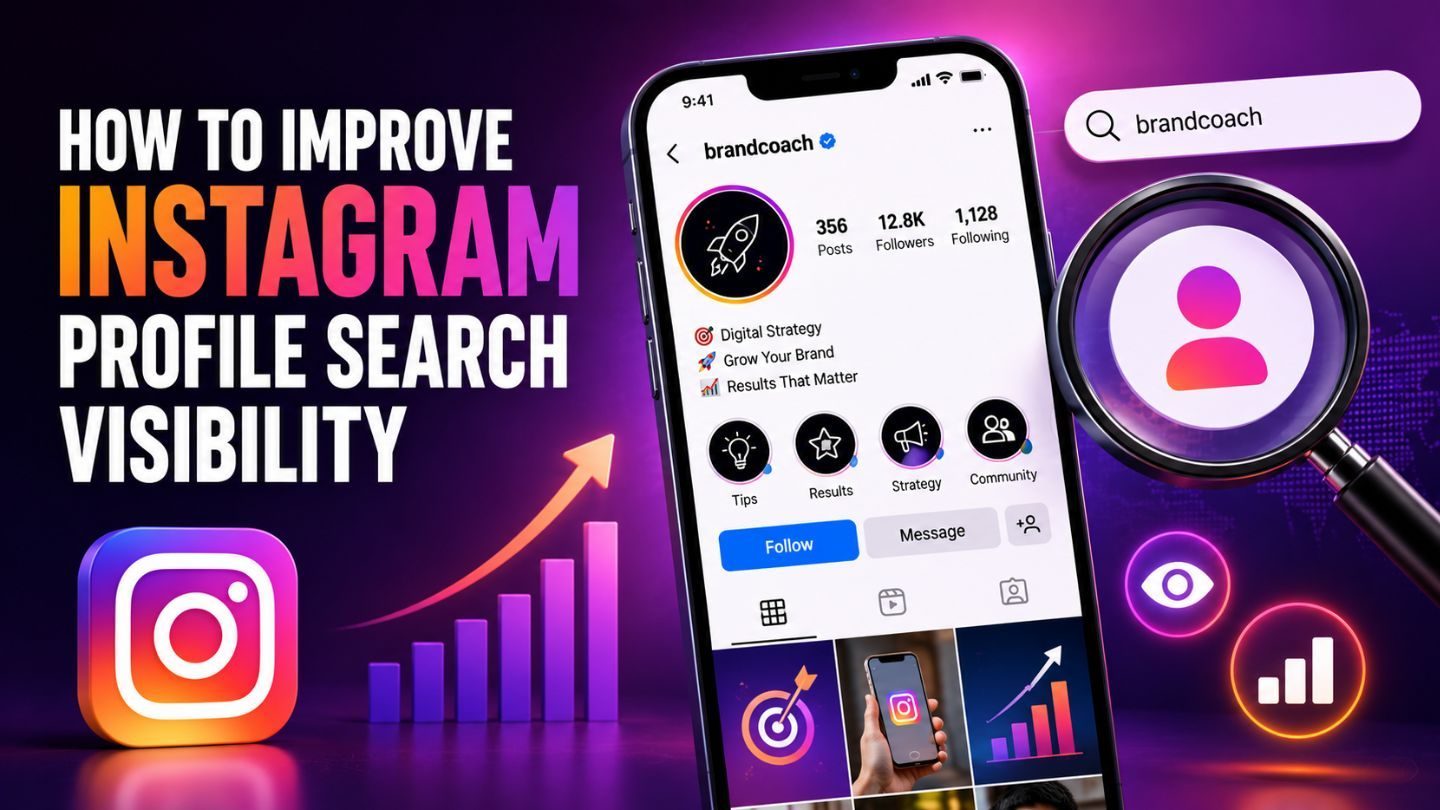
People search inside Instagram the way they search inside Google, typing what they want and picking from what appears. Yet most businesses still treat their profile as a design exercise rather than a search result. That’s a gap worth closing, because appearing in Instagram search puts you in front of people with active intent rather than passive scrollers. This blog covers how Instagram search actually works, which profile fields influence it, and the practical changes that make your business findable rather than merely present.
Key Takeaways
- Instagram search behaves more like a search engine every year.
- The name field is indexed; the bio largely is not.
- Consistent content topics teach the algorithm what you’re about.
- Engagement signals influence which profiles surface for a query.
- Keyword stuffing hurts conversion without helping discovery.
How Instagram Search Actually Works
Instagram’s search pulls from several signals at once: what you typed, the accounts and content most relevant to it, and how popular and engaged those results are. It’s less sophisticated than Google, but the underlying logic is familiar: relevance plus authority, filtered through personalization based on who’s searching.
The important shift is behavioral rather than technical. A large share of users, particularly younger ones, now open Instagram to find something specific rather than to browse. They type a service, a place, or a product category. If your profile doesn’t match those queries, you’re invisible to that entire mode of discovery regardless of how good your content is. Teams already thinking about how to rank social content on Google will recognize the pattern; it’s the same problem in a different search box.
The Name Field Does the Heavy Lifting
This is the single most impactful and most ignored field on the platform. Instagram indexes the name field, the display text under your handle, and matches it against queries. Most businesses fill it with their brand name and nothing else, which tells the algorithm what you’re called and nothing about what you do.
Adding what you actually offer changes that immediately. "Harbor Dental" becomes "Harbor Dental | Family Dentist," and suddenly you’re eligible for queries you were never in the running for. The field allows sixty-four characters, which is enough for your brand plus one or two genuine descriptors. Keep it readable, not stuffed; a name field crammed with keywords looks desperate and converts badly even when it surfaces.
The Bio Persuades, the Name Field Finds
Understanding this division prevents the most common mistake. Put your discoverability terms in the name field and use the bio to convince the person who arrives.
Read More: The Role of Keywords in Instagram Captions and Profile Optimization
Content Consistency Teaches the Algorithm

Instagram builds an understanding of what your account is about from what you post, and it does this from captions, hashtags, image content, and the engagement patterns around them. An account posting about one clear subject builds a strong signal. An account posting whatever came to mind that week builds nothing, because there’s no pattern to learn. Understanding where hashtags end and keywords begin helps you decide what that pattern should be built from.
This is where scattered content strategies quietly cost you. Alt text descriptions, keyword-aware captions, and consistent subject matter all feed the same understanding. Hashtags help but do less than most people assume now; they’re a supporting signal rather than the mechanism. Businesses seeing weak reach often find this is the root cause, which connects to why content isn’t reaching followers more directly than any posting-time theory.
Engagement Feeds Discovery
Instagram surfaces profiles it expects people to engage with, which means your existing engagement rate influences whether new people find you. That creates a loop: good content earns engagement, engagement improves visibility, and visibility brings more people who engage. It also means a dormant account gets progressively harder to discover.
The signals that matter most aren’t the ones businesses chase. Saves and shares carry more weight than likes, because they indicate the content was worth keeping or worth showing someone else. Comments matter more than passive scrolling. Understanding which Instagram metrics actually matter reshapes what you optimize for and usually improves discoverability as a side effect.
The Stuffing Trap
Once people learn the name field is indexed, the temptation is to fill it entirely with search terms. "Best Dentist Cheap Dental Emergency Teeth Whitening" technically contains keywords and comprehensively destroys any impression of professionalism. You might surface more and convert far less, which is a net loss.
The same logic applies to bios crammed with terms and captions written for an algorithm rather than a person. Instagram is a visual, human platform, and the moment your profile reads as machine-optimized, the people who find you leave. Discoverability without credibility produces traffic that never converts, which is just a more expensive form of invisibility. The failure mode is the same one behind keyword stuffing on a website, just compressed into a smaller field.
Location Signals Matter More Than People Expect
For any business serving a defined area, geography is part of discoverability, and most profiles ignore it. Instagram uses location cues from tagged posts, the location attached to your profile, and the language in your content to work out where you’re relevant. A profile with no location signal at all is competing nationally by default, which for a local business means competing pointlessly.
The fixes are small. Tag your actual location on posts rather than a generic city marker. Include the area you serve in the name field if there’s room, or the bio if there isn’t. Post content that references where you are without turning every caption into a geography lesson. It’s a modest amount of effort that narrows your competition from everyone to the handful of businesses actually near your customer.
Checking Whether It’s Working
Instagram’s insights include a breakdown of where profile visits came from, and the search portion tells you directly whether this work is paying off. Watch that number over weeks rather than days, and compare it against changes you made rather than against a general sense of momentum.
The manual test is equally useful. Open Instagram, search the terms a customer would use to find a business like yours, and see whether you appear. If you don’t, and your competitors do, look at what their name fields say. That five-minute exercise usually identifies the gap faster than any analytics screen, and it costs nothing to repeat monthly.
Location Signals for Local Businesses
If you serve a geographic area, location does real work in Instagram search. Tagging your posts with a location, adding your city to the name field where it fits naturally, and appearing in location-based content all contribute to surfacing for people searching nearby.
The location tag on posts is the most underused of these. It puts your content into a feed people actively browse when researching an area, which is a discovery surface most businesses ignore entirely. It costs one tap per post, and it’s the difference between appearing in local exploration and being invisible to it.
Alt Text Is Doing More Than Accessibility
Instagram generates automatic alt text for every image, describing what it thinks is in the picture. That description feeds the platform’s understanding of your content, and the automatic version is frequently vague or wrong. Writing your own replaces a guess with a fact.
The benefit runs both ways. Accurate alt text makes your content genuinely accessible to users with visual impairments, which matters on its own terms, and it gives the algorithm a clearer signal about what you post. It takes fifteen seconds per image, and almost nobody does it, which makes it one of the cheaper advantages available.
Read More: Visual Search SEO: How to Optimize Images for Better Rankings
Patience and the Compounding Problem
Search visibility on Instagram builds slowly, and the mechanism punishes impatience. Changing your name field, then changing it again three weeks later because nothing happened, then changing your content focus the following month, teaches the algorithm nothing except that your account is inconsistent.
Give changes a proper window before judging them, and change one thing at a time so you can tell what worked. This is boring advice, and it’s the difference between an account that gradually becomes findable and one that churns through tactics indefinitely. The compounding only happens if you stop resetting it.
Handles, Consistency, and the Search You Don’t Control

People searching for you by name will type variations, and an inconsistent handle across platforms means some of them won’t find you. Matching your username to your brand and to what you use elsewhere removes a small friction that compounds across every platform someone checks.
It matters beyond Instagram, too. Your profile frequently appears in Google results for your business name, which means your handle and name field are part of your search presence generally. A handful of underscores and numbers reads as an afterthought in exactly the moment someone is deciding whether you’re established.
Getting Found by People Already Looking
Instagram search visibility isn’t a separate discipline; it’s the recognition that a meaningful share of your potential customers are typing queries rather than scrolling feeds. Getting found by them takes a name field that describes what you do, content consistent enough to teach the algorithm your subject, engagement that signals you’re worth surfacing, and enough restraint to avoid turning your profile into a keyword list. The people who find you this way arrive with intent, which makes them worth considerably more than a passive impression.
At The Ocean Marketing, we help businesses build social media marketing that gets found by the right people rather than just seen by more of them. Whether you want help optimizing your profile for search, building a content approach with a clear subject, or a free SEO audit to see how your wider presence performs, our team can help. Contact us and let’s make your profile findable.