

Running a second Instagram account doubles the work, and sometimes it is genuinely worth it. The question is whether your situation calls for separating audiences and content, or whether you would be better served putting all your effort into one strong account. Get this wrong, and you end up with either a confused single account or two half-maintained ones. This article covers when a second account makes sense, when it does not, and how to decide based on your actual situation.
Key Takeaways
- A second account splits your effort, so it needs a real reason.
- Genuinely distinct audiences or content can justify separating accounts.
- Two weak accounts usually lose to one strong one.
- Consider whether one account could serve both purposes well.
- Decide based on your situation, not on a vague hope for more reach.
What Is the Real Cost of a Second Account?
The real cost is that a second account roughly doubles the work, since each account needs its own consistent content, engagement, and attention to grow. That cost is the core of the decision, because splitting your finite effort across two accounts means each gets less, and an account that gets too little attention struggles.
This is why a second account needs a genuine reason rather than a hopeful one. The default assumption that more accounts means more reach ignores that the same total effort now has to cover two accounts instead of one, when increasing Instagram reach without posting more often does more for a single account than splitting it ever would.
When Does a Second Account Make Sense?
A second account makes sense when you have genuinely distinct audiences or distinct content that do not serve each other well on a single account. If you are trying to reach two groups who want different things, or producing two kinds of content that would confuse a single audience, separating them can make each account clearer and more focused.
The signal that separation is worth it is that combining everything on one account would dilute its focus and confuse its audience, while separating gives each a clear identity and purpose. In that situation, the doubled effort buys genuine clarity, the same focus that the Instagram profile checklist every business needs builds into a single account.
Separate Only What Genuinely Conflicts
If two audiences or content types would confuse each other on one account, separating helps. If they coexist fine, one account is stronger.
When Is One Account Better?
One account is usually better when your audiences or content are not genuinely distinct, because two weak accounts lose to a single focused one. Splitting content that is not truly distinct divides your effort and your audience for no real gain, leaving you with two accounts that each struggle to reach the strength one could have achieved.
The question to ask honestly is whether one account could serve both purposes well. If a single account with thoughtful content could reach your audience without confusion, that is almost always the stronger choice, since it concentrates all your effort into building one account that genuinely performs. Varied content can coexist on one account when you handle Instagram story vs reel vs feed post formats deliberately rather than splitting them into separate accounts.
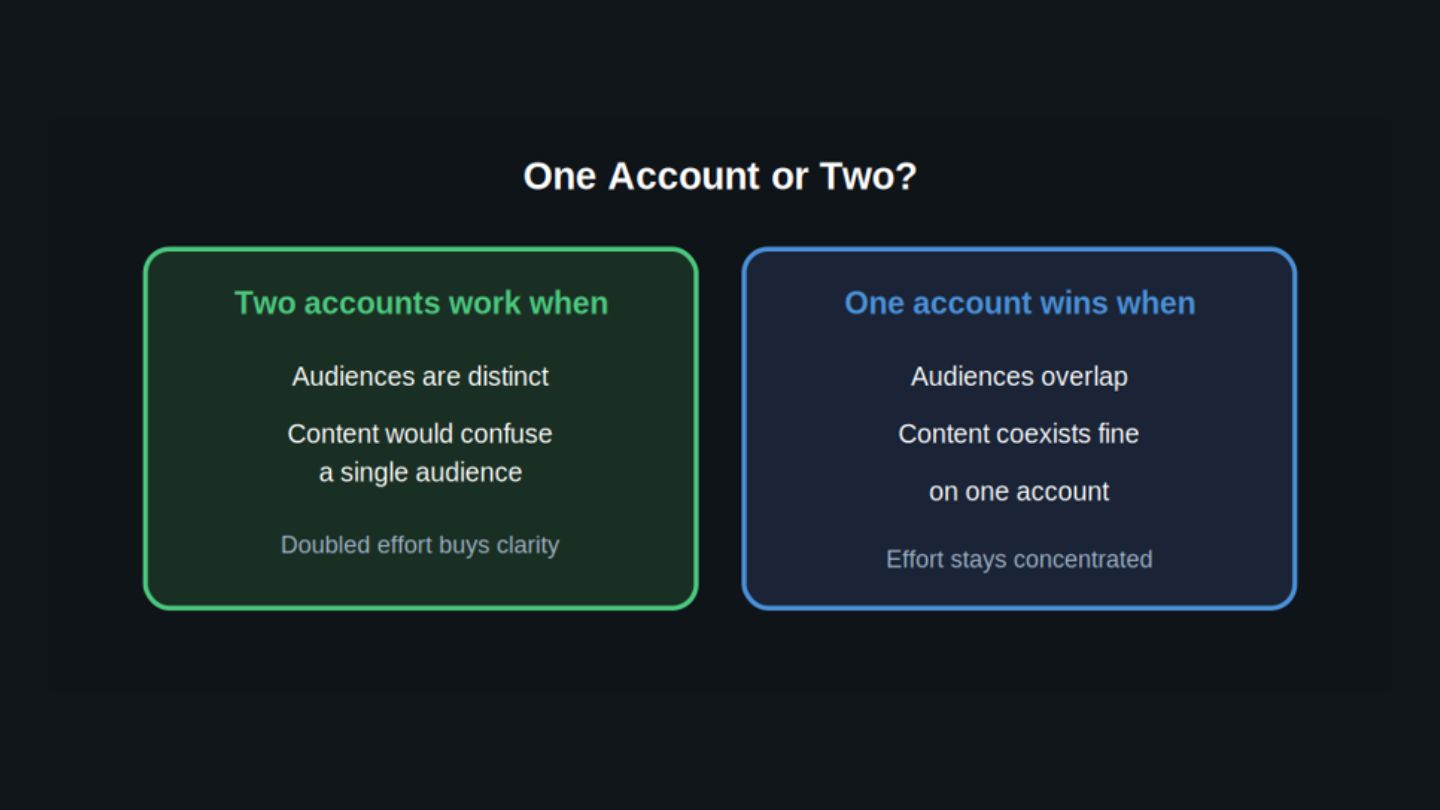
Separate only when audiences or content genuinely conflict; otherwise one focused account is stronger.
What Is the Confusion Test?
The confusion test is a simple way to decide: would combining everything on one account genuinely confuse the audience, or would it be fine? If a single audience would be confused or poorly served by the mix of content and purposes, that points toward separating. If they would be perfectly happy with it all in one place, that points toward staying unified.
This test cuts through the vague instinct that more accounts are better by forcing a concrete question about whether separation actually solves a real problem. Most of the time, content that seems like it needs its own account actually coexists fine with the rest, and the confusion it would supposedly cause is imagined rather than real. Being honest about this prevents splitting effort for no reason.
How Do You Make the Decision?
You make the decision based on your actual situation rather than a hope that more accounts mean more reach. Weigh the real cost of doubled effort against the genuine benefit of separation, and ask whether your audiences and content are truly distinct enough that one account cannot serve them well. If they are, a second account can be worth it; if they are not, one strong account wins.
It is also worth remembering that you can start with one account and add a second later if a genuine need emerges, rather than splitting prematurely. Beginning focused and separating only when a real reason appears keeps your effort concentrated until the evidence genuinely calls for splitting it, and when engagement on your main account dips, why Instagram engagement drops and how to fix it usually solves the problem without a second account.
Deciding Whether Two Accounts Are Worth It
A second Instagram account roughly doubles your work, so it needs a genuine reason rather than a vague hope for more reach. It makes sense when you have truly distinct audiences or content that would confuse each other on one account, and it does not when splitting simply divides your effort for no real gain. Apply the confusion test honestly, weigh the doubled cost against the real benefit, and remember you can always separate later if a genuine need emerges. More often than not, one strong, focused account beats two divided ones.
At The Ocean Marketing, we help businesses make sound Social Media Marketing decisions rather than spreading effort thin on assumptions. Whether you need help deciding on your account structure, building one account that genuinely performs, or a free SEO audit to see how your wider presence performs, our team can help. Contact us and let's put your effort where it actually works.
Frequently Asked Questions
Should my business have two Instagram accounts?
Only if you have genuinely distinct audiences or content that would confuse each other on one account. A second account doubles the work, so it needs a real reason. If your content coexists fine on a single account, one strong, focused account almost always beats two divided ones.
Do multiple Instagram accounts help you reach more people?
Not automatically. More accounts split the same finite effort, so each gets less of the attention that drives growth. Reach comes from engagement and quality, not from the number of accounts, which is why two weak accounts usually underperform one strong one.
Can I start with one Instagram account and split later?
Yes, and that is usually the wiser path. Beginning with one account keeps your effort concentrated while you build strength, and you can separate later if a genuine need for distinct audiences or content emerges. Splitting prematurely on an assumption is the more common mistake.