

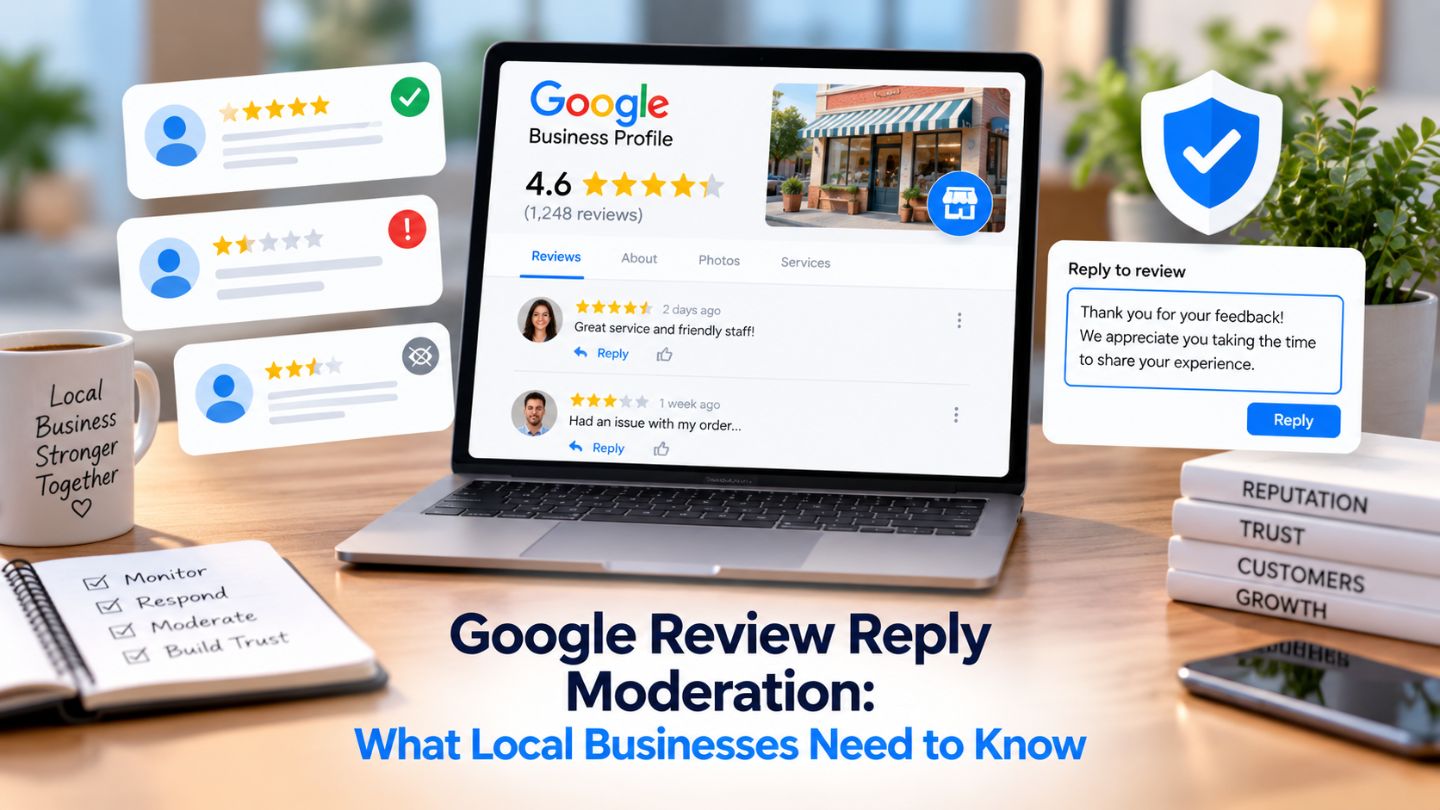
Most businesses know reviews are moderated and assume their own replies are not. They are, and a reply that gets removed takes your side of the conversation with it while the original review stays visible. This blog covers what actually triggers moderation on responses, why replies disappear without notification, and how to write ones that survive, because an unanswered complaint is considerably more damaging than a carefully worded answer.
Key Takeaways
- Business review replies are subject to Google’s content policies and can be restricted or removed if they violate them.
- Removed replies rarely come with a notification.
- Personal details in a reply are a common removal trigger.
- Promotional language in responses can get them filtered.
- A removed reply leaves the complaint standing unanswered.
Replies Are Moderated Too
The policies covering review content apply to responses as well. That surprises businesses who assume the owner reply field is theirs to use freely, and it explains replies that seem to vanish for no reason. There is usually a reason; it is simply not communicated.
The asymmetry is what makes it costly. If your reply is removed, the review remains, so a reader now sees a complaint with no response from the business. That looks worse than never having replied at all, because a reader cannot tell the difference between a reply that was removed and a business that ignored the customer.
Keeping a Record of What You Wrote

Because removals are silent, having a copy of each reply you posted makes it possible to tell whether something disappeared and what it said. A short log- review date, what you wrote, whether it is still visible- is enough.
That record is also useful if a pattern emerges, since it lets you compare what survived against what did not rather than guessing. It takes seconds per reply and saves reconstructing responses from memory later.
What Commonly Triggers Removal
Avoid sharing private or account-specific information such as addresses, order details, financial information, or other sensitive records. Personalizing a response is fine, but do not disclose information the customer did not make public. Privacy rules apply regardless of who disclosed the information first.
Promotional content is the second common trigger. Adding a discount code, linking to a booking page, or using the reply as advertising space treats the response field as marketing rather than communication, and it gets filtered accordingly. The reply should address the review, not pitch. Policy breaches on a profile can escalate beyond a single removal, which is worth understanding alongside the reasons a profile gets suspended.
Responding to Positive Reviews Too
Most businesses reply only to complaints, which leaves the majority of their reviews unacknowledged and makes the reply history look reactive. Brief responses to positive reviews demonstrate an active business and add your own descriptive language alongside the customer's.
They should stay short and specific rather than becoming a template repeated verbatim, since an identical reply pasted under twenty reviews reads as automated and adds nothing. Referencing what the customer actually mentioned takes seconds and reads as genuine. That descriptive language has a second use, since customer reviews can be turned into website content that works well beyond the profile.
The Tone Problem
Defensive or combative replies risk removal and, more importantly, damage you even when they survive. Disputing a customer's account point by point reads badly to every future reader, regardless of whether you are factually right, because the audience is not the reviewer.
A measured reply that acknowledges the experience, states briefly what you have done or will do, and offers a route to continue the conversation privately performs better on every axis. It is less likely to be removed, and it demonstrates to prospective customers how you handle problems. Understanding whether review responses genuinely help with search is worth knowing, though the credibility effect on readers is the stronger argument.
Write for the Next Customer
The reviewer has already formed their opinion. Everyone reading afterward has not, and they are the actual audience for anything you write.
Read More: The Psychology of Trust: Why 5-Star Ratings Aren't Always Best
Checking Whether Your Replies Are Still There
Because removal is largely silent, the only reliable method is periodic review. Look at your recent reviews as a member of the public would and confirm your responses are actually visible, rather than assuming they are because you wrote them.
Doing this monthly catches gaps while they still matter. It also surfaces the pattern: if replies of a certain type consistently disappear, you have learned something about what to avoid without needing an explanation. Reviewing why businesses sometimes lose reviews suddenly is useful context, since the same moderation systems affect both sides of the exchange.
Who Should Be Writing These
Review replies are public statements about your business, and letting whoever is free that afternoon write them produces inconsistent tone and occasional damage. Assigning ownership to someone who understands both the operational side and how the response reads publicly avoids that.
A short internal guideline covering what not to include, personal details, offers, and disputes over facts gives whoever holds the role something concrete to work from. It also means responses go out promptly rather than waiting for a decision about who should handle them.
Handling Reviews You Believe Are Illegitimate
The reply field is the wrong tool for disputing a review's authenticity. Arguing publicly that a reviewer is not a real customer looks defensive to readers and does nothing to remove the review, which requires the reporting process rather than a response.
The better sequence is to report through the proper channel and, separately, leave a brief neutral reply so the review is not left unanswered while the report is pending. That way the record shows a business responding professionally rather than one arguing with its customers. The process for handling a fake review properly is separate from the reply and should stay that way.
A Reply Template That Survives
The structure that consistently works is short: acknowledge the specific issue without repeating personal details, state briefly what has been done or what you are offering, and provide a general contact route rather than requesting information publicly. Three or four sentences is usually enough.
Avoid naming the customer, avoid mentioning anything that identifies their transaction, avoid links and offers, and avoid contradicting their account of events. That leaves less room than most businesses expect, and the constraint generally produces a better reply than a longer, more defensive one would have.
Responding Promptly Enough to Matter
A reply appearing months after the review reads as damage control rather than customer service, and by then most people who will read that review already have. Responding within a few days keeps the exchange looking like a live business handling something.
That requires monitoring rather than periodic checking, which for most businesses means notifications enabled and a named person responsible. The response itself takes two minutes; the delay usually comes from nobody knowing the review arrived.
Read More: Google Reviews & SEO: Advanced Strategies That Scale
What to Do When a Reply Disappears

If a response you wrote is no longer visible, the practical move is rewriting it more conservatively rather than resubmitting the same text. Strip anything identifying, remove any offer or link, and shorten it, since the shorter and more neutral version usually survives.
Repeatedly posting a reply that keeps getting removed achieves nothing and may draw attention to the profile. If a conservatively written version also disappears, the issue is likely with the review itself rather than your response, which is a different process entirely.
Keeping Your Side of the Conversation Visible
Review replies are moderated, removals are largely silent, and a removed reply leaves a complaint standing on its own. Keeping personal details out, keeping promotion out, staying measured regardless of provocation, and checking periodically that your responses are actually still visible are what keep your side of the record intact. Write for the customers reading later rather than the one who already left, and most of the risk of removal disappears along with the defensive tone.
At The Ocean Marketing, we help businesses manage Google Maps SEO, including the review handling that shapes how a business looks to anyone checking. Whether you need help building a response process, auditing what is currently visible on your profile, or a free SEO audit to see where your local presence stands, our team can help. Contact us and let's make sure your responses are doing their job.