
Responding to reviews matters for local businesses, and as review volume grows, the temptation to automate those responses grows with it. Automated responses save time; manual responses carry genuine care. The right balance depends on your volume, your resources, and what you are willing to trade. This article compares the two, covers where each makes sense, and explains why a purely automated approach often costs more in trust than it saves in time.
Key Takeaways
- Manual responses carry genuine care; automated ones save time.
- Generic automated replies can read as impersonal and hurt trust.
- Negative reviews almost always need a genuine human response.
- A hybrid approach often balances efficiency and authenticity.
- The goal is responses that feel genuine, however they are produced.
What Does Each Approach Offer?
Each approach offers a different trade-off: manual responses offer authenticity, automated ones offer efficiency. Manual review responses are written by a person for a specific review, so they can acknowledge the actual details of what the customer said, while automated responses use templates or AI to generate replies at scale, saving enormous time when review volume is high.
Both have a legitimate place, and the trade-off is real rather than one being simply better. A business drowning in reviews cannot hand-write every response, and a business that automates everything risks replies that read as hollow. Responding at all matters first, and Google review responses can help with SEO on top of the trust they build with customers.
Why Do Generic Automated Replies Hurt Trust?
Generic automated replies hurt trust because customers notice when a reply could have been sent to anyone. A response that does not engage with what the person actually said can do more harm than no response at all, since it signals that the business is going through the motions rather than genuinely caring.
This is the hidden cost of full automation: time saved at the expense of the trust that responding was supposed to build. A review response exists partly to show prospective customers how the business treats people, so a visibly generic reply sends the wrong message to everyone reading it. Earning genuine reviews and handling them well is a longer game, and advanced Google Reviews and local SEO strategies are what make it scale.
A Hollow Reply Can Be Worse Than Silence
A visibly generic automated response can signal indifference more loudly than no reply would. If a response reads as going through the motions, it works against you.
Why Do Negative Reviews Need a Human?
Negative reviews need a human because a generic automated reply to a genuine complaint is almost always a mistake. Someone with a real grievance who receives an obviously templated response feels unheard, which can deepen the damage, and everyone reading sees a business that does not take problems seriously.
Negative reviews are exactly where genuine, thoughtful, human responses matter most, acknowledging the specific issue and responding with real care. The stakes for how you are perceived are highest here, and knowing why Google review replies get removed keeps a careful response from vanishing after you have written it.
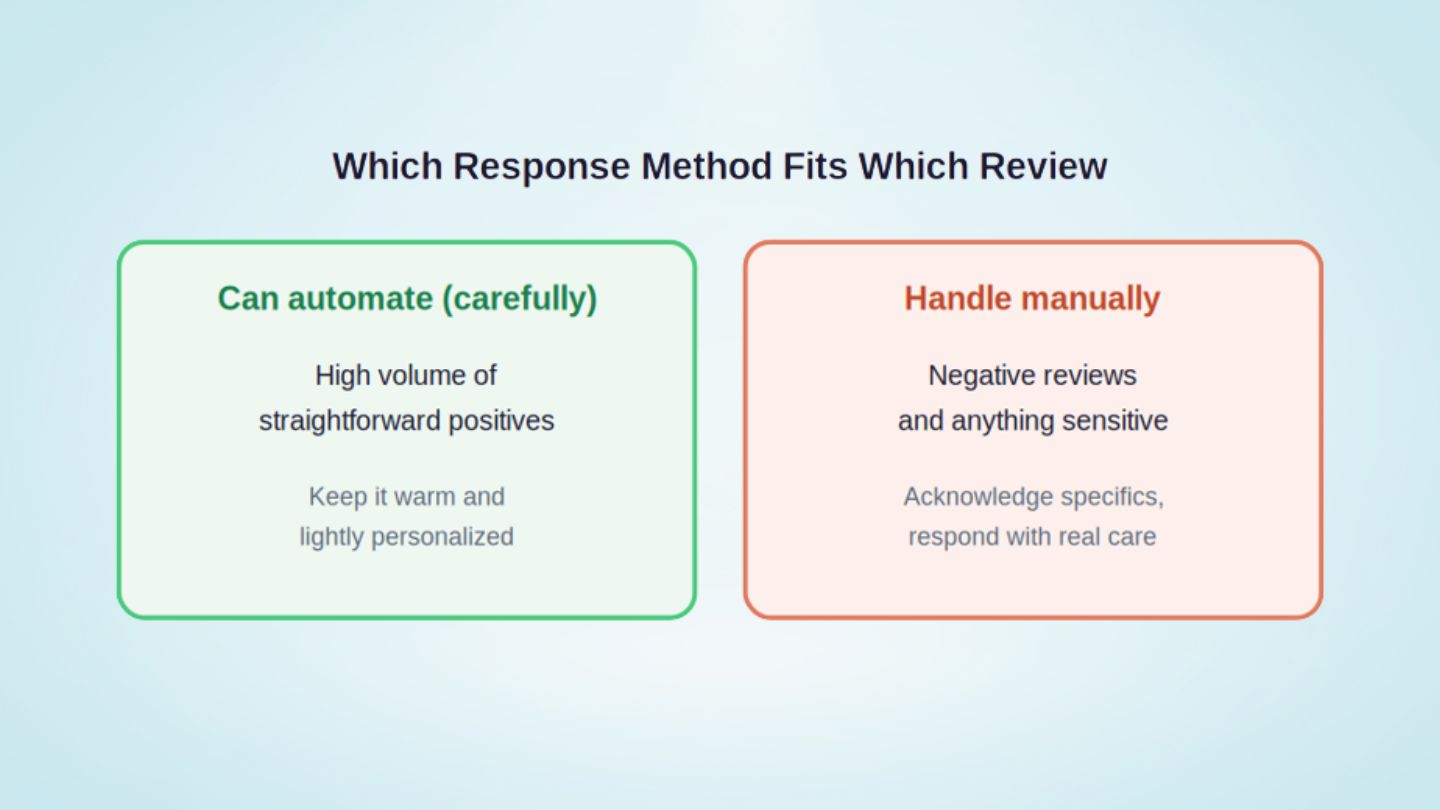
Automation suits high-volume positives; negative and sensitive reviews need genuine human attention.
Where Does Automation Fit?
Automation fits best for high volumes of straightforward positive reviews, where a warm response is appropriate, and the sheer number makes individual replies impractical. Even here, the goal is responses that feel genuine rather than obviously mass-produced, so automation that allows some personalization beats purely generic templates.
The sensible use of automation is to handle the volume that would otherwise go unanswered, freeing human attention for the responses that genuinely need it. Used this way, automation extends your capacity to respond rather than replacing genuine engagement, and for the reviews that are questionable or damaging, human judgment remains essential, since removing a fake review from a Google Business Profile is a process no template can handle.
Why Is a Hybrid Approach Usually Best?
A hybrid approach is usually best because it balances efficiency against authenticity: automate or streamline responses to high-volume positive reviews while handling negative reviews and anything sensitive personally. This uses automation where it is low-risk and reserves genuine human attention for where it matters most.
The guiding principle is that responses should feel genuine regardless of how they are produced. If automation helps you respond to more reviews while keeping replies that feel real, it is serving you well; if it produces hollow replies that undermine trust, it is costing more than it saves. Matching the method to the review, and never letting efficiency hollow out authenticity, is what makes the hybrid approach work.
Balancing Efficiency and Genuine Care

Automated and manual review responses trade efficiency against authenticity, and the right balance depends on your volume and what you are willing to trade. Manual responses carry genuine care and are essential for negative reviews, where a generic reply does real damage. Automation can sensibly handle high volumes of straightforward positive reviews, as long as the replies still feel genuine. For most businesses, a hybrid works best, automating the low-risk volume while reserving real human attention for what matters.
At The Ocean Marketing, we help businesses manage Google Maps SEO, including review strategies that stay authentic as volume grows. Whether you need a response approach that scales without going hollow, help handling difficult reviews, or a free SEO audit to see where your local presence stands, our team can help. Contact us and let's keep your review responses genuine.
Frequently Asked Questions
Should I automate my Google review responses?
You can automate carefully for high volumes of straightforward positive reviews, as long as the replies stay warm and feel genuine. Negative reviews and anything sensitive should be handled personally, because a generic reply there does real damage. A hybrid of both usually works best.
Do automated review responses hurt your business?
They can, when they read as generic and impersonal, because that signals indifference to everyone reading. Automation that allows personalization and is reserved for straightforward positives avoids this. The harm comes from hollow replies, not from efficiency itself.
How should I respond to a negative review?
Personally and specifically. Acknowledge the actual issue, respond with genuine care, and avoid anything that reads as templated. A thoughtful human response to a complaint shows every prospective customer how you handle problems, which matters more than the single reply itself.