

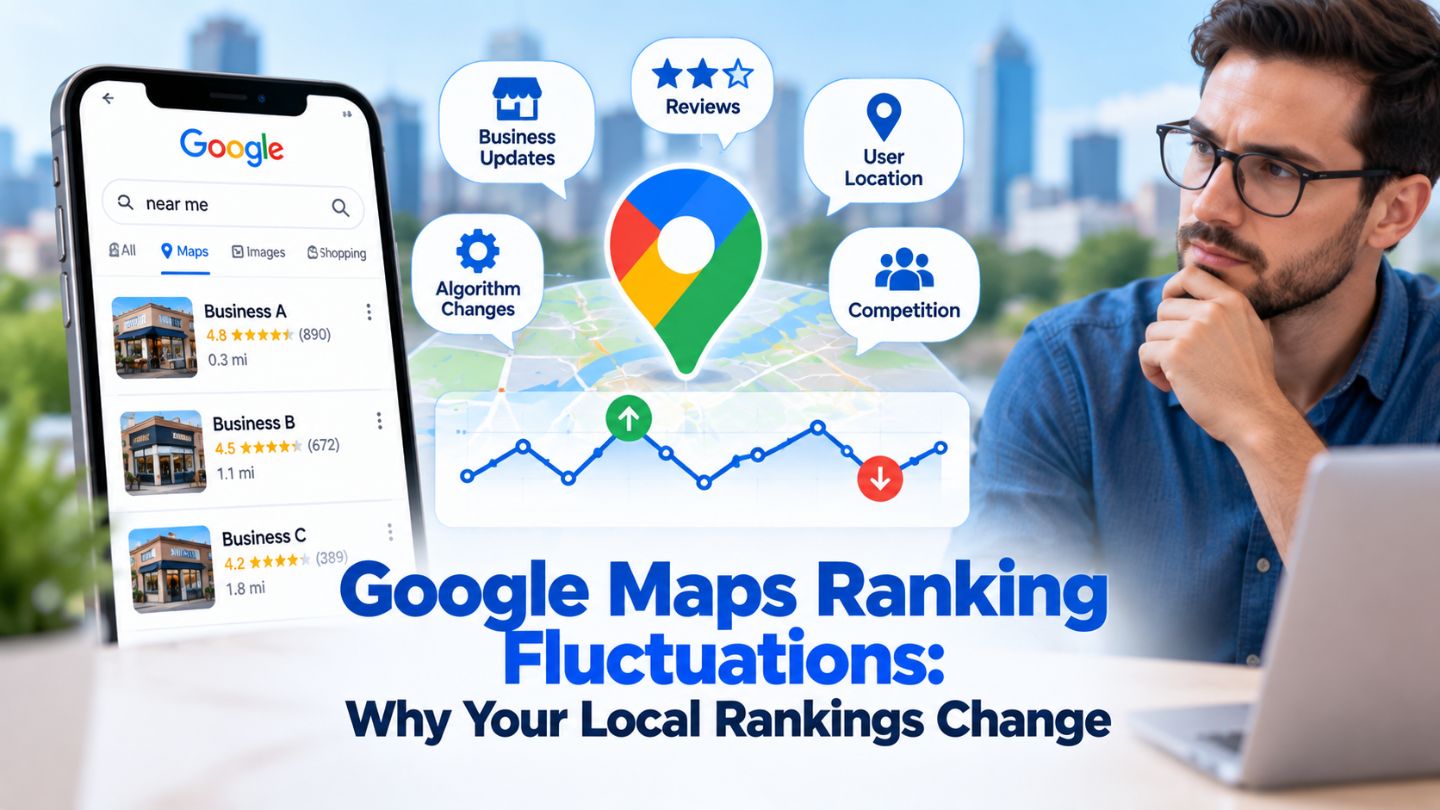
Local rankings move around more than most business owners expect, and a position that sat comfortably at the top for weeks can slip without anything obvious changing on your end. Some of that movement is normal and not worth reacting to; some of it signals a genuine problem. Knowing the difference prevents both panic and neglect. This blog covers why local rankings fluctuate, which movements are noise, which are signal, and what actually stabilizes a ranking over time.
Key Takeaways
- Local ranking movement is normal and often not worth reacting to.
- The searcher's location changes results more than most owners realize.
- Competitor activity and review velocity cause genuine fluctuation.
- Reacting to normal noise can destabilize a ranking further.
- Consistency over time stabilizes rankings more than quick fixes.
Why Local Rankings Move Constantly
Local search is more volatile than traditional search by design, because it factors in the searcher's exact location, the time, and a constantly shifting competitive field. Two people searching the same term from different points a mile apart can see different results, which means your ranking is not a single fixed position but a range that varies by who is searching and from where.
This is the first thing to internalize: there is no one true ranking to defend. What looks like a drop might be you checking from a different location than usual, or the local field reshuffling in a way that has nothing to do with your business. Understanding how proximity, relevance, and prominence work in Google Maps SEO explains why the number is inherently less stable than a traditional ranking.
The Location Factor People Forget

The single most common source of apparent fluctuation is the searcher's location, and it is the one owners most often overlook. Checking your ranking from your office, your home, and your phone on mobile data can produce three different positions, none of which is wrong. Proximity is a ranking factor, so your position genuinely changes as the searcher moves.
This means the way you check your own ranking matters enormously. Casually searching your term and panicking at the result ignores that you are seeing one location's version of it. Consistent tracking from a fixed reference point, rather than ad hoc checks from wherever you happen to be, is the only way to tell real movement from the noise your own location introduces.
Stop Checking From Your Phone
Your phone knows exactly where you are and personalizes accordingly. It is the least reliable way to gauge your true ranking, even though it is the most tempting.
Read More: Search Personalization: How User History Affects Rankings
What Counts as Genuine Signal
Some fluctuation does reflect real change worth understanding. A competitor who suddenly accumulates reviews, updates their profile, or starts actively managing their presence can move up and push you down. A change to your own profile, intended or accidental, can shift your position. A genuine algorithm update reshapes the field for everyone.
The way to distinguish these from noise is duration and pattern. A single day's dip that recovers is almost always noise. A steady decline over several weeks, or a sudden drop that holds, is signal worth investigating. Reacting to the first kind as though it were the second is how owners create problems that were not there, which connects to why advanced Google Reviews and local SEO strategies for growth.
Why Reacting to Noise Backfires
The instinct when a ranking dips is to change something, and with normal fluctuation that instinct causes harm. Editing your profile, adjusting your categories, or overhauling your approach in response to a temporary dip can introduce genuine instability, because significant profile changes can themselves trigger a reassessment of your ranking.
This creates a cycle where reacting to noise produces real movement, which prompts more reacting, which produces more movement. Businesses that constantly tinker with their profile in response to every fluctuation tend to have less stable rankings than those that set it up correctly and leave it alone. Restraint is genuinely a strategy here, not just inaction. Categories are the setting people reach for first, so it helps to know how business categories affect map visibility before changing one.
What Actually Stabilizes a Ranking
Stable rankings come from consistency over time rather than from quick interventions. A complete, accurate profile that does not keep changing, a steady flow of genuine reviews rather than bursts, consistent business information across the web, and sustained relevance signals all build a position that holds up through the normal churn.
The businesses with the steadiest local rankings are usually the ones that got the fundamentals right and then maintained them patiently, rather than the ones chasing every fluctuation with a new tactic. This is slow, unglamorous work, and it is what actually produces the stability that reactive tinkering never will. Understanding what the Google 3 Pack is and how to rank higher in local search matters far more than reacting to daily movement.
When Fluctuation Is Worth Investigating

There are clear cases that warrant a real look. A sustained decline over weeks rather than days. A sudden drop that does not recover. A ranking that falls right after you made a change, which points at the change as the cause. A competitor who has clearly done something specific to overtake you. These are signals, and investigating them is appropriate.
Even then, the response should be measured and diagnostic rather than reactive. Work out what actually changed before changing anything yourself, since the most common cause of a real drop is either a competitor's genuine improvement or an inconsistency that crept into your own information. Both have specific fixes; neither is solved by anxious tinkering.
How to Track Rankings Meaningfully
Because casual checking from your own device is so unreliable, tracking rankings meaningfully requires a consistent method. That means checking from a fixed reference point rather than wherever you happen to be, tracking over time rather than reacting to single snapshots, and looking at the trend rather than any individual day's position. Consistency in how you measure is what makes the measurement worth anything.
The goal is to be able to distinguish a real, sustained change from the normal daily churn, which is only possible with a consistent baseline to compare against. Ad hoc checks produce ad hoc panic; systematic tracking produces the ability to tell when something actually happened. The method matters as much as the checking, because inconsistent measurement generates false signals that lead to exactly the reactive tinkering that destabilizes rankings.
Read More: What Are the Benefits of Regular Rank Tracking for SEO Growth?
The Competitor Dimension
A good deal of local ranking movement is driven by what competitors do rather than by anything you did. A competitor who starts actively managing their profile, accumulating reviews, or improving their presence can shift the whole local field, moving you down without any change on your end. This is genuine movement, but the cause is external, and the response is different from fixing something you broke.
Recognizing when a change was driven by competitor activity rather than your own helps you respond appropriately. If a competitor genuinely improved, the answer is to strengthen your own fundamentals rather than to panic-edit your profile, which would only add self-inflicted instability to a change that was already external. Understanding the competitive dynamics of your local field is part of reading fluctuation correctly rather than misdiagnosing it. Strengthening fundamentals usually starts with local citation building, which is slow and hard for a competitor to undo.
Living With Movement Without Overreacting
Local ranking fluctuation is mostly normal, driven by the searcher's location and a constantly shifting field, and the biggest mistake is treating routine noise as a crisis. Check your ranking consistently rather than from wherever you happen to be, distinguish a temporary dip from a sustained decline, and resist the urge to overhaul your profile every time the number moves. Genuine drops that hold are worth investigating calmly; the daily churn is worth ignoring. Stability comes from consistency over time, not from reacting to every movement.
At The Ocean Marketing, we help businesses build Google Maps SEO that holds up through the normal volatility of local search. Whether you need help telling noise from a genuine problem, stabilizing a ranking that has actually slipped, or a free SEO audit to see where your local presence stands, our team can help. Contact us and let's work out what your rankings are actually doing.