

Older content that is no longer performing presents a choice: improve it or remove it. Content refresh updates and strengthens a page; content pruning deletes or consolidates it. Both are legitimate, and choosing the wrong one wastes effort or throws away value. The decision depends on whether the page still has potential worth investing in, and this article gives you a way to make that call with confidence rather than guessing.
Key Takeaways
- Refresh improves a page; pruning removes or consolidates it.
- The choice depends on whether the page still has genuine potential.
- Refresh pages with value worth recovering; prune pages without it.
- Pruning weak content can strengthen the site as a whole.
- The decision should be deliberate, not a reflex in either direction.
What Is the Difference Between Pruning and Refreshing?
The difference is that a refresh invests in a page while pruning retires it. Content refresh means taking an existing page and improving it, updating outdated information, adding depth, and improving clarity until it competes again. Content pruning means removing a page entirely or consolidating it into another, accepting that it is not worth keeping as it stands.
Both are normal parts of maintaining a site over time, since not every page stays valuable forever. The skill is matching the approach to the page, because refreshing a page with no potential wastes effort while pruning a page that could have been recovered throws away value. Understanding the types of content decay and how to fix them helps clarify which situation you are actually in.
When Should You Refresh a Page?
You should refresh when a page has genuine potential that is not being realized: the topic still matters, the page once performed or could, and the reason it is underperforming is fixable. Outdated information, thin depth, or poor clarity are all problems a refresh solves, recovering the value the page is capable of delivering.
The sign that refresh is worth it is that the underlying topic is still valuable and the page's problems are addressable. This is often more efficient than creating new content, since the page already exists and may retain some authority, and extending the value of existing work connects to repurposing one blog into multiple marketing assets as another way to get more from what you have.
Refresh What Can Still Win
If the topic still matters and the problems are fixable, refresh. The page has value worth recovering rather than discarding.
When Should You Prune a Page?
You should prune when a page no longer has genuine potential: the topic is no longer relevant, the content cannot realistically be made to compete, or the page serves no real purpose. Keeping such pages does not help, and removing or consolidating them can actually strengthen the site by focusing its authority on the content that matters.
This is counterintuitive for anyone who assumes more pages is always better, and a site cluttered with weak, irrelevant pages can perform worse than a leaner one. Removing content that drags rather than contributes is a legitimate improvement, not a loss, which is why content pruning can improve rankings by deleting pages rather than harming them.
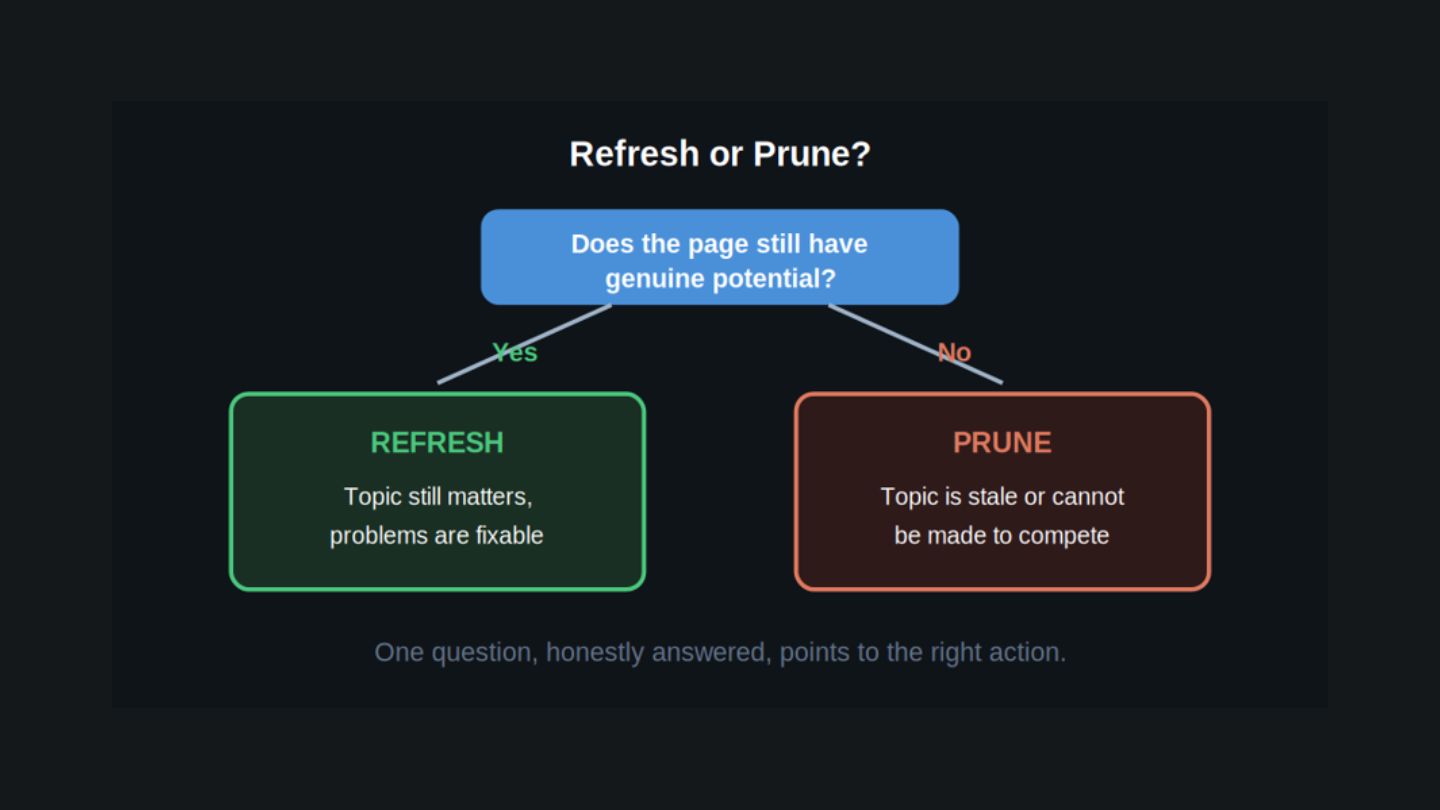
The deciding question is whether the page has genuine potential worth investing in.
How Do You Tell the Difference?
You tell the difference by honestly assessing potential and looking at why the page is underperforming. If the cause is something a refresh fixes- outdated information, thin content, poor clarity- there is potential to recover. If the cause is that nobody wants the topic anymore or competitors have made the page obsolete in a way you cannot match, that is a pruning signal.
Defaulting to either keeping everything or deleting aggressively is what goes wrong; the diagnosis should point to the decision. Part of that assessment is judging whether the page is genuinely thin, because thin content gets penalized either way, and a thin page with a valuable topic is a refresh candidate while a thin page with no audience is a pruning one.
Why Does Pruning Strengthen a Site?
Pruning strengthens a site because weak, irrelevant pages dilute its authority and clarity, giving both visitors and search engines more noise to wade through. Removing that noise concentrates the site's strength on the content that genuinely earns its place, which is why a leaner site of strong pages can outperform a larger padded one.
This makes pruning a positive act of focus rather than just cleanup. A leaner site of strong, relevant pages presents a clearer picture of what you are about and what you are authoritative on, and deciding what to remove is as much a part of content strategy as deciding what to create. When refreshing, choosing whether a page needs more depth or simply clearer writing connects to content depth versus clarity and what improves rankings.
Making the Call With Confidence

Content pruning and content refresh are both legitimate responses to underperforming content, and the right one depends entirely on whether the page has genuine potential worth investing in. Refresh pages where the topic still matters and the problems are fixable, since the effort recovers real value. Prune pages that are no longer relevant or cannot be made to compete, because removing them focuses the site's authority rather than diluting it. Make the decision deliberately by honestly assessing potential, and both your strong pages and your overall site will perform better for it.
At The Ocean Marketing, we help businesses make the most of their Content Writing through deliberate decisions about what to improve and what to retire. Whether you need underperforming content audited, a refresh-or-prune call made, or a free SEO audit to see how your content performs, our team can help. Contact us and let's get your content working as a whole.
Frequently Asked Questions
Is it bad for SEO to delete pages?
Not when done deliberately. Removing weak, irrelevant pages that cannot compete can strengthen a site by concentrating its authority on content that matters. The risk is deleting pages that had recoverable value, which is why the decision should rest on an honest assessment of potential.
How do I know whether to refresh or prune a page?
Ask whether the page has genuine potential worth investing in. If the topic still matters and the problems are fixable, refresh it. If the topic is no longer relevant or the page cannot be made to compete, prune it. The reason it is underperforming usually points to the answer.
What is content consolidation?
Consolidation merges several weaker pages on similar topics into one stronger page, then redirects the old URLs. It captures the value scattered across thin pages while removing the clutter of having many, sitting between a straight refresh and an outright deletion.