
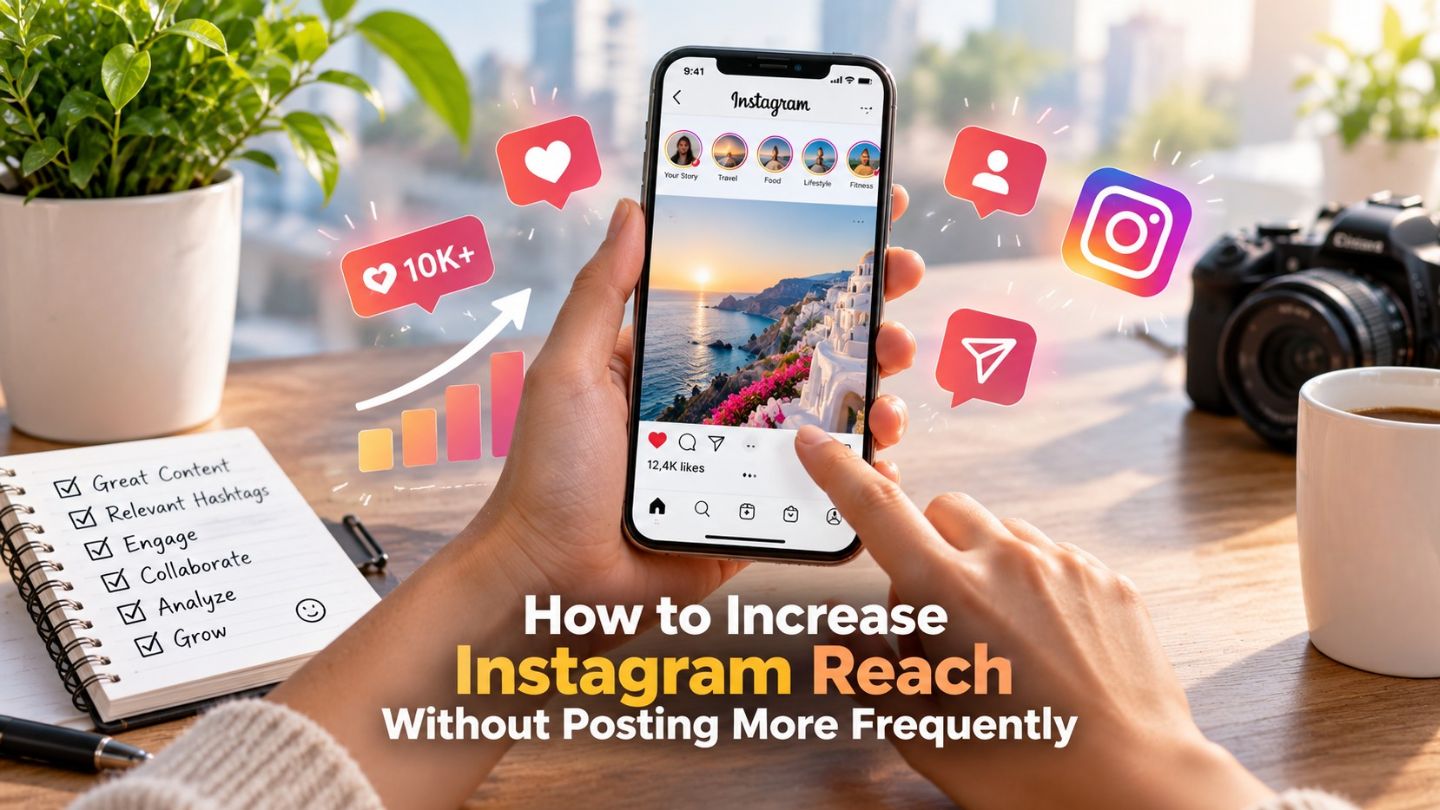
The standard advice for weak reach is to post more often, which is both exhausting and frequently wrong. Reach depends on how strongly individual posts perform, but posting frequency can also influence total reach by creating more opportunities for discovery. The goal is to increase cadence only when content quality can be maintained. This blog covers what actually determines distribution, the levers that raise reach without raising output, and where posting frequency genuinely does matter.
Key Takeaways
- Strong early engagement can help distribution, but reach develops from multiple signals over time.
- Shares and sends are especially important discovery signals, while saves, likes, watch behavior, comments, and other interactions can also contribute to performance.
- Posting more does not guarantee better results if quality drops, even though a sustainable increase in posting frequency can create additional opportunities for reach.
- Format choice and posting frequency both influence reach, and the best mix depends on the audience, content type, and ability to maintain quality.
- Existing high performers can be extended rather than replaced.
How Distribution Is Actually Decided
A new post is shown to a small portion of your audience first. How that group responds, whether they watch, save, share, or scroll past, determines whether it gets shown more widely. Reach is therefore an outcome of early performance rather than a fixed property of your account size.
This explains why posting volume does not reliably increase reach. Each additional post enters the same test, and weak posts that fail it do not simply reach fewer people; they contribute to a pattern the system learns from. Ten mediocre posts can leave an account worse positioned than three strong ones.
Which Signals Carry the Most Weight

Likes are the cheapest possible interaction and are weighted accordingly. Saves indicate the content was worth keeping, and shares indicate it was worth showing someone else, both of which are far stronger evidence of value and are treated as such.
That reframes what content should be designed to do. A post that someone will save, a reference, a checklist, something they will want again, outperforms a post that earns a quick tap of approval. Understanding which engagement signals actually matter most changes what you optimize for, and usually improves reach as a side effect.
The First Hour Is the Whole Game
Because early response drives distribution, anything that improves engagement in the first hour has an outsized effect. Posting when your specific audience is actually active, rather than at a time drawn from a generic best-practice chart, is the simplest version of this.
Responding to comments quickly matters for the same reason: replies are interactions, and an active comment thread in the first hour signals that the post is worth showing to more people. Publishing and walking away wastes the window that determines everything afterward.
Check Your Own Active Hours
Insights show when your followers are online. That data beats any general recommendation, and most accounts find their genuine peak differs from the one they had been posting at.
Read More: How Instagram Tests Your Content Before Pushing It Viral
Collaboration Extends Reach Without New Content
Publishing a post jointly with another account places it in both audiences, which multiplies reach without producing anything additional. For businesses with partners, suppliers, or complementary local services, this is an underused mechanism that costs nothing beyond coordination.
The pairing has to be genuine, since an audience that has no interest in the other account will not engage, and weak engagement caps distribution as usual. Where the overlap is real, it is one of the few levers that increases reach without increasing output. The mechanics of Instagram collab posts are worth understanding before you arrange one.
Format Choice Moves Reach More Than Frequency
The platform distributes formats unevenly, and choosing the wrong one for your content caps reach before quality even enters the picture. Video content generally reaches further than static; carousels earn more time-on-post than single images; content that keeps people on the platform outperforms content pushing them away.
Matching format to what the content actually is produces better results than posting more of whatever is easiest to make. A comparison suits a carousel, a process suits video, a single striking result suits an image. Reviewing how Reels and carousels differ for growth is worth doing before adding to the schedule.
Audience Quality Affects Reach
An audience padded with inactive or purchased followers depresses engagement rate, which directly suppresses distribution. A smaller genuinely interested audience outperforms a larger passive one, because the early response that drives reach comes from people who actually care.
This is why buying followers is counterproductive beyond the credibility problem. It permanently worsens the ratio the platform uses to decide whether content is worth showing more widely, and the damage is difficult to undo without losing the followers you paid for. It is also worth knowing that the platform runs its own checks, which is the subject of how Instagram handles fake followers.
Extending What Already Worked
Most accounts have a handful of posts that substantially outperformed the rest, and then moved on from them. Those are the clearest signal available about what your specific audience responds to, and they can be extended rather than treated as one-offs.
That might mean covering the same subject from another angle, turning a strong static post into a Reel, or building a follow-up that answers the questions the original attracted in the comments. This raises average performance without raising output, which is the entire goal. Working out why engagement sometimes drops despite consistent posting often points to the same underlying issue.
Stories Support the Main Feed
Stories do not carry the same discovery weight as feed posts, and they keep an account active in front of its existing audience, which supports the early engagement that feed posts depend on. An account that appears regularly in Stories has an audience more likely to respond quickly when something is posted.
They are also cheaper to produce, which makes them a reasonable way to maintain presence without diluting the quality of feed content. Using them to hold attention between stronger posts is a better use than treating them as another publishing obligation.
When Frequency Genuinely Matters
There is a floor. An account posting once a month has too little data for the system to learn from and too little presence for an audience to form a habit around. Very infrequent posting gives an account fewer opportunities to reach people. For many accounts, increasing from occasional posting to a sustainable weekly cadence can improve overall visibility, provided quality remains strong.
Above that, the returns depend entirely on whether quality holds. Going from two strong posts a week to five weak ones is a downgrade. Going from two to three, with the third genuinely as good, is an improvement. The honest question is whether you can sustain the standard at the higher cadence, and for most small teams the answer is no.
Diagnosing a Sudden Drop
When reach falls sharply rather than gradually, the cause is usually identifiable: a change in posting time, a format shift, a run of weaker content, or occasionally a technical issue with the account. Reviewing what changed in the fortnight before the drop is more productive than assuming a penalty.
It is also worth checking whether the drop is in reach or in impressions from a specific source, since those point to different causes. A fall in non-follower reach suggests content is not passing the early test; a fall in follower reach suggests an audience that has stopped engaging.
Being Realistic About What Reach Is Worth

Reach is an intermediate metric, and an account can improve it substantially while producing no additional business. Content designed purely to travel widely often attracts an audience with no interest in what you sell, which inflates the number and nothing else.
The more useful question is whether reach among people who could plausibly buy is improving. Follower quality, profile visits from relevant searches, and inquiries arriving through the platform answer that better than a raw impressions figure ever will.
Read More: How to Turn Instagram Profile Visits Into Website Traffic
Raising Reach Without Raising Output
Reach responds to how content performs early, not how often it appears. That makes the productive levers different from the obvious ones: design for saves and shares rather than likes, post when your audience is actually online, be present in the first hour to feed the comment thread, match format to content, and extend the posts that already worked instead of abandoning them. Frequency matters below a floor and stops helping the moment it starts costing quality.
At The Ocean Marketing, we build social media marketing around the signals that actually drive distribution rather than output targets. Whether you need help diagnosing weak reach, restructuring content around what your audience responds to, or a free SEO audit to see how your wider presence performs, our team can help. Contact us and let's find out what's capping your reach.