
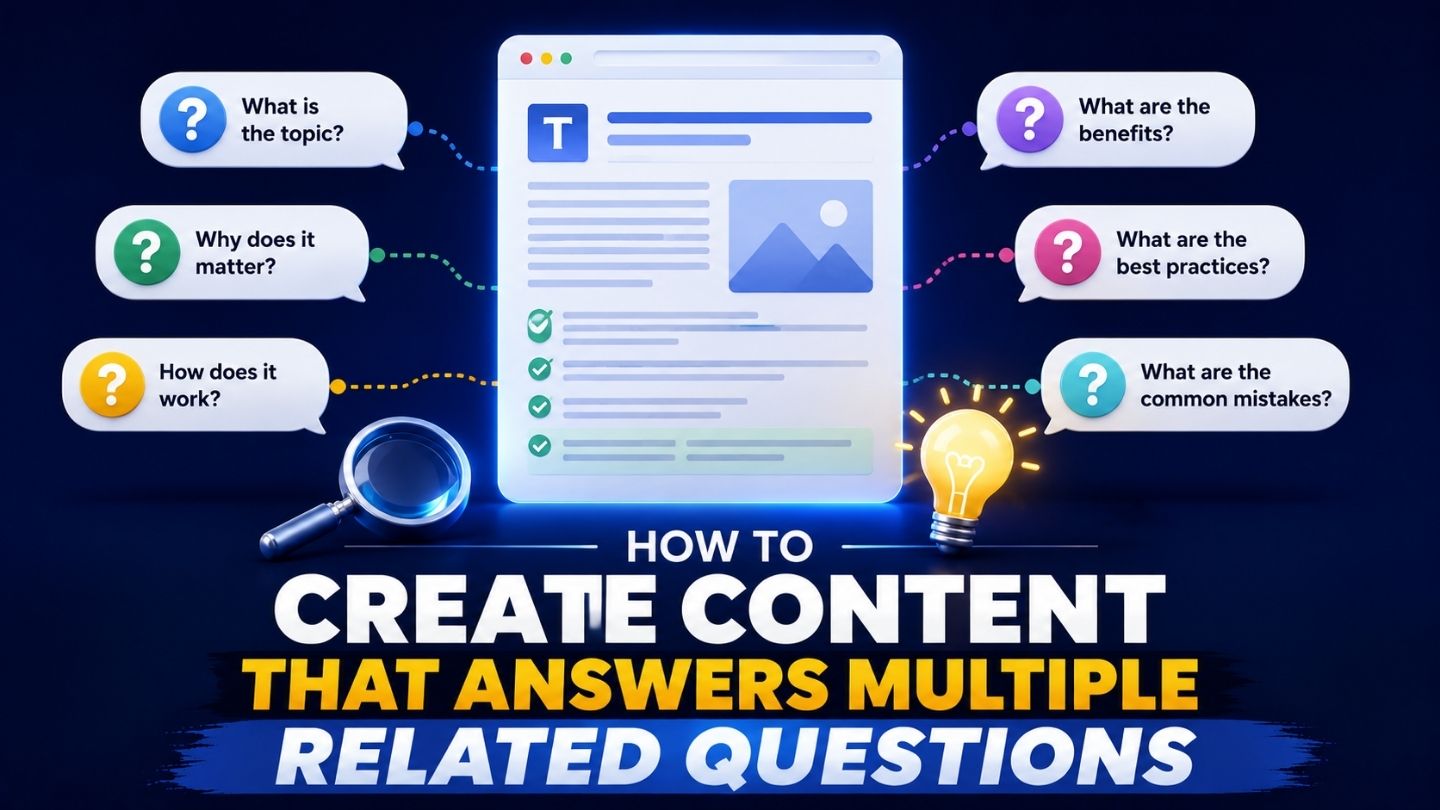
A page built around a single question competes against every other page built around that same question, and there are usually a lot of them. A page that genuinely answers several related questions someone would naturally ask in sequence becomes something harder to replace, because it saves the reader from opening five tabs. This blog covers how to identify the question clusters worth combining, structure a page so each answer stays clean and extractable, and avoid the sprawling, unfocused result that happens when this goes wrong.
Key Takeaways
- Related questions cluster naturally around how someone actually researches a topic.
- Combining them well reduces the need to visit multiple sources.
- Each answer still needs to stand alone for both readers and AI extraction.
- Poor combination produces sprawl rather than genuine comprehensiveness.
- Internal structure, not just content, determines whether this works.
How This Changes the Way You Plan Content Calendars
Planning around question clusters rather than individual keywords changes what a content calendar actually looks like. Instead of a list of thirty disconnected keyword targets, a calendar organized around clusters groups related pieces together, sometimes as sections of one page, sometimes as a small linked set, which makes the overall coverage strategy visible in a way a flat keyword list never does.
This also makes gaps easier to spot during planning rather than after publishing. A calendar organized by cluster makes it immediately obvious when a topic has definitional and process content planned but nothing addressing comparison or troubleshooting, a gap that's much harder to notice when every piece is tracked as an isolated keyword target with no visible relationship to the others.
Why Single-Question Pages Compete So Hard

If your page answers exactly one narrow question, it's competing directly against every other page that answers that same narrow question, and differentiation gets difficult when the answer itself is fairly settled. There's only so many ways to explain what something is before every version starts sounding interchangeable, and ranking becomes largely a function of domain authority rather than genuine content quality.
Pages that competently answer a cluster of related questions someone would naturally ask in sequence sidestep this somewhat, because fewer competitors have bothered to build the complete cluster, and the value to the reader is qualitatively different: not needing to leave and search again for the next logical question is worth something real, even when each individual answer isn't dramatically better than a single-question competitor's.
Using Customer Support Data as a Cluster Source
Support tickets and customer service transcripts are an underused source for identifying genuine question clusters, because they capture the actual sequence of questions a real, often frustrated, person asks when trying to solve a specific problem, which tends to be more reliable than inferring a sequence from keyword tool suggestions alone.
Reviewing a sample of support conversations around a topic, noting the order questions typically arise in, often reveals a cluster structure that matches real usage far more precisely than a purely search-driven research process, since it reflects genuine confusion points rather than assumed ones.
Finding the Questions That Actually Cluster
Not every related question belongs on the same page, and forcing unrelated ones together produces sprawl rather than genuine value. The questions worth combining are the ones that follow naturally from each other in a real person's research process; someone who asks the first question is highly likely to ask the second one next, in more or less that order.
Look at your own Search Console data for queries that already land on the same page despite the page only explicitly answering one of them; that's a signal the questions are already clustering in practice. Look at forum threads and comment sections in your industry for the natural follow-up questions people ask after getting an initial answer. Those sequences, not a keyword tool's list of vaguely related terms, are the real cluster.
Structuring So Each Answer Still Stands Alone
The temptation once you've identified a cluster is to write one flowing narrative that moves through all the questions together, which reads pleasantly and extracts terribly. Each question deserves its own clear heading and a self-contained answer in the first sentence or two beneath it, because both human skimmers and AI systems need to be able to grab just the piece relevant to their specific question. This same self-contained-passage principle is covered from the search-demand side in what TOFU keywords actually represent, matching structure to where a reader sits in their research.
This means resisting the urge to write "as mentioned above" or "building on the previous point," phrasing that makes sense in a linear read and breaks when a section gets extracted or when a reader jumps straight to the third question via a table of contents. Each section should function correctly whether someone reads the whole page top to bottom or lands directly on one heading from a search result.
A Table of Contents Isn't Optional Here
For a page covering several questions, a jump-to-section table of contents near the top respects readers who already know which specific question they came for and don't want to scroll past the ones they don't.
How Many Questions Is Too Many
There's a real ceiling here, and pages that try to answer every conceivably related question become unfocused rather than comprehensive. If the cluster starts including questions that only a small fraction of your audience would ask after the first one, you've drifted from a genuine research sequence into an exhaustive list built for its own sake, which serves nobody particularly well.
A useful test: could you describe the page's scope in one sentence that still sounds specific? "Everything about choosing, installing, and maintaining a home water filter" is focused. "Everything about water filters" is not, and will produce a page trying to be several different pages at once, none of them particularly well. If the sentence starts sounding like a category description rather than a specific research journey, narrow it.
Where This Overlaps With Query Templates
This approach connects directly to thinking in query shapes rather than isolated keywords: definitional, comparative, process, troubleshooting, applied to a single core topic in sequence. A page addressing what something is, how it compares to the main alternative, and how to actually do it, in that order, mirrors how a real research journey typically unfolds and gives you a natural structure to build the cluster around rather than guessing at what belongs together.
Understanding how topical authority builds through comprehensive coverage reinforces why this matters beyond any single page: a site that consistently anticipates and answers the next logical question, rather than stopping at the first one, builds a different kind of trust with both readers and search systems over time.
Testing Whether It Actually Works
The real test of a multi-question page isn't whether it ranks for the primary term; it's whether it reduces bounce-and-research behavior- someone landing, finding their first answer, and then leaving to search the follow-up question elsewhere rather than finding it right there. Session data showing multiple scroll depths and time spent beyond what a single answer would require is a good sign the clustering is working as intended. Reviewing entity SEO and how Google understands content context alongside your own analytics helps confirm whether the cluster is genuinely reducing the need for readers to search elsewhere.
If analytics show people consistently leaving right after the point where your first answer ends, the cluster either isn't matching their real follow-up questions or the structure isn't making the additional answers easy enough to find. Both are fixable once you know which one you're looking at, which is exactly why checking the data matters more than assuming the page is working because it covers a lot of ground.
When to Split a Cluster Into Separate Pages Instead

Not every identified cluster belongs on a single page; sometimes the individual questions are substantial enough that combining them produces an unwieldy page regardless of how well it's structured. If any single answer within the cluster would reasonably run past a thousand words on its own, it likely deserves its own dedicated page, linked from a shorter overview rather than crammed alongside three other substantial answers.
The general rule: combine questions when each individual answer is relatively concise, and the value is in convenience, and split them into separate linked pages when any individual answer has enough depth to stand as its own comprehensive resource. Forcing a genuinely deep answer to share space with three shorter ones usually shortchanges the deep one.
Building Pages That Actually Finish the Job
Combining genuinely related questions into a single well-structured page reduces the friction of research and builds a kind of value single-question content structurally can't match, provided the cluster reflects a real question sequence, and each answer still stands cleanly on its own. Get the scope too broad, and you've built sprawl instead of comprehensiveness. Get it right, and you've built something that keeps a reader on your page instead of sending them back to search for the next thing they needed to know.
At The Ocean Marketing, we help businesses build Content Writing that maps to how people actually research a topic rather than a single keyword in isolation. Whether you need help identifying real question clusters in your industry, restructuring existing content for better extractability, or a free SEO audit to see how your content is performing, our team can help. Contact us and let's find the questions your content should be answering together.