
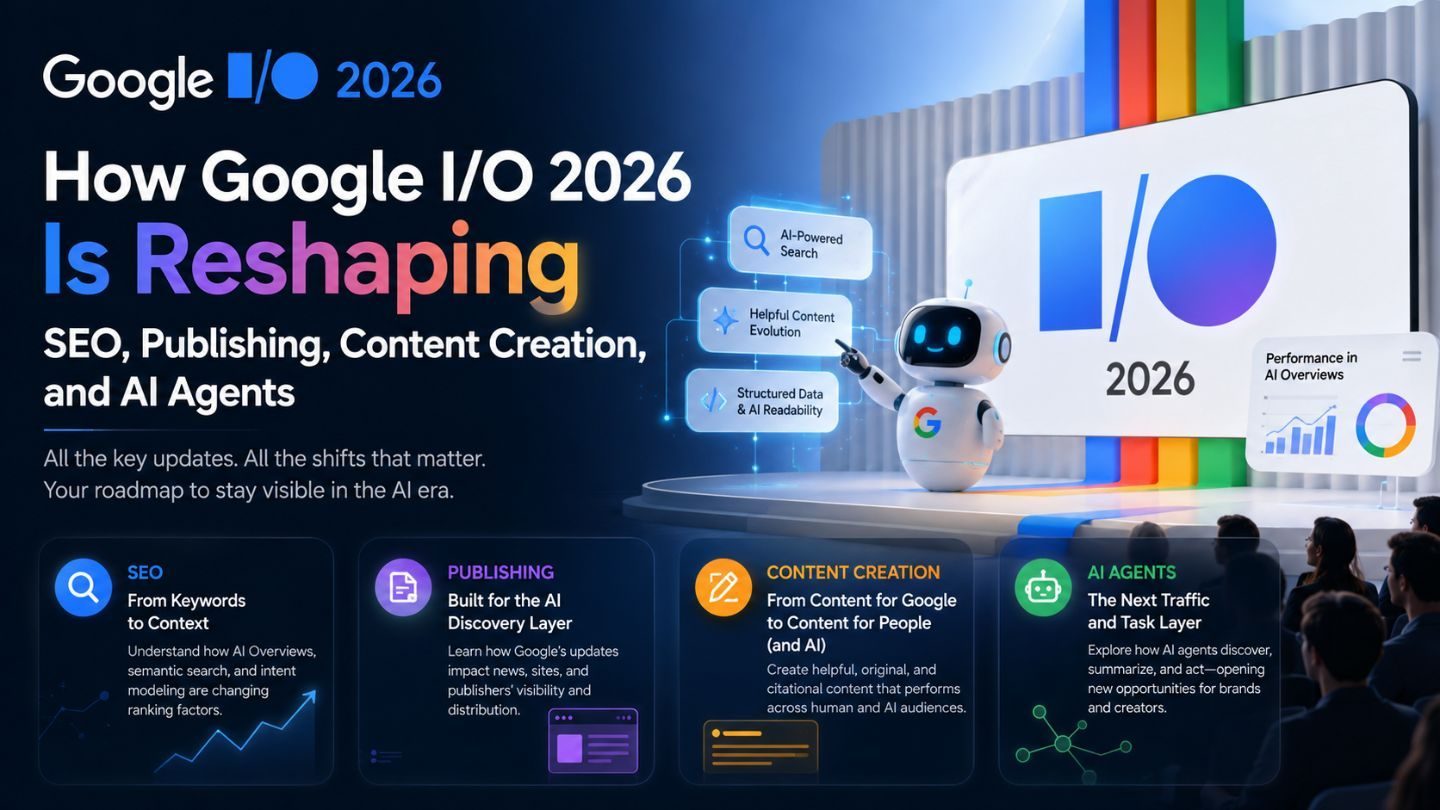
Google I/O 2026 introduced some of the most transformative updates the digital industry has seen in years. From advanced AI-powered search experiences to intelligent publishing systems and autonomous AI agents, the event made one thing very clear: the future of SEO and content creation is evolving faster than ever. Businesses, marketers, publishers, and creators now face a new digital landscape in which traditional optimization strategies alone are no longer sufficient to maintain visibility and engagement.
The rapid integration of AI into Google’s ecosystem is changing how search results are generated, how users consume information, and how websites compete for attention. Instead of simply ranking webpages based on keywords and backlinks, Google is moving toward understanding intent, context, personalization, and real-time interactions through AI-generated experiences. This shift is pushing businesses to rethink their content strategies, website structures, and publishing workflows.
Key Takeaways
- Google I/O 2026 emphasized AI-first search experiences and conversational interactions.
- SEO strategies now require a stronger focus on authority, expertise, and user intent.
- AI-generated summaries are changing how publishers receive organic traffic.
- Content creation is shifting toward experience-driven and human-enhanced material.
- AI agents are becoming essential tools for automation, research, and customer interactions.
- Businesses must adapt quickly to maintain search visibility and digital competitiveness.
The Rise of AI-Powered Search Experiences
One of the biggest announcements at Google I/O 2026 was the expansion of AI-generated search experiences across Google’s ecosystem. Search is no longer limited to displaying a list of blue links. Instead, users are increasingly presented with AI-generated summaries, recommendations, comparisons, and direct answers before they even visit a website. This change is fundamentally reshaping how SEO professionals approach content optimization.
For years, websites focused heavily on ranking for specific keywords and driving clicks through search engine result pages. However, AI-powered search now aims to satisfy user intent instantly by compiling information from multiple trusted sources into conversational responses. As a result, websites must provide deeper expertise, original insights, and highly authoritative content that AI systems recognize as trustworthy and valuable.
This also means businesses can no longer rely solely on surface-level optimization tactics. Thin content, excessive keyword stuffing, and generic articles are becoming less effective because AI systems prioritize meaningful information and contextual relevance. Websites that consistently publish expert-driven, accurate, and user-focused content are more likely to maintain visibility in this evolving environment. As search becomes more conversational, businesses also need to understand what answer engine optimization is. This approach focuses on creating content that can be clearly understood, summarized, and surfaced by AI-powered search systems. Instead of only targeting rankings, brands must now structure their content around direct answers, user intent, and trustworthy information.
How SEO Strategies Are Rapidly Changing
SEO in 2026 is becoming more sophisticated than ever before. Google’s AI advancements are rewarding websites that demonstrate real expertise, credibility, and strong user engagement signals. Search engines are placing greater importance on content quality, brand authority, and the overall user experience instead of simply matching exact keyword phrases.
This shift requires businesses to create content that answers broader user questions rather than focusing only on isolated search terms. Search intent optimization has become critical because Google’s AI models now understand conversational queries and contextual relationships between topics. Websites that cover subjects comprehensively are more likely to appear in AI-generated responses and featured search experiences. Another important factor is how AI answers citations, influence visibility in AI-generated search results. Google’s AI systems are becoming more selective about the sources they reference, which means businesses need accurate, authoritative, and well-structured content that search engines can confidently use in AI responses.
Technical SEO also remains essential, but the priorities are evolving. Fast-loading websites, structured data, mobile usability, accessibility, and clean site architecture continue to play important roles in helping AI systems understand and index content effectively. Additionally, first-party data, audience trust, and branded search demand are becoming stronger ranking indicators as Google prioritizes reliable sources.
Another major development is the growing importance of multimedia content. Google’s AI systems are increasingly capable of interpreting videos, images, podcasts, and interactive elements. Businesses that diversify their content formats can improve engagement while expanding their opportunities for visibility across multiple search experiences.
The Impact on Digital Publishing

Google I/O 2026 also highlighted major changes for publishers and media websites. AI-generated answers are significantly affecting organic traffic patterns because users can now obtain summarized information directly within search results. While this raises concerns for publishers who depend on clicks and ad revenue, it also encourages the industry to evolve toward more distinctive, high-value content.
Publishers are now being pushed to create material that cannot be easily replicated by AI summarization alone. Investigative journalism, expert commentary, industry analysis, unique research, and experience-based storytelling are becoming more valuable than generic informational content. Readers are increasingly looking for trustworthy perspectives, deeper insights, and authentic voices rather than repetitive articles that offer little originality.
Subscription-based models, community-driven content, and niche authority publishing are also gaining momentum. Since AI systems draw on information from multiple sources, publishers with strong reputations and specialized expertise may benefit from increased visibility and credibility. Building audience loyalty is now just as important as optimizing for search rankings.
Another significant change involves content freshness and consistency. AI-powered search favors up-to-date, relevant information, so publishers must maintain an active publishing schedule and regularly refresh older content to remain competitive. Static websites that rarely update their material may gradually lose visibility over time.
Read More: Content Refreshing Strategy: When and How to Update Old Posts
Content Creation Is Becoming More Human-Centric
Despite the rapid growth of AI-generated content tools, Google I/O 2026 reinforced the importance of human expertise and originality. AI can assist with drafting, research, summarization, and automation, but content that genuinely connects with audiences still depends heavily on human creativity, perspective, and emotional understanding.
Many businesses initially believed AI could replace large portions of content creation workflows entirely. However, the reality is proving more nuanced. Google’s evolving algorithms are increasingly adept at identifying low-quality AI-generated content that lacks depth, accuracy, or authenticity. As a result, successful brands are now combining AI efficiency with human oversight to create stronger and more engaging content.
Storytelling, personal experiences, expert opinions, and brand voice are becoming major differentiators in content marketing. Readers are increasingly drawn toward content that feels authentic and insightful rather than robotic or formulaic. Businesses that rely too heavily on mass-produced AI content risk damaging trust and reducing audience engagement. The rise of conversational search also makes prompt-based SEO more valuable for modern content strategies. As users search with longer, more question-based, and more intent-rich queries, businesses must create content that naturally matches how people ask for information through AI tools and search platforms.
The future of content creation will likely involve collaboration between humans and AI systems. AI tools can streamline repetitive tasks, assist with research, and generate initial drafts, while human creators focus on strategy, creativity, editing, and emotional resonance. This hybrid approach allows businesses to scale content production without sacrificing quality.
AI Agents Are Transforming Digital Operations
One of the most exciting developments from Google I/O 2026 was the advancement of AI agents capable of handling complex tasks autonomously. These intelligent systems are moving beyond simple chatbots and becoming highly functional assistants for businesses, marketers, and consumers alike.
AI agents can now perform multi-step research, analyze large datasets, automate workflows, schedule tasks, generate reports, and even interact with customers in highly personalized ways. For SEO professionals and content teams, this opens entirely new possibilities for efficiency and scalability.
Businesses can use AI agents to monitor keyword trends, analyze competitor performance, identify content gaps, automate technical audits, and optimize publishing workflows. Customer service teams can deploy AI agents to manage inquiries, improve response times, and personalize user experiences at scale. E-commerce businesses can leverage AI-powered recommendations and automated shopping assistance to improve conversions and customer satisfaction.
However, the rise of AI agents also introduces new challenges. Businesses must ensure transparency, maintain data privacy standards, and monitor AI-generated outputs carefully to avoid inaccuracies or misleading information. Human supervision remains critical to maintaining trust and quality control.
As AI agents become more advanced, businesses that integrate them strategically into their operations may gain significant competitive advantages in productivity, personalization, and decision-making.
Why Businesses Must Adapt Quickly
The announcements from Google I/O 2026 make one thing undeniable: businesses that fail to adapt to AI-driven digital trends risk falling behind. The SEO and content marketing landscape is no longer centered solely around search rankings. Instead, success now depends on authority, audience trust, experience-driven content, and intelligent technology integration.
Companies that continue using outdated SEO tactics without evolving their strategies may experience declining visibility and reduced organic traffic. At the same time, businesses willing to embrace AI responsibly while maintaining strong human-centered content practices can position themselves for long-term growth.
This transition period also creates opportunities for smaller businesses and niche brands. AI-powered search often prioritizes expertise and relevance over sheer domain size, meaning specialized businesses with valuable insights can compete more effectively against larger competitors. Building a strong digital presence through consistent, high-quality content and user-focused experiences is becoming more important than ever.
Organizations should also invest in ongoing learning and adaptation. The pace of technological change is accelerating, and staying informed about evolving search trends, AI capabilities, and content strategies will be essential to maintaining competitiveness.
Read More: SEO vs AIO vs GEO vs AEO: Pillars of Modern Search Strategy
The Future of SEO and Content Marketing

Google I/O 2026 signaled a major turning point for the digital marketing industry. SEO is no longer just about rankings, backlinks, and keywords. It is evolving into a broader strategy focused on trust, expertise, personalization, and intelligent, AI-powered user experiences.
Content creation is becoming more strategic and human-focused, while AI agents are transforming workflows and operational efficiency. Publishers are adapting to changing traffic patterns, and businesses are rethinking how they connect with audiences in increasingly conversational search environments.
The companies that succeed in this new era will be those that combine technological innovation with authentic human value. Rather than viewing AI as a replacement for creativity and expertise, forward-thinking businesses will use it as a tool to enhance productivity while continuing to prioritize originality, trustworthiness, and meaningful audience engagement.
As the digital ecosystem continues evolving, businesses that embrace change, refine their strategies, and invest in quality experiences will be better positioned to thrive in the AI-powered future of search and content marketing.
Final Thoughts
Google I/O 2026 has highlighted how rapidly AI is transforming SEO, publishing, content creation, and digital experiences. From AI-powered search results to advanced automation tools and intelligent AI agents, businesses now need to focus more on expertise, user intent, authenticity, and high-quality content to remain competitive online. Companies that adapt to these evolving search trends and invest in user-focused strategies will be better positioned for long-term digital growth and stronger online visibility.
At The Ocean Marketing, we help businesses stay ahead in the changing digital landscape with advanced SEO strategies, content optimization, and AI-focused marketing solutions. Whether you want to improve rankings, increase traffic, or strengthen your online presence, our team is here to support your growth. Get your Free SEO Audit today and discover how our professional SEO services can help your business achieve better visibility, stronger engagement, and long-term success. Contact us to learn more about our customized digital marketing solutions.