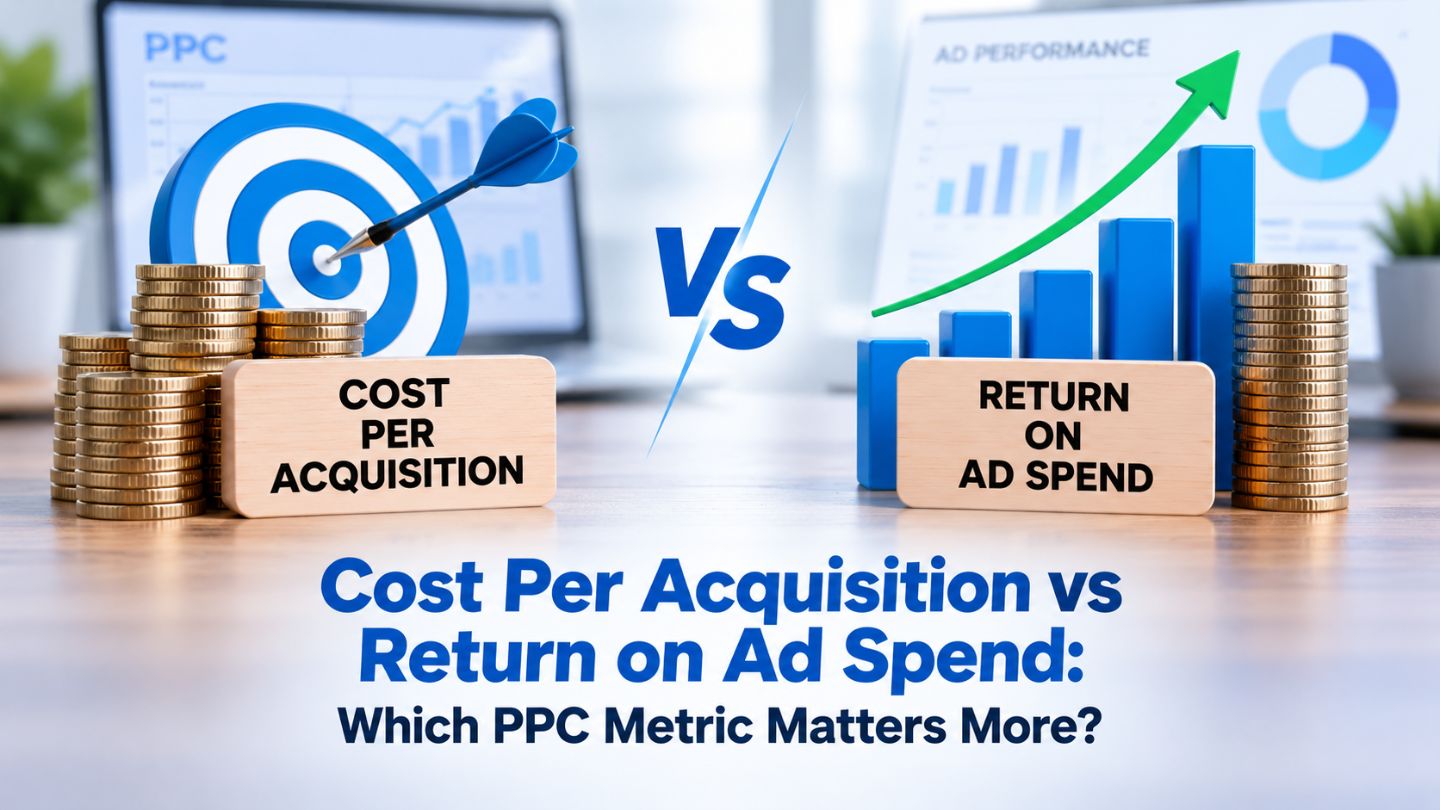
Two accounts can hit the same cost per acquisition and be worth completely different amounts to the business, because one acquired customers who spend twice as much as the other. That gap is exactly what cost per acquisition hides and return on ad spend reveals. Neither metric is wrong, they answer different questions, and choosing the wrong one to optimize toward quietly steers budget in the wrong direction. This blog covers what each actually measures, where each misleads, and how to decide which should lead your decisions.
Key Takeaways
- CPA measures cost per conversion; ROAS measures revenue per ad dollar.
- CPA suits businesses where every conversion is worth roughly the same.
- ROAS suits variable order values and revenue-focused goals.
- Optimizing CPA alone can ignore which customers are actually profitable.
- Margin, not revenue, is what either metric should ultimately serve.
What Each Metric Actually Measures
Cost per acquisition tells you what it costs to produce one conversion, whether that is a sale, a lead, or a signup. It is a cost-side metric, clean and easy to compare across campaigns, and it treats every conversion as equivalent. That last part is its strength and its blind spot at the same time.
Return on ad spend measures revenue generated for every dollar spent, so it accounts for the value of what was sold rather than just the count. A campaign producing fewer but larger sales can look worse on cost per acquisition and better on return on ad spend, and that divergence is precisely the information a single metric would have hidden from you.
Where CPA Is the Right Lens
Cost per acquisition works well when your conversions are genuinely similar in value. A service business where nearly every lead is worth about the same, a subscription at a single price point, a fixed-fee offering- all of these fit cost per acquisition cleanly because the metric's core assumption, that conversions are interchangeable, actually holds.
It is also simply easier to work with when revenue attribution is messy or delayed. If the sale happens weeks later, offline, or through a process the ad platform cannot see, cost per acquisition on a reliable lead event may be the more trustworthy number. Understanding the key differences between Pay Per Click and Cost Per Click is worth being clear on here, since the terminology gets muddled and the distinction affects how you read your own reports.
Where ROAS Earns Its Place
Return on ad spend becomes the better guide when order values vary meaningfully. Ecommerce with a wide price range, businesses selling both entry products and premium ones, anything where one customer might be worth ten times another, all need a metric that weights by value rather than counting conversions equally.
In those cases, optimizing cost per acquisition can actively mislead. Pushing hard to lower cost per acquisition might mean chasing cheap, low-value conversions while starving the campaigns that bring in the customers who actually drive revenue. Return on ad spend keeps the focus on value produced, which is usually closer to what the business actually cares about.
Check Which One Your Goal Implies
If leadership talks about revenue and growth, ROAS fits. If they talk about efficient lead cost against a known lifetime value, CPA fits. The metric should match the actual objective, not the other way around.
Read More: PPC Funnel Mapping: How to Align Ads With Funnel Stages
The Number Neither Metric Shows

Both cost per acquisition and return on ad spend can look excellent while the business loses money, because neither accounts for margin. A strong return on ad spend on a product with thin margins can be less profitable than a weaker one on a high-margin product, and cost per acquisition says nothing about profitability at all.
This is the trap accounts fall into when they optimize to a target number without connecting it to actual profit. A return on ad spend target set without reference to margin is a guess, and hitting it feels like success while the finance team wonders where the money went. This ties closely to improving PPC campaigns to generate high-quality leads, since the value of a conversion is what both metrics ultimately depend on. The metric you optimize should trace back to margin, not stop at revenue or conversion count.
Using Them Together
The strongest accounts rarely rely on one number. Cost per acquisition tells you efficiency, return on ad spend tells you value, and watching both prevents either from steering you wrong. A campaign with rising cost per acquisition but improving return on ad spend might be acquiring more valuable customers, which is a decision to make deliberately rather than a problem to fix reflexively.
The practical setup is to define acceptable ranges for both, tied to your actual margins, and treat a conflict between them as a signal worth investigating rather than a contradiction. When they disagree, that disagreement usually contains the most useful information in the account. Pairing this with regular Google Ads account audits and the monthly PPC checklist keeps both metrics honest as the account evolves.
Why Lead Quality Sits Underneath Both
Neither cost per acquisition nor return on ad spend fully accounts for whether the conversions were any good. A campaign can produce cheap conversions on paper that turn out to be unqualified leads, or high-revenue sales that come with returns and refunds. The metric looks healthy while the actual business outcome does not, because both numbers stop at the conversion rather than following it through.
This is why connecting these metrics back to what happens after the conversion matters so much. If your systems can tie a lead or sale to whether it actually became a profitable customer, both cost per acquisition and return on ad spend become far more trustworthy. Optimizing toward conversions that look good but do not close is a common and expensive way to hit a target number while missing the point of it entirely. Tying conversions back to what actually drives PPC success is what stops either metric from flattering a weak account.
How the Metric Choice Shapes Bidding
The metric you optimize toward does not just measure performance, it steers the automated bidding that increasingly runs accounts. Tell the system to minimize cost per acquisition and it will chase the cheapest conversions, which may not be the most valuable ones. Tell it to maximize return on ad spend and it will chase revenue, which may not be the most profitable revenue. The system does exactly what you asked, which is the problem when you asked for the wrong thing.
This makes the choice of metric a strategic decision rather than a reporting preference, because it shapes where the algorithm sends your budget. Getting it wrong means the system efficiently optimizes toward an outcome that does not serve the business, and it does so confidently enough that the numbers look fine while the results disappoint. Defining the target carefully, and tying it to margin, is what keeps the automation working for you rather than against you.
Read More: AI-Powered Bid Strategies: Are They Better Than Manual Bidding?
Watching Both Prevents Blind Spots

The habit worth building is watching both metrics together rather than fixating on one, because each covers a blind spot the other has. Cost per acquisition alone can hide that you are acquiring low-value customers; return on ad spend alone can hide inefficiency. Seen together, a divergence between them becomes a signal rather than a contradiction, pointing at exactly the thing worth investigating.
This dual view is what separates accounts that are genuinely well managed from ones that merely hit a target number. When the two metrics disagree, that disagreement usually contains the most useful information in the account, and a manager watching both catches it while one watching a single number misses it entirely. Building that check into a short weekly diagnostic routine is what makes the habit survive a busy month.
Choosing the Metric That Fits Your Business
Cost per acquisition and return on ad spend are not competitors, they are different questions, and the right one depends on whether your conversions are worth roughly the same or vary widely, and whether your goal is efficient volume or revenue value. Optimize cost per acquisition when conversions are interchangeable and attribution is clean; optimize return on ad spend when order values vary and revenue is the goal. And whichever you lead with, keep it tied to margin, because a great number on either metric means nothing if the business is not actually making money.
At The Ocean Marketing, we build PPC strategies around the metric that actually reflects your business rather than whichever number is easiest to report. Whether you need help deciding what to optimize toward, connecting your targets back to real margin, or a free SEO audit to see how your paid and organic efforts fit together, our team can help. Contact us and let's work out what your account should actually be chasing.