
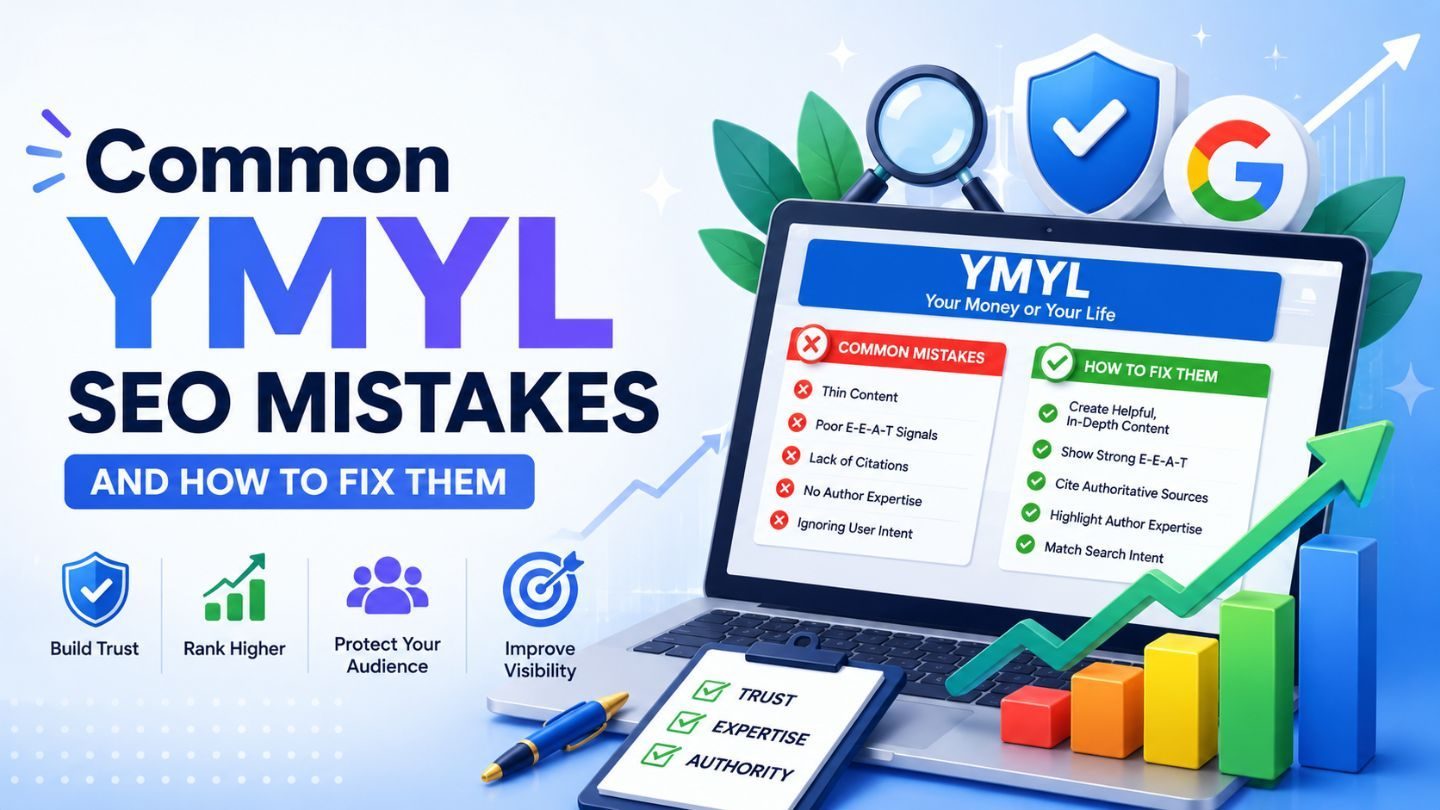
YMYL (Your Money or Your Life) content demands a higher level of accuracy, trust, and responsibility because it directly influences important decisions related to health, finance, and safety. Unlike regular content, even small SEO mistakes in this space can impact both rankings and user confidence. Many websites unknowingly follow general SEO practices that don’t fully align with YMYL expectations, leading to missed opportunities and reduced credibility. This blog outlines the most common YMYL SEO mistakes and practical ways to fix them effectively. By understanding these issues, you can build stronger authority and create content that truly earns user trust.
Key Takeaways
- YMYL SEO is more about trust than just rankings
- Authority and credibility directly impact visibility
- Content depth matters more than content volume
- User intent must guide content creation
- Technical SEO still supports trust and usability
- Transparency plays a major role in conversions
- Consistency in quality builds long-term authority
Why YMYL SEO Fails Even When “Everything Looks Right”
One of the biggest frustrations with YMYL content is that everything can appear optimized on the surface – keywords are placed correctly, headings are structured, and the content seems informative – yet rankings remain poor. The reason behind this often lies in a disconnect between optimization and trust. Unlike general blogs, YMYL content is evaluated not just on what is written, but on who wrote it, how reliable it is, and whether it genuinely helps the reader make a safe decision. When websites treat YMYL content like a standard SEO checklist, they miss the deeper expectation of authority and accountability, which ultimately affects both rankings and user confidence.
The “Looks Good But Isn’t Trusted” Problem
A common mistake businesses make is assuming that well-written content is enough to rank, without realizing that trust signals play an equally important role. A page may be grammatically perfect and keyword-optimized, but if it lacks author credibility, real-world expertise, or any indication of authority, it quietly fails in search performance. This creates a situation where the content seems fine internally but does not compete externally against pages backed by stronger authority signals.
In YMYL SEO, trust is not built through wording alone; it also depends on how clearly a website demonstrates real credibility, expertise, and authority across its content. Strong E-E-A-T optimization for building authority helps make that trust more visible to both users and search engines. Fixing this issue requires shifting focus from just writing to proving. Adding real author profiles, demonstrating industry experience, and supporting claims with credible references helps transform content from “informative” to “trustworthy.” Over time, this builds a stronger connection with both users and search engines.
When Content Exists But Doesn’t Deliver Value
Another pattern seen in YMYL websites is the presence of content that technically answers a query but does not go deep enough to be useful. This often happens when businesses prioritize publishing frequency over depth, resulting in pages that feel incomplete or overly general. In YMYL topics, users are not just browsing – they are looking for clarity, reassurance, and actionable understanding, which thin content fails to provide.
This is also where businesses need to understand which drives better rankings: content depth or clarity, because detailed content should answer user concerns clearly without becoming overwhelming or difficult to follow. Improving this is less about adding more pages and more about strengthening existing ones. Expanding explanations, including practical insights, and addressing real concerns users might have, creates a more meaningful experience. Content should feel like guidance, not just information, especially in high-stakes niches.
Read More: How Skimmable Content Boosts Engagement & Conversions
The Hidden Damage of Over-Optimization
There is a tendency to push SEO too far by forcing keywords into content in a way that disrupts natural readability. While this approach may have worked in the past, it now creates a negative experience for users, particularly in YMYL content where clarity and professionalism are critical. When readers sense that content is written for search engines rather than for them, trust begins to decline almost immediately. The solution lies in restraint and balance. Keywords should support the content, not dominate it. Writing in a natural tone, using variations, and focusing on clarity ensures that the message remains strong while still being optimized. This approach not only improves readability but also aligns better with modern search engine expectations.
When Headlines Attract But Content Pushes Users Away
Click-driven headlines can sometimes backfire in YMYL niches, where users expect honesty and precision. A headline that promises more than the content delivers creates a sense of doubt, which is particularly harmful when the topic involves important decisions. Even if the intention is to improve click-through rates, misleading titles often result in higher bounce rates and reduced trust. A better approach is to treat headlines as a promise that must be fulfilled. Clear, accurate, and value-driven titles set the right expectation and attract users who are genuinely interested in the content. This not only improves engagement but also strengthens credibility over time.
Technical SEO: The Silent Trust Factor
Technical issues are often overlooked because they operate in the background, yet they have a direct impact on how users perceive your website. Slow loading times, poor mobile experience, or navigation issues can make even high-quality content feel unreliable. In YMYL contexts, these small frustrations can lead users to question the overall credibility of the site. Addressing technical SEO is about creating a seamless experience. A fast, responsive, and well-structured website reinforces the sense that the content is professional and trustworthy. This indirectly supports all other SEO efforts by ensuring users stay engaged.
Outdated Information and Its Long-Term Impact
One of the more subtle mistakes in YMYL SEO is allowing content to age without updates. Information that was accurate a year ago may no longer be relevant today, especially in industries that evolve quickly. When users encounter outdated details, it not only affects their trust in that page but also in the website as a whole. For pages that no longer support rankings or user trust, to boost SEO rankings, understanding how content pruning helps by deleting pages that determine whether outdated content should be updated, merged, or removed to improve overall site quality. Regular updates help maintain relevance and authority. Revisiting content, refining details, and incorporating new insights ensures that your website continues to provide value. This ongoing effort signals reliability and keeps your content competitive.
Read More: Content Refreshing Strategy: When and How to Update Old Posts
The Missing Trust Signals That Cost Conversions
Many websites underestimate the importance of visible trust elements such as contact information, disclaimers, and transparency pages. While these may seem secondary, they play a crucial role in how users evaluate credibility. In YMYL niches, users often look for reassurance before taking any action, and the absence of these signals can create hesitation. Strengthening trust signals is a straightforward but impactful improvement. Making it easy for users to verify your legitimacy, understand your policies, and contact you builds confidence. This not only improves SEO performance but also increases conversion potential.
Writing Without Understanding User Intent
A technically optimized page can still fail if it does not align with what the user actually wants. This often happens when content is created based on keywords alone, without considering the intent behind them. In YMYL topics, search intent is usually very specific, and missing that intent results in content that feels irrelevant. Improving alignment with user intent requires a deeper understanding of the audience. Thinking about why someone is searching for a topic and what they expect to gain helps shape content that truly satisfies their needs. This approach leads to better engagement and stronger rankings.
Final Thoughts
YMYL SEO requires more than just basic optimization – it demands a strong focus on trust, accuracy, and user intent. Throughout this blog, we explored how common mistakes such as ignoring E-E-A-T, publishing thin content, lacking credible sources, and overlooking technical SEO can significantly impact both rankings and credibility. Fixing these issues involves creating in-depth, reliable content, maintaining transparency, and ensuring a seamless user experience. When these elements come together, your website not only performs better in search results but also becomes a dependable source for your audience.
At The Ocean Marketing, we specialize in delivering impactful SEO and content writing strategies, helping businesses build authority in competitive niches. We also offer a free SEO audit to identify gaps and opportunities for improving your website’s performance. Our approach focuses on combining data-driven insights with high-quality content to create sustainable growth for your brand. Let us help you strengthen your digital presence and achieve long-term success. Contact us today to get started.