
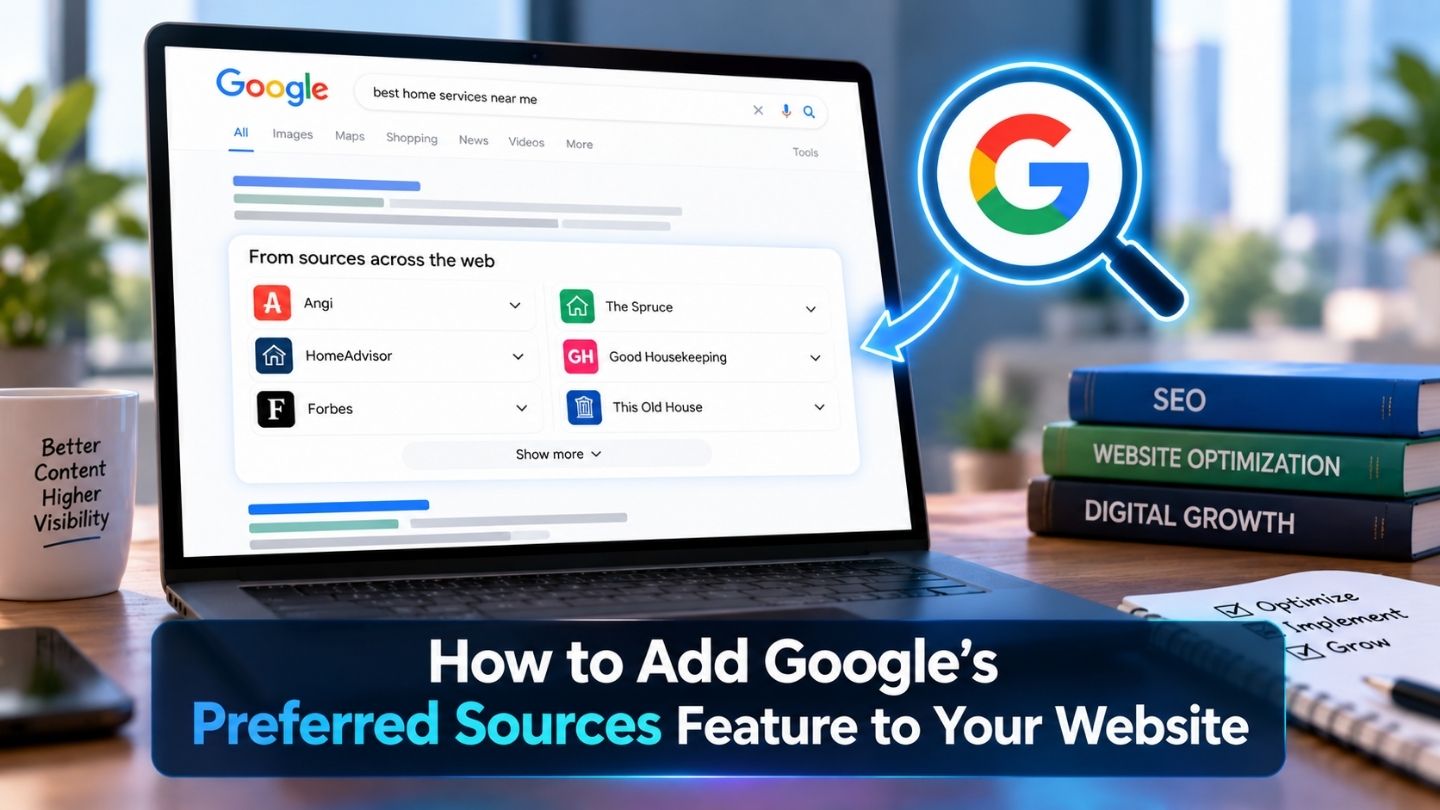
Google's Preferred Sources feature lets people choose publications they want to see more often in their results, which turns a passive audience into an opt-in one. For businesses publishing regularly, that is a meaningful shift in how repeat visibility gets earned. This blog outlines what the feature actually does, the technical and structural groundwork a site needs before it can benefit, and the realistic expectations worth setting, because being eligible and being chosen are two different problems.
Key Takeaways
- Preferred Sources let users opt into seeing a publisher more frequently.
- Eligibility depends on consistent publishing and clean technical structure.
- Clear publisher identity signals matter more than page-level optimization.
- Site architecture and speed affect whether people stay long enough to opt in.
- This rewards long-term publishing consistency, not a one-time setup.
What the Feature Actually Does
The mechanic is straightforward: a user indicates that they want to see more from a particular source, and their results start reflecting that preference. It does not override relevance, and it does not manufacture visibility for content nobody wants. What it does is give an existing audience a way to formalize a preference they already had.
That framing matters because it sets a realistic ceiling. This feature amplifies an audience relationship you have already built. A site nobody currently recognizes does not become visible through it. A site with a genuine readership gets more consistent placement in front of the people who already value it, which compounds over time in a way one-off traffic does not.
Add Google’s Preferred Sources Button to Your Site
Google now gives publishers an official button they can embed on their website so readers can add the publication as a Preferred Source. The standard implementation uses Google’s JavaScript and automatically localizes the button, while an advanced option allows custom design assets.
Before adding it, first confirm that your domain or subdomain appears in Google’s source-preferences tool. The button does not manually enroll a site into Preferred Sources; it helps readers select a source that Google already recognizes as available.
Read More: Google Search Profiles for Publishers and Creators: Features, Benefits, and SEO Impact
Defining What You Actually Publish About
A site that covers everything gives a reader no reason to want more of it specifically. The businesses that earn this kind of preference tend to be recognizably about something, narrow enough that someone could describe what you publish in a sentence.
That definition is a strategic decision rather than an editorial one, and it usually means declining topics that are adjacent but not yours. The discipline is uncomfortable in the short term, and it is what makes a publication worth subscribing to in any form. Building that recognizable territory is what topic clusters are for, applied to a publication rather than a single page.
The Publishing Consistency Requirement

Being a plausible preferred source means publishing enough that a preference is worth expressing. Someone is not going to opt into more results from a site that posts twice a year. Regular, predictable publishing on a defined subject is the underlying qualification, and there is no technical shortcut around it.
Consistency here means cadence and subject together. A site publishing weekly across six unrelated topics gives a reader no clear reason to want more of it. A site publishing regularly within a recognizable area builds the association that makes opting in feel worthwhile. This is the same accumulation that drives topical authority rather than isolated keyword wins, applied to audience preference instead of ranking.
Making Your Publisher Identity Unambiguous
For a system to treat your site as a source rather than a collection of pages, it needs to identify the publisher clearly. That means Organization markup on your core pages, consistent naming across every property you control, and author attribution that connects real people to the work they produced. That last part depends on having author pages worth pointing at rather than a name with no page behind it.
Sites that publish under a rotating house byline, or that describe themselves slightly differently across their homepage, social profiles, and about page, make this identification harder than it needs to be. Tightening it is unglamorous work with broad benefit, since the same clarity feeds how structured data affects visibility in AI-driven results as well as source-level recognition.
Fix the Homepage First
It is the page most likely to establish organizational identity and the one most often left with no structured markup at all. Correcting it there benefits every page that links back.
Where Site Design Genuinely Affects This
Opting into more of a source is a decision someone makes after a good experience, which means the experience has to be good. A page that loads slowly, buries the article under interstitials, or makes the next relevant piece hard to find gives a reader no reason to want more. The technical eligibility and the human decision are two separate gates, and design controls the second one.
Practically, that means fast loading on mobile, a readable article template, clear paths to related pieces, and navigation that does not fight the reader. This is where design work stops being cosmetic and starts affecting whether a visit turns into a relationship rather than a single pageview. Reviewing common mobile menu problems that frustrate visitors is a reasonable starting point, since most of this traffic arrives on a phone.
Setting Realistic Expectations
This is not a feature that produces a visible traffic jump in a fortnight. Its value accrues among people who already read you, which means the effect shows up as steadier returning traffic and stronger brand search rather than a spike in new visitors. Judging it on first-week numbers will make it look like nothing happened.
It also does not rescue thin content. A reader who opts in and then encounters generic material will simply stop engaging, and the preference becomes worthless. The feature raises the ceiling for sites that are already worth reading, and does nothing at all for sites that are not, which is a fair arrangement but an unsatisfying one for anyone hoping for a shortcut.
A Practical Order of Operations
Start with the identity signals, since they are quick, concrete, and benefit everything else. Confirm Organization and author markup is present and accurate, and reconcile any naming inconsistencies across your properties. Then check the reading experience on a real phone, honestly, and fix whatever makes the article harder to finish than it should be.
Only after that does publishing cadence become the main lever, and it is the slowest of the three to move. Committing to a realistic schedule within a defined subject area, and holding it for months rather than weeks, is what actually builds the audience relationship the feature depends on. There is no version of this that works without that part.
Where This Sits Against Everything Else

It is worth being clear that this is a supporting play rather than a foundation. A site with weak content, poor technical health, or no audience does not fix any of that by preparing for a preference feature, and the effort is better spent on whichever of those is actually limiting you.
Read More: E-E-A-T Optimization: How to Build Authority in Your Niche
For a business already publishing consistently to a genuine readership, the groundwork is cheap, and the compounding is real. The order matters more than the individual tactic: fundamentals first, then the identity and experience work that lets an existing audience formalize a preference they already had.
Earning a Place Readers Choose
Preferred Sources rewards something older than any specific feature: publishing consistently enough, on a clear enough subject, with a good enough reading experience, that people actively want more of it. The technical groundwork- clean publisher identity, accurate markup, a fast and readable site- makes you eligible and legible. The audience relationship is what makes anyone actually opt in. Getting both right takes months rather than an afternoon, and the resulting visibility is considerably more durable than anything a single optimization produces.
At The Ocean Marketing, we combine SEO groundwork with the website design and publishing discipline that makes a site worth returning to. Whether you need help getting your publisher signals right, improving the reading experience on mobile, or a free SEO audit to see where your site currently stands, our team can help. Contact us and let's work out what your site needs first.