
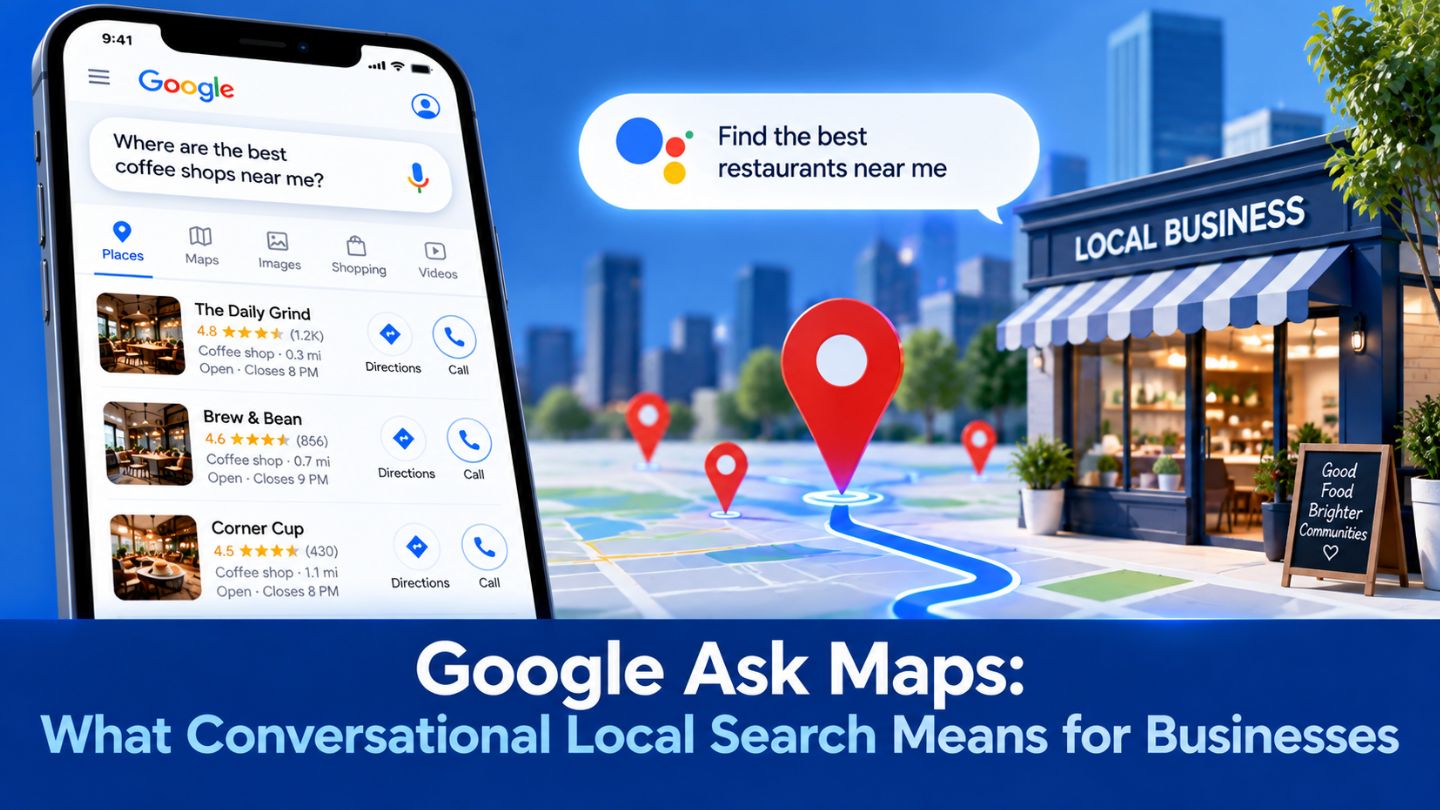
Local search is shifting from short queries to full questions, and conversational features inside Maps change what it takes to be the answer. "Somewhere quiet nearby that's open late and does gluten-free" is a very different request than "restaurant near me," and it is answered from different signals. This blog outlines what conversational local search actually draws on, which parts of your presence suddenly matter more, and what businesses should be doing about it now.
Key Takeaways
- Conversational queries carry more specific, layered requirements than keyword searches.
- Attributes and structured profile details do more work than before.
- Review text becomes a source of answers, not just a rating.
- Incomplete profiles get filtered out of specific requests entirely.
- Being the answer matters more than ranking in a list.
What Changes When Queries Become Questions
A short keyword query returns a list and lets the person filter it themselves. A conversational query asks the system to do that filtering first, which means your business either satisfies the stated conditions or is excluded before the user sees anything. There is no equivalent of scrolling past the top three when the answer was assembled rather than listed.
That raises the cost of missing information sharply. If someone asks for a place with outdoor seating and your profile never states that you have it, you are not ranked lower; you are simply absent from that answer. The filtering happens on structured data you either provided or did not.
Attributes Stop Being Optional
Business profile attributes, the checkboxes covering accessibility, amenities, payment options, and service details, have historically been treated as a completeness exercise nobody hurried to finish. In a conversational context, they become the primary filter, because they are the machine-readable statements about what you actually offer.
Working through them properly is a genuinely high-return afternoon. Every attribute you leave unset is a question you cannot be the answer to. This sits alongside how business categories affect map visibility: category tells the system what kind of business you are, attributes tell it what you specifically do.
Photos Answer Questions Text Cannot.

A conversational request about whether somewhere is suitable for a particular purpose is partly answered by what the place visibly looks like. Current photographs of the interior, the entrance, parking, and the actual product give both the system and the person something concrete to assess against a specific requirement.
Most profiles carry a handful of images from whenever the listing was created and nothing since. Refreshing them, including the unglamorous practical shots people actually want, accessibility, seating, where to park, costs an afternoon and answers a category of questions your text never addresses. Where those photos were taken can matter too, which is the question behind geo-tagging images on a business profile.
Reviews Become a Source of Answers
Ratings summarize sentiment. Review text describes specifics, and conversational systems can draw on that text to satisfy conditions your profile never stated. If customers repeatedly mention that a place is quiet, or good for working, or unusually fast at lunch, that language becomes usable evidence.
This gives review management a purpose beyond reputation. Encouraging customers to describe what they actually did and valued produces richer material than a five-star rating with no words attached. It also means responding to reviews has compound value, since replies add your own descriptive language to the same pool. Reviewing whether review responses genuinely help with search is useful context before scaling that effort.
Ask for Specifics, Not Stars
A request that nudges customers to mention what they came for produces reviews that can answer future questions. A generic request for a rating produces a number that answers nothing.
Read More: Google Reviews & SEO: Advanced Strategies That Scale
Consistency Across Every Listing
Conversational answers draw on more than one source, and contradictions between them introduce exactly the doubt you are trying to remove. Hours listed differently on your site than your profile, or services described inconsistently across directories, weaken confidence in all of them.
Auditing the handful of places your business details appear, and making them identical rather than merely similar, is unglamorous and directly supports being selected as a reliable answer. It is also the cheapest credibility work available. Getting those listings aligned in the first place is what local citation building is for.
Completeness Is the New Baseline
Hours, including holiday variations, accurate service lists, current photos, correct contact details, and populated attributes together determine how many questions you are eligible to answer. A sparse profile can still rank for a broad category search and quietly fails every specific request.
Hours deserve particular attention because they are both the most checked field and the most neglected, and a conversational query about what is open right now resolves entirely on that data. Getting it wrong does not just cost a listing position; it sends someone to a closed door and produces the review that follows.
Where This Leaves Traditional Local Ranking

None of this replaces the fundamentals. Proximity, relevance, and prominence still determine whether you are in consideration at all, and a business with no reviews and inconsistent citations does not become visible because it has filled in some attributes. Conversational features sit on top of the existing system rather than beside it.
What changes is the second stage. Being in the eligible set is necessary and no longer sufficient, because the specific conditions in the question decide who survives the filter. Businesses already strong on the fundamentals behind local pack visibility get the most from this work; businesses weak there should fix that first.
Your Website Still Feeds This
Profile data is not the only input. Service pages, FAQ content, and location pages on your own site describe specifics that a listing has no field for, and that content contributes to how well your business can be matched to a detailed request.
This is a reason to keep service descriptions genuinely specific rather than generic. A page stating exactly what you do, for whom, in which area, with what constraints, gives far more to work with than one describing your commitment to quality. The listing establishes the facts; the site supplies the detail.
Read More: How to Boost Local SEO with Strategic Service Area Pages
A Practical Order of Work
Start with attributes and hours, since they are quick, concrete, and directly determine eligibility. Then audit your profile for anything a customer might reasonably ask about that you have not stated anywhere: parking, accessibility, whether you take walk-ins, what you actually specialize in.
After that, shift attention to review language rather than review volume. A steady flow of reviews that describe specific experiences is worth more here than a larger number of unelaborated ratings, and it accumulates rather than needing constant renewal. None of this is dramatic work, and the businesses that do it are simply eligible for more questions than the ones that do not.
Measuring Something With No Ranking Position

Conversational results do not produce a position you can track, which makes standard local rank reporting an incomplete picture. Profile insights showing how people found you, searches versus direct lookups, and the actions taken afterward tell you more about whether this is working.
The manual check is worth adding too: phrase the questions a genuine customer would ask, run them, and note whether you appear and how you are described. Doing that quarterly and keeping a short record reveals direction over time in a way a single snapshot never will.
Keeping the Profile Current
Conversational answers are only as accurate as the data behind them, which makes stale profile information actively harmful rather than merely incomplete. Hours that changed, services no longer offered, or an attribute that was true two years ago all produce confidently wrong answers.
Building a short quarterly check into someone's calendar- hours, including holidays, service list, attributes, photos- prevents the slow drift that turns a well-built profile into a misleading one. It is ten minutes of work protecting everything else you have done.
Being the Answer Rather Than an Option
Conversational local search rewards businesses that have stated clearly what they are and what they offer, in fields a system can actually read. Attributes and hours decide which questions you qualify for. Review text supplies details your profile never covered. Underneath it all, the traditional local signals still decide whether you are considered at all. The shift is from being listed among options to being selected as the answer, and completeness is what makes that possible.
At The Ocean Marketing, we help businesses build Google Maps SEO that holds up as local search keeps changing shape. Whether you need a profile audit, help building a review approach that produces useful detail, or a free SEO audit to see where your local presence stands, our team can help. Contact us and let's make sure you're eligible for the questions your customers are actually asking.