
Ask two SEOs about directory links, and you’ll get an argument. One says they’re a relic that stopped working a decade ago, the other says their local clients rank because of them. Both are describing something real, because directory links and editorial links do completely different jobs. Judging one by the other’s standard is how the confusion starts. This blog outlines what each type actually contributes, where directories still earn their place, why editorial links carry more weight, and how to invest in both without wasting budget.
Key Takeaways
- Editorial links are earned through content someone chose to reference.
- Directory links are placements you submit rather than earn.
- Directories support local visibility and citation consistency.
- Editorial links carry far more authority and are far harder to get.
- Paid directory schemes remain a reliable way to waste money.
What Separates the Two
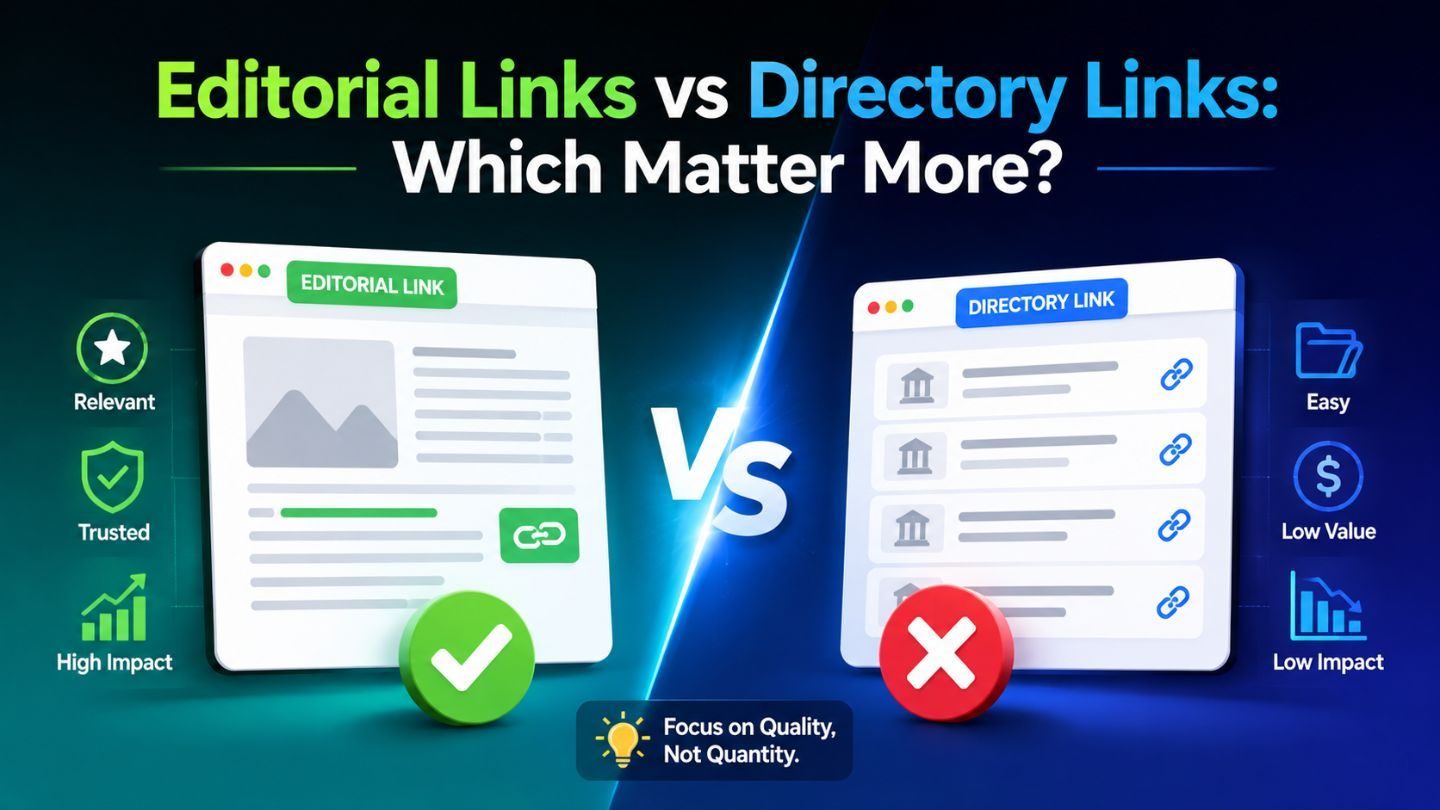
An editorial link happens when someone writing about a subject decides your page is worth pointing readers to. Nobody asked, nobody paid, a human made a judgment. That judgment is precisely why search engines value it; it’s a signal that can’t be manufactured at scale without leaving obvious traces.
A directory link is a listing you submitted. You filled a form, provided your details, and were added. There’s no editorial judgment involved, which means there’s very little authority to pass. That doesn’t make directories worthless; it means their value comes from somewhere other than link equity, and confusing the two is the source of most bad directory advice.
Why Editorial Links Carry the Weight
Search engines have spent two decades learning to distinguish links that reflect genuine endorsement from links that reflect effort. Editorial links pass that test because they’re expensive in the only currency that matters; someone had to think you were worth mentioning. That scarcity is the value.
They also arrive with context that directories can’t provide. A link from an article about your subject, surrounded by relevant text, from a site whose audience overlaps yours, tells search engines something specific about what you’re relevant for. Understanding contextual link building and what passes value explains why placement inside relevant content matters more than the raw authority of the domain hosting it.
Hard to Get Is the Point
If editorial links were easy, they’d be worthless. The difficulty is the filter that makes them meaningful, which is why shortcuts around it consistently fail.
Read More: How to Recognize High-Quality Backlinks
Where Directory Links Still Do Real Work
Here’s the part the dismissive camp misses. For local businesses, directory listings serve a purpose that has nothing to do with link equity. They establish citation consistency, your name, address, and phone appearing identically across the places search engines check when verifying that a business exists where it claims to.
That consistency directly affects local search visibility. Get it wrong, with three variations of your address across different listings, and you introduce doubt into the exact system you’re trying to convince. This is why NAP consistency is crucial for local SEO, and why a plumber ignoring directories entirely is leaving something real on the table even though the links themselves pass almost nothing.
The Directories Worth Bothering With

The useful ones share a few traits. They’re genuinely used by humans, not just built for SEO. They’re relevant to your industry or your location. They’re curated to some degree rather than accepting anything with a pulse. Google Business Profile, major industry associations, established local chambers, and well-known review platforms.
The useless ones are equally identifiable. Anything promising hundreds of listings for a flat fee. Directories with no visible editorial standard, no real traffic, and a footer full of unrelated categories. Anything that emails you unsolicited. The rule of thumb is simple: if a directory would exist even if search engines vanished tomorrow, it’s probably worth being in. That test is also the practical starting point for local citation building, where a handful of solid listings outperform hundreds of weak ones.
How to Earn Editorial Links Without Begging
The mechanics are less mysterious than the industry suggests. People link to things that are useful to their readers, original data, a genuinely better explanation, a tool, a perspective nobody else offered. If your content is a rewrite of what already ranks, there’s no reason for anyone to reference it over the original.
The other route is being findable by people who are already writing. Journalists and bloggers looking for a source, an expert quote, or a statistic will link to whoever they find and trust. That means being present in the places they look and having something quotable when they arrive. Approaches like building links without outreach emails work precisely because they put you in the path of people already looking to link to someone.
Splitting Your Effort Sensibly
Directories are a finite project. Get listed accurately on the platforms that matter for your industry and location, verify the details are consistent, and then largely stop. It’s a few days of work and a periodic audit, not an ongoing campaign. Treating it as ongoing is how businesses end up paying for listings on sites nobody has ever visited.
Editorial links are the opposite: an indefinite investment tied to producing things worth referencing. That’s where the ongoing budget belongs, because that’s where the compounding happens. A business spending equally on both has almost certainly got the ratio wrong, and the correction is usually to finish the directory work properly and redirect the rest.
The Paid Directory Trap
Someone will email offering a listing on a high-authority directory for a modest annual fee. The metrics they quote will look impressive. The site will have a domain rating that sounds meaningful. And the link will do nothing essentially, because a directory that sells placement has no editorial standard, and search engines worked that out a long time ago.
The tell is in the business model. A directory that exists to serve users makes money from users or advertisers. A directory that makes its money selling links to businesses exists to sell links, and everyone, including Google, understands that. If the pitch emphasizes domain authority rather than the audience you’d reach, you’re being sold a metric rather than a result.
Industry Directories Are the Exception
Not all directories are equal, and the useful ones are usually the ones that would exist anyway. A professional body’s member list. A trade association’s supplier register. A regional business network. These have genuine gatekeeping, real users, and inclusion signals something because it required qualifying.
They also frequently carry more weight than their metrics suggest, because relevance matters more than raw authority. A link from a small, tightly focused industry body can be worth more than one from a large general directory, precisely because the association is meaningful. Those are worth the membership fee. Most other directories aren’t worth the ten minutes to submit.
Auditing What You Already Have
Before pursuing anything new, look at what you’ve accumulated. Businesses that have been trading for years usually have listings they’ve forgotten, some with an old address, some with a phone number that no longer rings, some on sites that have since become spam.
Cleaning that up is unglamorous and often more valuable than any new link. Inconsistent information across listings actively undermines local visibility, and a link from a site that’s degraded into a link farm is a liability rather than an asset. An afternoon fixing what exists usually beats a week chasing what doesn’t.
Read More: Toxic Backlinks: How to Find and Remove Them
How to Judge a Directory in Two Minutes

There’s a quick test that settles most cases. Search the directory’s name and see whether real people discuss it. Look at whether its listings appear in search results for the terms it covers. Check whether the businesses listed are ones you’d recognize or a random assortment of anything that paid.
If it passes those, it’s probably worth being in. If it fails, no amount of quoted domain authority changes the answer. The metric describes the domain, not the value of a listing on it, and directories selling placement have every incentive to lead with the metric precisely because the rest of the picture doesn’t sell.
Relevance Beats Authority More Often Than You’d Think
There’s a habit of ranking link opportunities by domain authority and working down the list, which quietly optimizes for the wrong thing. A link from a large general publication that has never covered your subject passes a less useful signal than one from a small site your customers actually read, because relevance is what tells search engines what you’re relevant for.
This matters for how you spend outreach effort. Chasing the big name that has no reason to care about you burns weeks. Approaching the niche publication whose readers are your buyers is easier, more likely to succeed, and produces a link that does more work. The domain metric is a proxy that stopped being a good one some time ago, and treating it as the sort order is how link building becomes busywork. It helps to know what domain authority and page authority actually measure before either becomes your sort order.
Investing Where the Value Actually Is
The editorial versus directory debate is mostly a category error. Editorial links carry authority because a person chose to give them, and that scarcity is the whole point. Directory links carry very little authority but do genuine work establishing that your business is real and consistently described, which matters enormously if you serve a local market. Do the directory work once, properly, on platforms that would exist without search engines. Then put the ongoing effort where it compounds, into being worth linking to.
At The Ocean Marketing, we build link-building programs around authority that holds up rather than volume that looks impressive in a report. Whether you need help auditing an existing link profile, sorting out inconsistent listings, or want a free SEO audit to see where your site stands, our team can help. Contact us and let’s work out where your link budget should actually go.