Skip to content
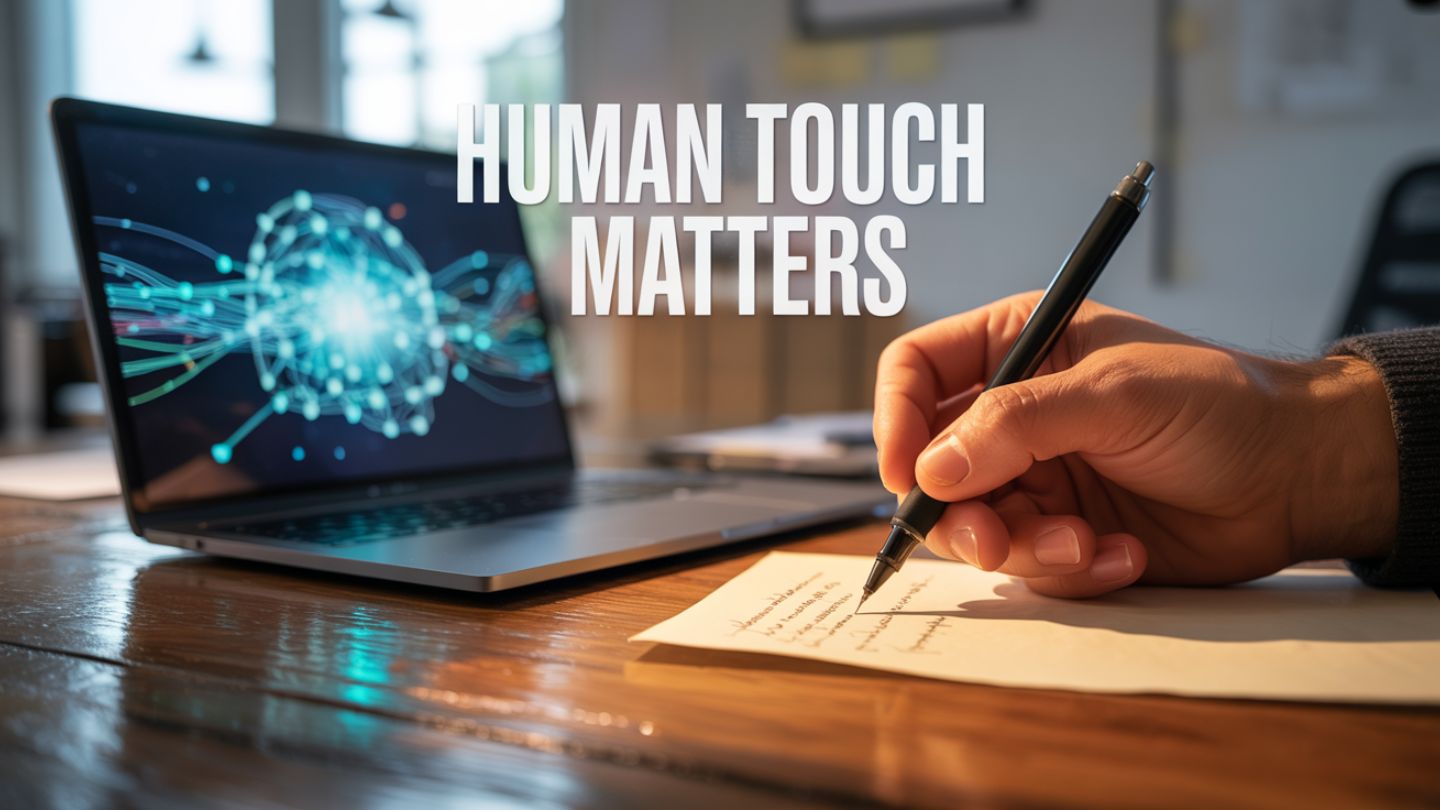
If you have opened LinkedIn or Twitter in the last year, you have seen the doomsday predictions. “AI is coming for your job.” “Writing is dead.” “Marketing teams are becoming obsolete.” The panic is palpable, but it is also largely misplaced.
Artificial Intelligence has undoubtedly shaken up the content marketing world. Tools like ChatGPT and Jasper can churn out blog posts in seconds, generate social media captions instantly, and analyze data faster than any human analyst could dream of. But does speed equal quality? Does efficiency replace connection?
The reality is far more nuanced than a simple “AI vs. Human” battle. We are looking at a shift in tools, not a replacement of talent. While algorithms are getting smarter, there are distinct, deeply human elements of marketing that code simply cannot replicate. Let’s dive into what AI does well, where it falls short, and why the future of content marketing is a partnership, not a takeover.
The Undeniable Power of AI in Content Creation
To understand where humans are needed, we first have to give credit where it is due. AI is not just a gimmick; it is a powerhouse for productivity. For content marketers who have spent years bogged down by repetitive tasks, these tools feel like a superpower.
Speed and scalability
The most obvious advantage is raw speed. A human writer might take four hours to research, draft, and edit a 1,500-word article. An AI model can generate a draft in under a minute. For businesses that need to scale content production, generating hundreds of product descriptions or SEO landing pages, AI is a logistical miracle. It removes the bottleneck of typing speed and basic composition. With the rapid growth, optimizing content for generative engines has become essential for organizations seeking to maintain their competitive edge and adapt quickly in an era of technological development.
Data Analysis and Pattern Recognition
AI excels at processing massive datasets. It can analyze thousands of competitor articles to identify keyword gaps or suggest topics that are currently trending. It removes the guesswork from strategy by providing data-backed suggestions on what to write about. It sees patterns in user behavior that might take a human strategist weeks to uncover. Additionally, gaining a detailed AI overview, such as understanding how citations in AI-generated content work and why they don’t always drive user engagement, helps marketers make informed decisions about data-driven content creation.
Overcoming the Blank Page
Writer’s block is a productivity killer. AI serves as a tireless brainstorming partner. It can generate fifty headline ideas, ten outline variations, or five different introductory hooks in moments. It acts as a springboard, getting the creative gears turning so marketers can jump straight into refining and polishing rather than staring at a blinking cursor.
The “Uncanny Valley” of Automated Content
Despite these superpowers, AI-generated content often hits a wall. You have probably read an article recently that felt… off. Maybe the phrasing was too perfect, the transitions too formulaic, or the insights strangely generic. This is the “uncanny valley” of text.
AI models are prediction engines. They predict the next likely word based on everything they have read before. This means they are inherently derivative. They cannot create something truly new; they can only remix what already exists. This leads to content that is technically accurate but emotionally hollow. It lacks the jagged edges, the hot takes, and the personal anecdotes that make writing memorable.
What Still Requires a Human Touch?

This is where the “vs.” in our title starts to break down. The battle isn’t about who writes faster; it’s about who connects deeper. There are specific realms of content marketing where human expertise remains absolutely irreplaceable.
1. Emotional Intelligence and Empathy
Marketing is not just about transferring information; it is about influencing behavior. To do that, you need to understand how people feel. An AI can tell you what a pain point is, but a human marketer understands how it feels to experience that pain.
A human writer knows how to use humor to disarm a skeptical reader. They know how to use vulnerability to build trust. They understand cultural nuances, sarcasm, and the subtle art of persuasion. AI struggles with tone. It often mistakes “professional” for “stiff” or “friendly” for “overly enthusiastic.” Humans navigate these emotional complexities instinctively.
2. Original Research and Lived Experience
AI cannot interview your CEO about their vision for the next five years. It cannot call up a satisfied customer and ask them for a quote about how your product changed their business. It cannot attend an industry conference and report on the mood in the room.
Great content often relies on primary sources, real conversations, original data, and lived experiences. When a marketer shares a personal story about a failure they learned from, it resonates because it is authentic. AI has no life, no experiences, and no failures. It can simulate a story, but it cannot share a truth. That’s why high-quality content crawled by Google often stands out; it’s informed by genuine insight and real-world perspective, something AI-generated content simply can’t duplicate.
3. Strategic Storytelling and Brand Voice
Every brand wants to stand out, but AI is designed to fit in. Because LLMs (Large Language Models) are trained on the average of the internet, their default output is average. If you ask an AI to write a “professional B2B article,” it will give you the most standard, middle-of-the-road version of that article.
A human content strategist builds a unique brand voice. They decide when to break grammatical rules for effect. They decide when to be controversial to spark debate. They weave a narrative thread that aligns with the company’s long-term goals, not just the immediate keyword requirements. Maintaining a consistent, distinct personality across emails, blogs, and social posts requires a human editor who understands the brand’s soul.
4. Ethics, Judgment, and Fact-Checking
AI hallucinations are real. Models can confidently state facts that are completely fabricated. In industries like healthcare, finance, or law, this is not just embarrassing; it is dangerous.
Human marketers act as the guardians of accuracy and ethics. They understand the weight of a claim. They know when a topic is too sensitive to be handled by an algorithm. They apply critical thinking to data sources. The judgment call, deciding whether we should publish this, not just can we write this, is a strictly human function.
The Future: The Centaur Model

So, where does this leave us? If AI provides speed and humans provide soul, the winner isn’t one or the other. It is the combination of both.
In chess, a “Centaur” is a team consisting of a human player and an AI computer. These teams consistently beat both solo human grandmasters and solo supercomputers. The future of content marketing is the Centaur Model.
Smart marketers are not fighting AI; they are orchestrating it. They use AI to transcribe interviews, summarize research, and generate rough outlines. This frees up their mental energy for the high-value tasks: interviewing experts, injecting personality, refining the strategy, and ensuring the final piece connects emotionally with the audience.
Adapting to the New Workflow
This shift requires marketers to evolve. The skill of “writing 500 words” is becoming less valuable than the skill of “editing and enhancing AI output.” We are moving from creators to curators.
- The Prompter: Learning how to talk to AI to get the best results is a new skill set.
- The Editor: The ability to spot a generic AI sentence and rewrite it with flair is crucial.
- The Strategist: As content becomes cheaper to produce, the strategy behind why we produce it becomes more valuable.
Final Thoughts
AI In an era crowded with automation, the core message is simple: content succeeds when it connects. The future belongs to brands that prioritize authenticity, emotional resonance, and genuine problem-solving over speed or volume. Human-driven storytelling remains the differentiator, even as AI accelerates workflows and expands creative capacity.
At The Ocean Marketing, we build strategies that merge technology with strong creative judgment, ensuring your Content Writing maintains a human pulse while your search visibility is supported through smart optimization. Conducting an in-depth review of your site’s performance through an SEO Audit from our team. Contact us to get the clarity needed to align your content with true audience intent.