Skip to content
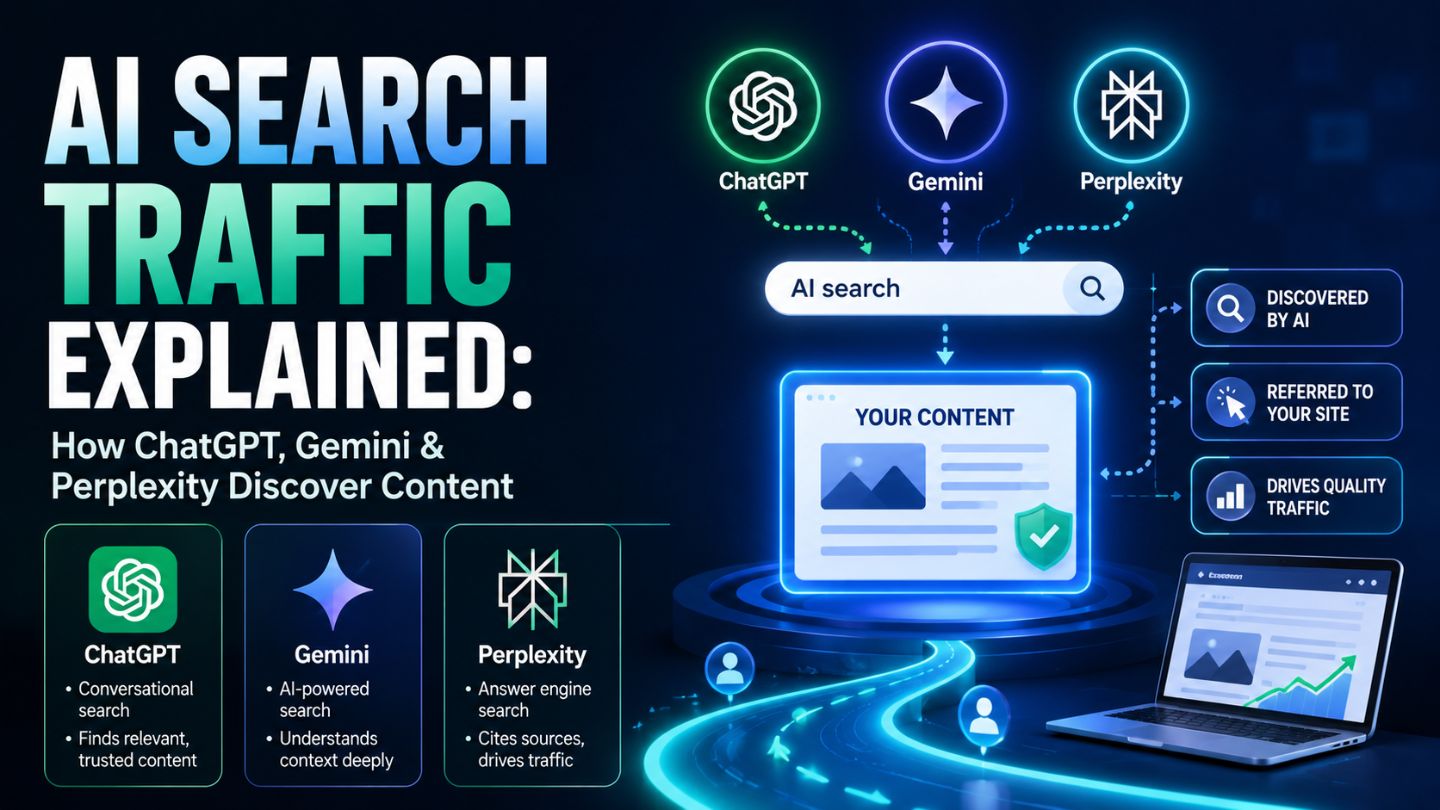
Search behavior is changing faster than many businesses realize. Instead of relying only on traditional search engines, users are increasingly turning to AI-powered platforms like ChatGPT, Gemini, and Perplexity to get direct answers, recommendations, and research support. As these tools become part of everyday online experiences, understanding how they find and reference content is becoming essential for website owners, marketers, and content creators. This blog outlines how AI search traffic works, how major AI platforms discover information, and what factors influence whether your content gets surfaced in AI-generated responses. In this blog, we’ll discuss what this shift means for visibility and how businesses can adapt their content strategies accordingly.
Key Takeaways
- AI search platforms gather information differently from traditional search engines.
- Content quality, authority, and structure influence AI visibility.
- Technical SEO still plays an important role in content discovery.
- AI tools often rely on multiple sources to generate responses.
- Clear, helpful, and trustworthy content has a better chance of being referenced.
- Businesses should optimize for both traditional and AI-driven search experiences.
The Rise of AI Search Traffic
For years, search traffic was largely associated with search engines such as Google and Bing. Users typed queries, reviewed search results, and clicked links that seemed relevant. AI search tools have introduced a different experience by delivering summarized answers directly within the interface, often reducing the need for multiple searches. This shift has created a new category of traffic known as AI search traffic. Visitors may discover your website because an AI assistant referenced your content, cited your page, or used information from your website to answer a user’s question. As adoption grows, understanding these pathways becomes increasingly important for maintaining online visibility.
How AI Platforms Gather Information
Although ChatGPT, Gemini, and Perplexity are often grouped together, they don’t all access information in exactly the same way. Each platform combines different technologies, data sources, and retrieval methods to generate responses for users. Some AI systems rely on previously trained knowledge, while others actively retrieve information from the web in real time.
Many modern AI platforms use a combination of both approaches. This allows them to provide current information while also drawing from broader patterns and context learned during training. This also connects closely with how answer engines present the most useful response when users expect a direct answer instead of a list of links.
Training Data vs. Real-Time Retrieval

Large language models are trained on vast amounts of publicly available information, books, websites, articles, and other digital content. This training helps AI systems understand language, concepts, and relationships between topics. However, training data alone has limitations because information changes constantly. To address this, many AI search experiences incorporate retrieval systems that pull information from current online sources when needed. This helps generate more accurate and up-to-date responses while connecting users to relevant websites.
How ChatGPT Discovers Content
ChatGPT can generate answers based on its training data, but when web access is enabled, it can also retrieve information from online sources. In these cases, content discovery depends on whether websites are crawlable, accessible, and considered useful for answering user queries. Web pages that provide clear explanations, strong topical relevance, and trustworthy information are more likely to contribute to responses. Structured content, descriptive headings, and comprehensive coverage often make it easier for AI systems to interpret and utilize information effectively. Website owners who want better visibility can also benefit from learning how to get a website indexed by ChatGPT search.
How Gemini Finds and Uses Information
Gemini benefits from Google’s extensive search infrastructure and understanding of web content. Since Google has spent decades organizing and evaluating online information, Gemini can leverage many of the same signals that help determine content quality and relevance. Content that performs well in traditional search often has advantages in AI search environments because it already demonstrates expertise, authority, and usefulness. While ranking factors may not be identical, strong SEO foundations frequently support visibility across both search formats.
Why Perplexity Places Heavy Focus on Sources
Perplexity has become known for emphasizing citations and source transparency. Rather than simply providing answers, it often highlights the websites that contributed to the response, making source quality especially important. Because citations are central to the user experience, websites with clear, informative, and well-supported content may gain additional exposure through Perplexity’s results.
This approach encourages publishers to focus on accuracy, depth, and credibility rather than producing content solely for search rankings. For a deeper look at source selection, it helps to understand how Google chooses sources for AI-powered answers across modern search results.
What Makes Content More Discoverable to AI?
AI platforms are designed to identify information that best answers user questions. While exact algorithms vary, several common characteristics tend to improve discoverability. Some important factors include:
- Clear and logical content structure
- Accurate and trustworthy information
- Strong topical relevance
- Descriptive headings and subheadings
- Well-organized website architecture
- Updated and current information
- Authoritative sources and references
- Positive user experience signals
Creating content with readers in mind often aligns naturally with what AI systems seek when generating responses. This balance between user value and content clarity can improve visibility across AI-powered search platforms.
Read More: Content Depth vs Clarity: Which Drives Better Rankings?
Why Traditional SEO Still Matters
There’s a misconception that AI search will replace SEO entirely. In reality, many AI discovery systems still depend on the same foundations that help search engines understand websites. Technical accessibility, content quality, internal linking, and site authority remain highly relevant. When search engines can crawl, index, and interpret your content effectively, AI systems often benefit as well. Strong SEO creates a solid framework that supports visibility across multiple discovery channels rather than limiting your reach to traditional search results alone.
Technical Elements That Support AI Discovery
Several technical factors can influence whether content is easily found and understood by AI systems, including:
- Fast-loading pages
- Mobile-friendly design
- Clean site architecture
- Proper schema markup
- Crawlable page structures
- Secure HTTPS connections
- Logical internal linking
These elements improve content accessibility and help both search engines and AI systems process information more efficiently. They also make it easier for users to navigate and engage with your website.
The Growing Importance of Content Quality
As AI-generated answers become more sophisticated, low-value content is becoming easier to identify and ignore. Platforms increasingly prioritize information that demonstrates expertise, provides genuine value, and answers user intent effectively. This means businesses should focus less on keyword stuffing and more on creating useful resources. Detailed guides, original insights, practical explanations, and topic expertise are more likely to stand out than content created solely to target rankings.
User Intent Is Becoming More Important Than Ever
One of the biggest strengths of AI search is its ability to understand context. Instead of matching keywords alone, AI systems attempt to determine what users actually want to know. Because of this, content should be developed around real questions, challenges, and informational needs. When a page addresses user intent clearly and thoroughly, it becomes more useful not only for readers but also for AI systems looking for reliable information sources.
Preparing Your Website for the Future of AI Search

Businesses do not need to completely reinvent their digital marketing strategies to benefit from AI search. In many cases, the fundamentals remain the same: create valuable content, maintain technical SEO health, and build topical authority within your industry. The difference is that content now needs to serve both human readers and AI systems. Clear structure, accurate information, strong expertise signals, and comprehensive topic coverage can help increase the likelihood of being discovered, referenced, and recommended by AI-powered platforms.
Read More: Topical Authority vs Keyword Authority: Which Drives Rankings Faster?
Final Thoughts
AI search traffic is reshaping how people discover information online. Platforms like ChatGPT, Gemini, and Perplexity are changing user behavior by delivering answers more directly while still relying on high-quality web content behind the scenes. Businesses that focus on relevance, authority, usability, and helpful information will be better positioned to benefit from this evolving search landscape.
At The Ocean Marketing, we help businesses adapt to emerging search trends through strategic SEO services. If you’re interested in understanding how your website is performing and where new opportunities may exist, request our free SEO audit. Contact us today to learn how we can help improve your visibility across both traditional search engines and AI-powered discovery platforms.