
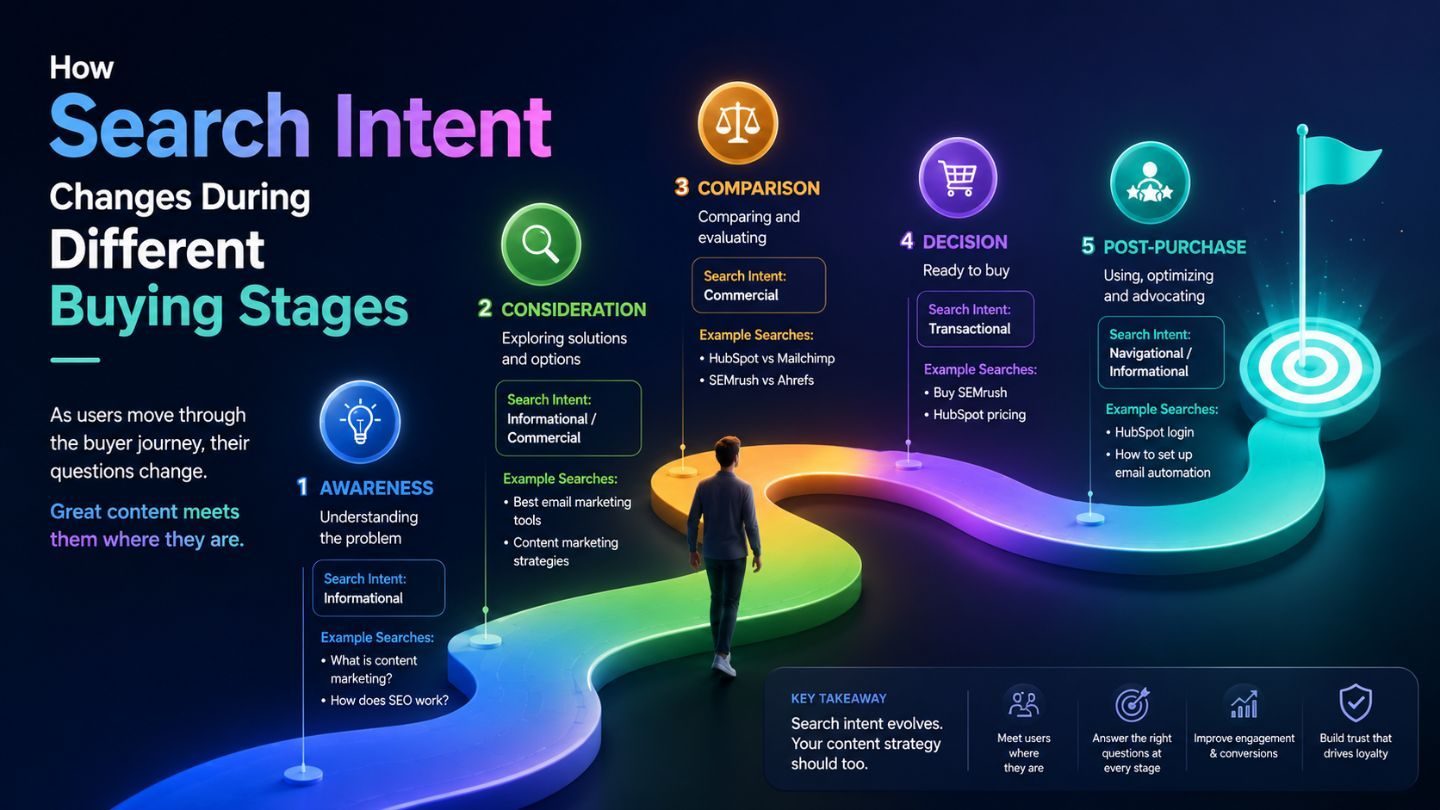
Search intent plays a major role in how customers interact with businesses online throughout their buying journey. As people move from researching a problem to making a final purchase decision, their search behavior and expectations change significantly. Understanding these shifts helps businesses create more relevant content that connects with users at the right stage. This blog outlines how search intent evolves during different buying stages, why it matters for content strategy, and how businesses can align their SEO efforts with customer behavior. By understanding user intent more effectively, brands can improve engagement, build trust, and increase conversions naturally.
Key Takeaways
- Search intent changes as users move from awareness to purchase decisions
- Informational searches dominate the early buying stage
- Commercial and transactional searches increase near conversion
- Content strategy should match the buyer’s mindset at every stage
- SEO success depends on satisfying user intent, not just ranking keywords
- Different content formats work better for different buying stages
- Businesses that align content with intent often see better engagement and leads
Understanding Search Intent and Why It Matters
Search intent refers to the reason behind a user’s online search. Some users are looking for information, while others are comparing products or preparing to make a purchase. Search engines have become highly advanced in identifying these intentions, which means websites must provide content that matches user expectations if they want to rank effectively. A keyword alone is no longer enough because search engines now focus on relevance, usefulness, and overall user experience.
A deeper understanding of search intent and why it is important for SEO also helps brands plan content around what users actually expect at each step. Instead of publishing generic blogs, they can deliver information that feels timely and helpful to readers. This improves trust, increases time spent on the site, and creates a smoother path toward conversions. Matching intent also helps reduce bounce rates because visitors find answers that directly relate to what they searched for online.
The Awareness Stage and Informational Intent
At the awareness stage, buyers are only beginning to recognize a problem or need. They are not ready to buy immediately because they first want to understand their situation better. Their searches are usually broad and educational, focusing on learning more about a topic. Keywords often include phrases such as “how to,” “why,” “what is,” or “tips for,” which signal informational intent rather than commercial interest.
Content created for this stage should focus on education rather than selling. Blog posts, guides, explainer articles, and beginner-friendly resources perform well because they help readers gain clarity. Businesses that push aggressive promotions too early can lose trust because users at this stage are looking for helpful insights, not sales pressure. Providing valuable information establishes authority and encourages users to return when they are ready for the next step.
Why Educational Content Builds Long-Term Trust
Educational content plays an important role in attracting users during the early stages of the buying process. People often remember brands that helped them solve problems before asking for anything in return. This creates a sense of credibility and makes future interactions more natural. Readers are more likely to trust businesses that prioritize guidance over direct selling because it shows expertise and customer understanding.
Another advantage of educational content is its ability to generate consistent organic traffic over time. Informational searches usually have high search volume because many users are researching similar topics. Well-optimized articles that genuinely answer user questions can continue attracting visitors for months or even years. These visitors may later move into the consideration stage, making early-stage content an essential part of a long-term digital strategy.
The Consideration Stage and Commercial Intent
As buyers move into the consideration stage, their search behavior becomes more specific. They already understand their problem and are now exploring possible solutions. Instead of broad educational searches, they begin comparing products, services, or providers. Keywords often include words such as “best,” “top,” “reviews,” “comparison,” or “alternatives,” which indicate commercial intent and growing purchase interest. Content at this stage should help users evaluate their options clearly.
Comparison articles, case studies, expert recommendations, and product breakdowns work especially well because they provide decision-making support. This is also where B2B and B2C SEO content writing becomes important because different audiences compare solutions, timelines, and trust signals in different ways. Buyers want reassurance that they are making the right choice, so transparency and practical details become highly important. Businesses that offer balanced and informative content can position themselves as trustworthy guides during this critical stage.
Read More: How Skimmable Content Boosts Engagement & Conversions
How User Expectations Become More Specific

During the consideration phase, users expect more detailed and solution-focused information. General explanations are no longer enough because buyers want content that directly addresses their unique concerns. They may search for pricing expectations, feature comparisons, customer experiences, or industry-specific recommendations. This change in behavior reflects growing confidence in the buying journey and a stronger desire for practical insights.
Brands that recognize these expectations can improve engagement by creating highly targeted content. Instead of publishing broad topics, they can answer niche questions that matter to potential customers. Personalized examples, real-world scenarios, and measurable benefits help users connect more strongly with the content. The more relevant the information feels, the more likely readers are to continue exploring the brand and eventually convert.
The Decision Stage and Transactional Intent
At the decision stage, users are close to making a purchase. Their searches become highly action-oriented because they already know what they want and are looking for the final push toward conversion. Keywords may include phrases like “buy now,” “contact,” “pricing,” “services near me,” or specific brand names. This is known as transactional intent because users are ready to take direct action.
Content for this stage should focus on removing doubts and simplifying the decision-making process. Clear service pages, pricing information, customer testimonials, and strong calls to action are extremely important here. Buyers want confidence that they are choosing the right provider, so trust signals such as reviews, certifications, and guarantees can strongly influence conversions. A confusing or incomplete page at this stage may cause potential customers to leave and choose a competitor instead.
Why Strong CTAs Matter in the Final Buying Stage
A well-placed call to action helps guide users toward the next step when they are ready to convert. Buyers at the transactional stage do not want unnecessary distractions because they are focused on completing a task efficiently. Clear instructions, such as contacting a company, requesting a consultation, or exploring services, can improve conversion rates significantly when presented naturally within the content. At this stage, SEO and CRO for business growth matter because traffic alone is not enough unless the page also encourages users to take meaningful action.
Strong CTAs should feel supportive rather than forceful. Instead of pressuring readers, businesses should emphasize how their services can help solve problems effectively. A helpful tone encourages users to trust the brand while making the process feel more comfortable. Effective CTAs also align with the search intent of users by offering exactly what they are already looking for at that stage of the journey.
How Search Engines Interpret Intent More Accurately
Modern search engines rely on advanced algorithms and user behavior analysis to understand search intent more effectively than ever before. They examine factors such as click-through rates, time spent on pages, search patterns, and content relevance to determine which results best satisfy users. This means websites that ignore intent often struggle to maintain rankings, even if they use the right keywords frequently.
Search engines also analyze the type of content users prefer for specific queries. For example, informational searches may prioritize blog articles and guides, while transactional searches may display product pages or service websites. Businesses that adapt their content strategy to these patterns can improve visibility and provide a better user experience. Understanding intent is now a central part of modern SEO rather than an optional optimization tactic.
Matching Content Formats to Buying Stages
Different content formats naturally align better with certain buying stages. Awareness-stage users respond well to educational blogs, videos, and beginner guides because these formats make information easier to understand. Consideration-stage users often prefer comparisons, case studies, webinars, and detailed reviews that support evaluation and research. Transactional users, on the other hand, look for concise landing pages, testimonials, and direct service information.
Choosing the right format helps businesses communicate more effectively with their audience. Content that matches user expectations feels more relevant and engaging, which increases the likelihood of conversions. A mismatch between format and intent can confuse readers or reduce trust because the information may not feel appropriate for their current needs. Successful content strategies focus on delivering the right message in the right format at the right time.
Read More: Types of Content Writing Meant for Your Business
Common Mistakes Businesses Make With Search Intent

One common mistake businesses make is focusing only on keywords without understanding the user’s true purpose behind them. A keyword may attract traffic, but if the content does not align with user expectations, visitors are unlikely to engage meaningfully. This often leads to high bounce rates and lower conversion performance because readers do not find the answers they expected.
Another mistake is using overly promotional language during the early buying stages. Users who are still researching problems may feel discouraged by aggressive sales tactics because they are not ready to commit yet. Businesses should instead guide readers gradually through the customer journey with helpful and relevant information. Aligning tone, structure, and content goals with search intent creates a more natural and effective experience for potential customers.
The Role of SEO in Understanding Buyer Behavior
SEO is no longer just about rankings and keyword placement because it now involves understanding customer psychology and behavior patterns. Businesses that study how users search at different buying stages can create content strategies that feel more personalized and useful. This approach improves visibility while also building stronger relationships with audiences over time.
A successful SEO strategy focuses on delivering value at every stage of the customer journey. By understanding intent, businesses can create content that educates, supports, and converts readers naturally. This balanced approach leads to more meaningful engagement and better long-term growth because users feel understood rather than targeted by generic marketing efforts.
Final Thoughts
Understanding how search intent changes during different buying stages is essential for creating content that truly connects with users. From informational searches in the awareness stage to transactional queries near conversion, every stage reflects a different customer mindset and expectation. Businesses that align their content with these changing behaviors can improve engagement, build stronger trust, and guide users more effectively through the buying journey. A well-planned strategy focused on user intent not only supports better rankings but also creates a more meaningful experience for potential customers.
At The Ocean Marketing, we help businesses strengthen their online presence with strategic SEO solutions designed around user behavior and search intent. Whether you want to improve visibility, attract qualified traffic, or understand how your website is performing, our team can assist you with a free SEO audit tailored to your business goals. Contact us today and let our team help you build a stronger and more effective digital presence.