Skip to content
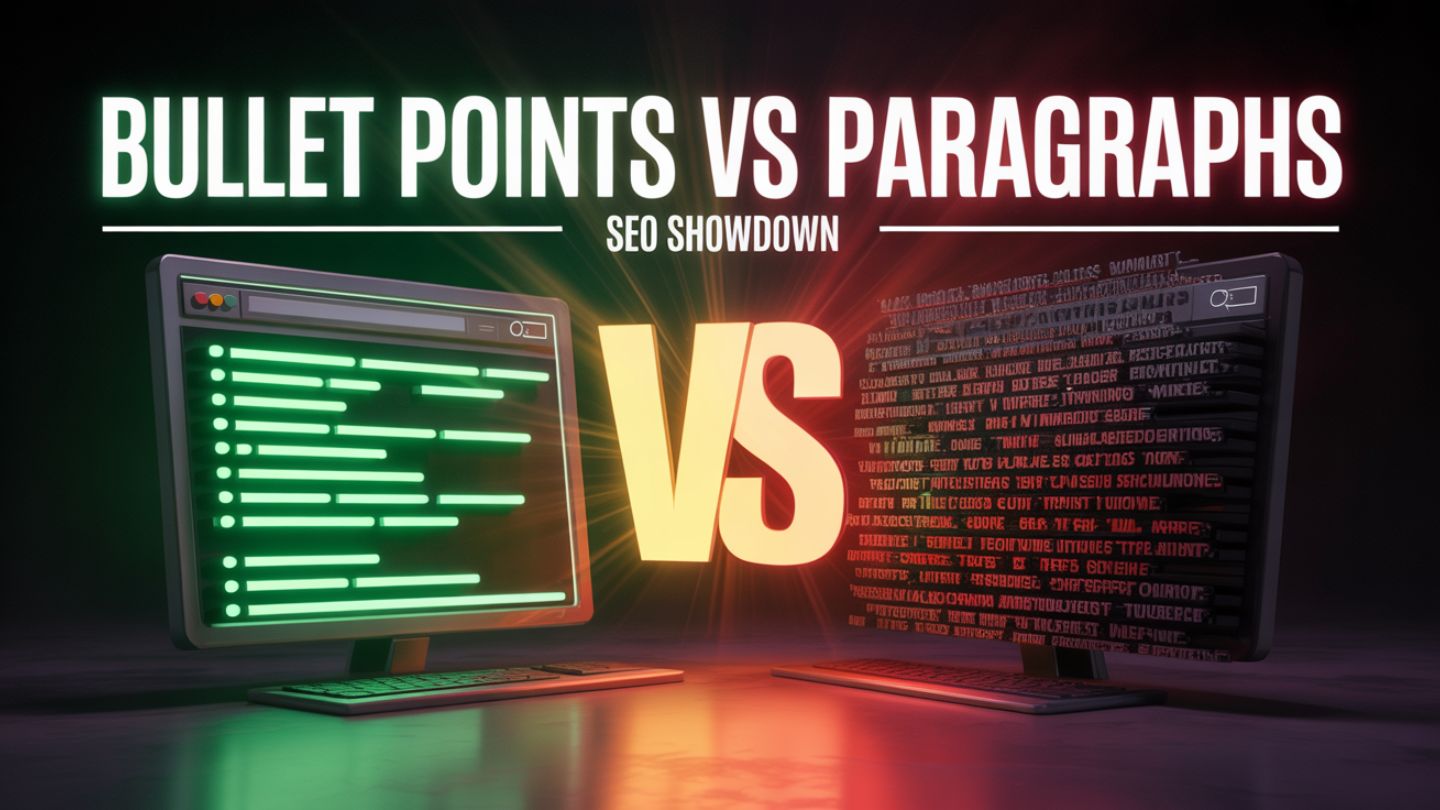
You’ve likely heard the advice a thousand times: “Break up your text.” “Make it scannable.” “Use white space.” But does Google care about how your content looks, or is it purely reading the words regardless of formatting? The debate between using bullet points versus traditional paragraphs isn’t just about aesthetics; it’s about how search engines digest, interpret, and rank your information.
Understanding how Google’s algorithms parse different content structures can be the difference between landing a featured snippet and getting buried on page two. Let’s dive deep into the mechanics of Google’s interpretation of lists versus blocks of text and how you can leverage both for maximum visibility.
Key Takeaways
- Google interprets formatting as a structural signal, not just visual design. HTML tags like <p>, <ul>, and <ol> help define content relationships.
- Paragraphs strengthen semantic relevance by providing context, depth, and natural keyword integration.
- Bullet points improve clarity, entity recognition, and increase the chances of earning featured snippets.
- “What” and “Why” queries typically favor concise paragraph answers, while “How to,” “Best,” and “Types of” queries favor structured lists.
- Combining paragraphs and bullet points creates the strongest SEO impact by balancing depth with skimmability.
- Strategic formatting enhances user experience, engagement signals, and overall search visibility.
The Algorithm’s Perspective: Structure is Signal
Google’s primary goal is to deliver the most relevant answer to a user’s query as quickly as possible. To do this, its crawlers need to understand the relationship between concepts on your page. This is where formatting becomes a critical signal.
When Googlebot crawls a page, it doesn’t just “read” the text; it analyzes the HTML tags that structure that text. It sees <ul> (unordered lists), <ol> (ordered lists), and <p> (paragraphs) as distinct data types. Each carries a different weight and implies a different type of information relationship.
This structural clarity is a core principle behind content chunking for SEO, where breaking information into logical sections improves crawlability, comprehension, and overall engagement signals.
How Google Sees Paragraphs

Paragraphs are the bread and butter of web content. Google views paragraphs as deep-dive content. They provide context, nuance, and detailed explanations.
From an algorithmic standpoint, paragraphs are used to establish semantic relevance. This is where Natural Language Processing (NLP) models like BERT (Bidirectional Encoder Representations from Transformers) shine. BERT analyzes the words in a sentence relative to all other words to understand context.
Advantages of Paragraphs:
- Contextual Depth: Paragraphs allow you to weave in long-tail keywords naturally.
- Narrative Flow: They help Google understand the “story” or logical progression of your argument.
- Sentiment Analysis: It is easier for algorithms to determine the sentiment (positive, negative, neutral) of a review or opinion piece within a paragraph structure.
Disadvantages of Paragraphs:
- Density Issues: If a paragraph is too long, Google might struggle to extract specific answers quickly.
- User Signals: Large walls of text often lead to higher bounce rates. Since user engagement signals (like time on page) indirectly influence rankings, poor readability hurts you.
This balance between depth and readability also ties into the broader discussion around ideal blog post length for SEO, where structure matters just as much as word count in determining search performance.
How Google Sees Bullet Points
Bullet points are efficiency engines. To Google, a list signals condensed information, steps in a process, or a collection of related items.
This format is particularly powerful for Entity Recognition. If you list five different types of apples, Google quickly identifies that the parent topic is “Apples” and the child entities are “Granny Smith,” “Fuji,” “Gala,” etc. The structure does the heavy lifting, so the algorithm doesn’t have to guess the relationship between the terms.
Advantages of Bullet Points:
- Featured Snippet Bait: Google loves lists for “Position Zero.” If a user asks “How to bake a cake,” Google prefers a numbered list over a 500-word narrative paragraph.
- Mobile-First Indexing: Lists render beautifully on mobile devices, which aligns with Google’s mobile-first approach.
- Skimmability: They improve the user experience (UX), keeping readers on the page longer.
Disadvantages of Bullet Points:
- Lack of Nuance: You cannot explain complex theories easily in a bullet point.
- Thin Content Risk: A page made entirely of lists might be flagged as “thin content” if it lacks sufficient depth or original analysis.
The Battle for the Featured Snippet

The most tangible impact of the “bullets vs. paragraphs” choice is seen in Featured Snippets. These are the boxes of information that appear at the very top of search results. Strong formatting combined with strategic SERP copywriting for optimized titles and descriptions increases the likelihood that Google selects your content for these prime positions.
When to Use Paragraphs for Snippets
Google tends to pull paragraph snippets for “What is” or “Why” questions. These queries require definitions or explanations.
- Example Query: “Why is the sky blue?”
- Ideal Format: A clear, concise paragraph (40–60 words) that directly answers the question in the first sentence.
When to Use Bullet Points for Snippets
Google almost exclusively pulls lists for “How to,” “Best of,” or “Types of” queries.
- Example Query: “Steps to change a tire.”
- Ideal Format: An ordered list (<ol>) where each step is clearly defined.
- Example Query: “Best marketing tools.”
Final Thoughts
In the end, the debate between bullet points and paragraphs isn’t about choosing one over the other; it’s about understanding how Google interprets structure as a signal. Paragraphs provide semantic depth, context, and authority, while bullet points deliver clarity, entity relationships, and snippet-friendly formatting. The real SEO advantage comes from strategically combining both formats to improve crawlability, enhance user experience, and increase your chances of earning featured snippets.
At The Ocean Marketing, our approach to SEO and content writing focuses on building content that balances structure, readability, and search intent. From optimizing formatting for featured snippets to conducting a detailed audit that uncovers structural and on-page opportunities, every strategy is designed to strengthen rankings and engagement. Businesses looking to evaluate their current content performance can start with a comprehensive free SEO audit to identify gaps and unlock scalable growth opportunities. Contact us today, and let’s transform your content into a high-ranking SEO growth engine.