Skip to content
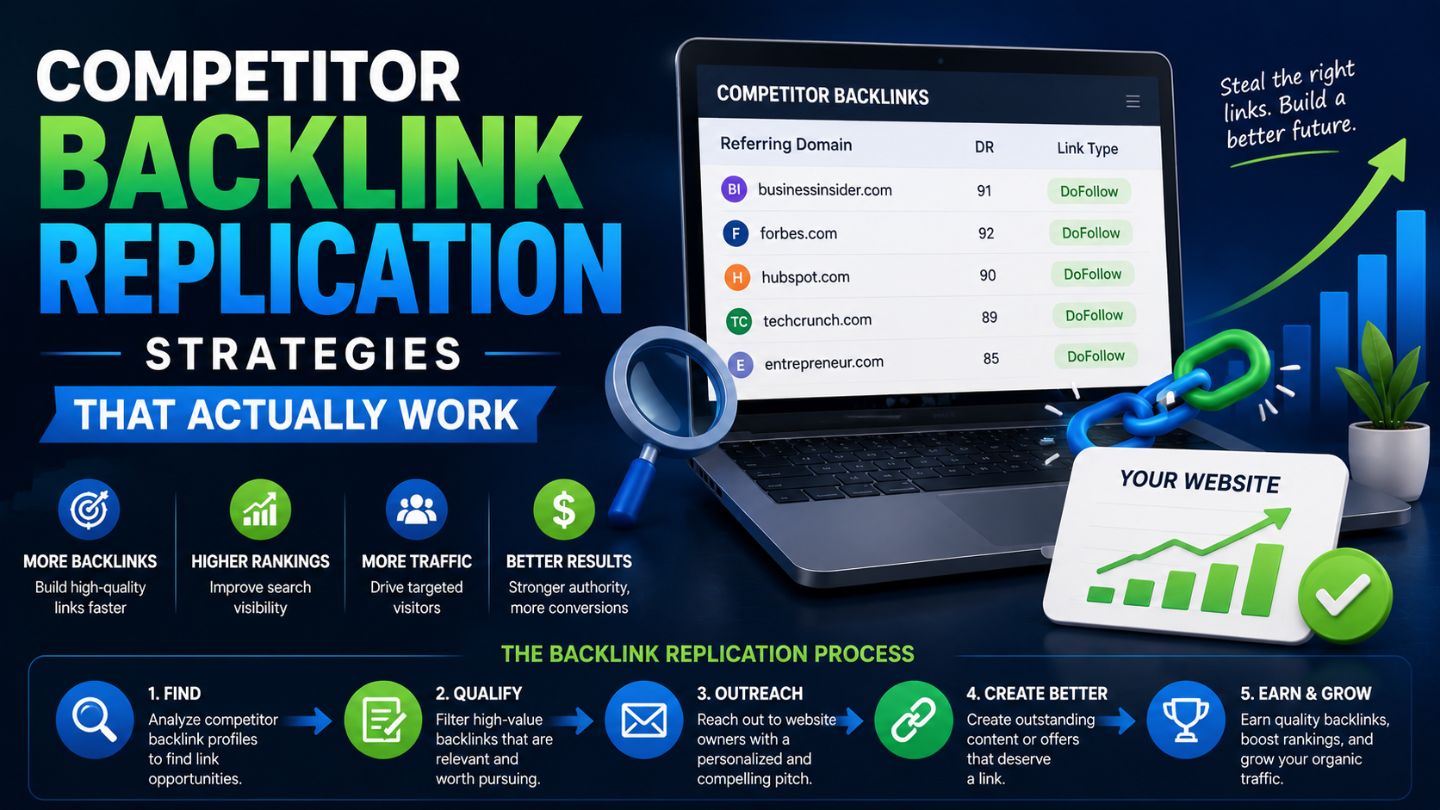
Competitor backlink analysis gets sold as a shortcut: export their links, get the same ones, rank where they rank. It rarely works that way, because most of their links aren’t replicable, and chasing the ones that are, indiscriminately, burns weeks for nothing. The useful version is more selective and less exciting. This blog outlines what competitor link data actually tells you, which links are genuinely worth pursuing, why blind replication fails, and how to use the analysis to find opportunities rather than a to-do list.
Key Takeaways
- Most competitor backlinks cannot be replicated and shouldn’t be chased.
- Link gaps across several competitors reveal the real opportunities.
- Understanding why a link exists matters more than that it exists.
- Replication without a reason to link produces rejection at scale.
- The analysis should generate strategy, not a checklist.
What Competitor Link Data Really Shows
A competitor’s backlink profile is a record of how they built authority over the years, which is genuinely useful information and frequently misread. It tells you which publications cover your industry, which formats earn references, and what kind of content gets linked. That’s intelligence.
What it doesn’t give you is a list of links you can go get. Their profile includes relationships, coverage from a launch, a founder’s old contacts, and dozens of links that exist for reasons that have nothing to do with anything you could replicate. Treating the export as a target list confuses the record of their history with a plan for your future, and those are very different documents.
Why Blind Replication Fails
The mechanics are unforgiving. You email a site that linked to your competitor and ask for the same treatment. The writer has no reason to care, no relationship with you, and no gap in their article that your link would fill. They already covered the subject, using someone else. You’re asking them to redo work for a stranger’s benefit.
That’s before the links that were never available. Sponsorships you didn’t pay for. A partner’s site. Coverage of a funding round you didn’t have. A directory that their industry association runs and yours doesn’t. A large chunk of any competitor profile falls into this category, and filtering it out is the first real task. Knowing how to recognize high-quality backlinks helps you cut the list down before you waste outreach on it.
Ask Why the Link Exists
Every link has a reason. If you can’t identify one that would apply to you, the link isn’t an opportunity; it’s just something that happened to someone else.
Read More: Contextual Link Building: What Actually Passes Value
The Gap Analysis That Actually Works

The valuable move isn’t looking at one competitor; it’s looking at several. Sites linking to three or four of your competitors but not to you are doing something specific: they cover this space, they link to businesses like yours, and they’ve somehow missed you. That’s a genuine gap rather than a coincidence.
Those sites are worth real attention, because the editorial precedent is established. They link to companies in your category, so the objection isn’t category-level. Something else is missing, usually awareness or a reason. That’s a solvable problem in a way that “they linked to a competitor once” isn’t, and it’s a far shorter list to work through. A link intersect analysis is the quickest way to produce that shortlist.
Finding the Content Pattern
Look at what earned the links rather than which domains gave them. If your competitor’s most-linked page is original research, that tells you something about your market that no domain list will. If it’s a free tool, or a definitive guide, or an industry survey they run annually, the lesson is about format and substance.
That insight is more valuable than any individual link, because it’s repeatable. Building your own version of whatever earns links in your space produces an asset that keeps attracting them, rather than a one-time outreach win. The competitor’s links are the evidence; the pattern behind them is the strategy. Approaches like building links without outreach emails work on exactly this principle.
The Links Genuinely Worth Chasing
A narrow set survives the filter. Resource pages and curated lists in your industry, where inclusion is the point, and the maintainer wants a complete list. Roundups that get updated, where a new entry is welcome rather than an imposition. Broken links pointing at pages that no longer exist, where you’re offering a fix rather than a favor. Google has its own advice on fixing broken backlinks that is worth reading before you pitch the replacement.
Also worth pursuing: sites that mentioned your competitor in a comparison where you’d legitimately belong, and publications that regularly cover your space but haven’t heard of you. Both have a natural reason to include you. Everything else on the export is noise, and being ruthless about that distinction is what separates useful analysis from a spreadsheet nobody finishes.
Timing Is Part of Why Their Links Exist
One thing an export can never show you is when the window was open. A competitor who launched into an uncrowded market got coverage that isn’t available now because the story was new then and isn’t anymore. Their link from a major publication reflects a moment, not a repeatable tactic.
That matters for expectations. Chasing the same publication with the same angle three years later means pitching a story that’s already been told, using them as evidence it works. The transferable lesson is that they found an angle when it was fresh, and your version of that is finding one now rather than replaying theirs. Their profile is a record of good timing as much as good outreach, and timing is the part you can’t copy.
Where This Analysis Really Pays Off
The best outcome from competitor link research usually isn’t links at all; it’s understanding. You learn which publications matter in your industry, what they cover, what earns their attention, and where your competitors have built positions you’ll never dislodge. That last part is valuable, knowing where not to fight saves more than winning small battles gains.
It also surfaces gaps in your own profile that have nothing to do with competitors. Categories of links everyone in your space has, and you don’t. Formats that earn references that you’ve never produced. Auditing your own profile alongside theirs, which is what a proper backlink audit checklist is for, turns the exercise from copying into diagnosis.
Picking the Right Competitors to Study
The competitor you worry about in sales meetings is often the wrong one to study for links. A business ten times your size has a link profile built on resources you don’t have, and copying their strategy means copying something you can’t execute.
More useful is the competitor slightly ahead of you, similar in size, further along. Their links were earned under constraints resembling yours, which makes their profile a plausible map rather than an aspiration. Studying the market leader tells you where you might get in a decade. Studying the business one step ahead tells you what to do this quarter.
Read More: Competitor Analysis: How to Find Competitors of Any Website
The Tools Only Show Part of the Picture
Every backlink tool has partial coverage. They crawl what they crawl, miss what they miss, and different tools return meaningfully different profiles for the same domain. Treating any single export as complete is the first error, and drawing confident conclusions from an incomplete picture is the second.
The practical adjustment is checking more than one source when the decision matters, and being skeptical of gaps. A link your tool doesn’t show might not exist, or might just be invisible to that crawler. Neither certainty is available, which argues for using the data as direction rather than as inventory.
Turning Analysis Into a Plan

The most common failure is a spreadsheet with four hundred rows that nobody ever works through. The analysis produced data, the data produced no decisions, and six months later, someone runs the export again. That’s a hobby rather than a strategy.
The fix is filtering hard before you start. From a full export, the genuinely actionable list is usually under thirty rows, and it fits on one screen. That’s a project someone can finish. Four hundred rows is a project someone will abandon in week two, and abandoning it feels like the analysis failed when really the filtering did.
What Their Gaps Tell You
The analysis usually focuses on what competitors have that you don’t. The reverse is worth a look too. Categories of links nobody in your space has earned represent either an opportunity everyone missed or a dead end everyone already tested.
Distinguishing those takes judgment rather than data. If no competitor has coverage in a publication your customers read, that’s worth investigating. If nobody in your industry has links from a category that seems obviously relevant, ask why before assuming you’ve spotted something they all missed. Sometimes the gap is an opening, and sometimes it’s a warning.
Using Competitor Data Properly
Competitor backlink replication fails when it’s treated as a copying exercise and works when it’s treated as research. Most of their links aren’t available to you, and chasing them wastes outreach on people with no reason to say yes. What the data genuinely offers is a map: which sites cover your space, which formats earn references, where multiple competitors are linked, where you aren’t, and where the fight is already lost. Use it to find the pattern and the gaps, then build something worth linking to.
At The Ocean Marketing, we approach link building as a strategy built on what’s actually achievable rather than a list exported from a tool. Whether you want help interpreting competitor data, auditing your own profile, or starting with a free SEO audit to see where your site stands, our team can help. Contact us and let’s find the opportunities that are really there.