
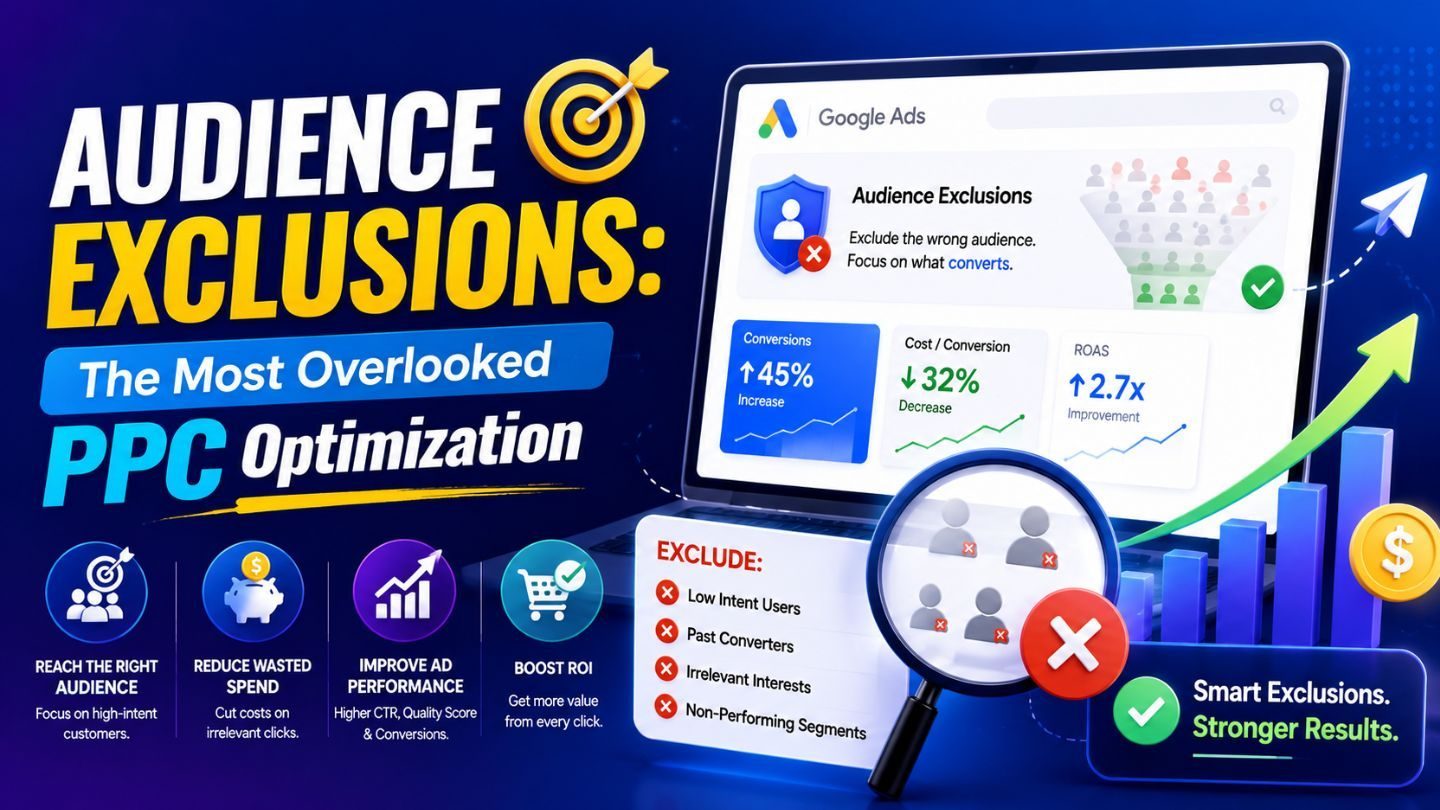
Many advertisers spend countless hours refining keywords, adjusting bids, and testing ad copy, yet still struggle with wasted ad spend. One of the most common reasons is that ads continue reaching people who are unlikely to convert. That's where audience exclusions come into play. While targeting often gets the spotlight, excluding the wrong audiences can be just as impactful. In this blog, we'll discuss why audience exclusions are among the most overlooked PPC optimization strategies, how they improve campaign performance, and where marketers can apply them to achieve better results.
Key Takeaways
- Audience exclusions help reduce wasted ad spend.
- They improve targeting precision and campaign efficiency.
- Excluding existing customers can prevent unnecessary spending.
- Better audience filtering often leads to stronger conversion rates.
- Audience exclusions should be reviewed regularly as campaigns evolve.
- Strategic exclusions help improve overall PPC return on investment.
Why Most PPC Campaigns Waste Budget on the Wrong Users
One of the biggest misconceptions in paid advertising is that success comes solely from reaching more people. In reality, campaign performance often improves when advertisers focus on reaching fewer, but more qualified, users. Even the most carefully selected keywords can attract visitors who have little intention of becoming customers.
Without audience exclusions, ads may appear to users who have already converted, to people researching competitors, to job seekers, to existing subscribers, or to audiences that don't fit the business's ideal customer profile. Every click from these users consumes budget that could be directed toward more valuable prospects. Over time, those unnecessary clicks can significantly impact campaign profitability. This is also why many advertisers focus on optimizing PPC campaigns for higher-quality leads before scaling spend.
Understanding Audience Exclusions Beyond Basic Targeting
Audience targeting tells advertising platforms who you want to reach. Audience exclusions tell them who you don't want to reach. While that distinction sounds simple, many advertisers fail to take full advantage of exclusion opportunities across their campaigns. Think of audience exclusions as a filtering system. Instead of allowing ads to reach everyone in a target group, exclusions remove segments that are unlikely to yield meaningful results. This additional layer of control helps create cleaner audience pools and allows marketing budgets to focus on users with stronger purchase intent.
The Hidden Cost of Not Using Audience Exclusions
Many PPC accounts experience performance issues that are not immediately obvious. Campaigns may generate traffic, impressions, and clicks while still underperforming in terms of revenue. Often, the problem isn't visibility, it's audience quality. When irrelevant audiences continue to see and click ads, key performance metrics become distorted. Cost per acquisition rises, conversion rates decline, and optimization decisions become harder because campaign data includes users who should never have been targeted in the first place. Audience exclusions help remove this noise, making campaign insights more accurate and actionable.
Common Audiences You Should Consider Excluding
Not every exclusion applies to every business, but certain audience categories are commonly removed from PPC campaigns to improve efficiency. Some frequently excluded audiences include:
- Existing customers when acquiring new customers
- Recent converters
- Job seekers
- Competitor employees
- Internal company staff
- Low-intent website visitors
- Users outside serviceable locations
- Irrelevant affinity audiences
The goal isn't to exclude as many people as possible. Instead, it's about identifying audience groups that consistently consume budget but fail to deliver meaningful business results.
Excluding Existing Customers Can Save a Significant Budget
Many businesses continue showing acquisition-focused ads to people who have already purchased. While retention campaigns have value, acquisition campaigns often perform better when existing customers are excluded from prospecting efforts. For example, if a software company is running lead-generation campaigns to attract new subscribers, serving those same ads to current customers results in unnecessary spending. Those customers have already completed the desired action. Excluding them allows more budget to be allocated toward finding new opportunities while maintaining separate campaigns for upselling or customer retention.
Read More: What Factors Influence PPC Campaign Success?
Audience Exclusions Improve Conversion Data Quality

Accurate campaign data is essential for making smart optimization decisions. If conversion reports include users who were never serious prospects, marketers may struggle to identify what is actually driving performance. Audience exclusions help create cleaner datasets by reducing interactions from low-value users. As a result, campaign managers can evaluate keyword performance, ad effectiveness, and bidding strategies with greater confidence. Cleaner data often leads to faster optimization cycles and better long-term outcomes.
Better Data Leads to Better Decisions
When campaign traffic becomes more relevant, advertisers gain clearer visibility into customer behavior. This makes it easier to identify successful audience segments, understand conversion patterns, and allocate budget more effectively. Instead of reacting to misleading performance metrics, marketers can focus on insights generated from users who genuinely fit their target audience profile. This creates a stronger foundation for future PPC growth.
Remarketing Campaigns Need Exclusions Too
Remarketing campaigns are often viewed as highly targeted by default, but they can still benefit significantly from audience exclusions. Not every past website visitor should continue seeing ads indefinitely. For instance, someone who recently completed a purchase may not need to see the same conversion-focused ads for weeks afterward. Similarly, users who spent only a few seconds on a website may not justify aggressive remarketing efforts. Strategic exclusions help ensure remarketing budgets are focused on users who still have realistic conversion potential.
Audience Exclusions and Customer Journey Alignment
Effective PPC strategies align messaging with different stages of the customer journey. Audience exclusions play a critical role in preventing overlap between these stages. A user who has already moved from awareness to purchase should not continue receiving introductory messaging designed for first-time prospects.
Likewise, existing customers may require different campaigns than users who are still evaluating options. By excluding audiences from inappropriate campaign stages, advertisers can create more relevant experiences and improve overall engagement. Audience exclusions become even more useful when paired with PPC funnel mapping that aligns ads with funnel stages.
How to Identify Exclusion Opportunities
Finding the right exclusions starts with analyzing campaign data rather than making assumptions. Many valuable opportunities become visible through audience reports, conversion trends, and behavioral insights. Look for audience segments that generate high click volume but low conversion rates. Review demographic performance, remarketing lists, customer match audiences, and website engagement patterns.
Over time, these reports often reveal audience groups that consistently underperform and may be strong candidates for exclusion. Regular performance reviews are important because audience behavior changes over time. An exclusion strategy that works today may need to be adjusted as campaign goals, customer preferences, and market conditions evolve.
Striking the Right Balance

Audience exclusions are powerful, but excessive use can unnecessarily limit campaign reach. The objective is not to shrink audiences as much as possible. Instead, it is to improve relevance while maintaining sufficient scale. This same balance applies when using a negative keywords strategy to scale campaigns without opening the door to irrelevant traffic.
Successful advertisers test exclusions carefully, monitor performance impacts, and make adjustments based on actual data. A balanced approach helps campaigns remain efficient without restricting growth opportunities. When implemented thoughtfully, audience exclusions create a healthier relationship between reach, relevance, and return on investment.
Read More: When to Pause or Optimize Underperforming Ad Campaigns
Final Thoughts
Audience exclusions may not receive the same attention as keywords, ad creative, or bidding strategies, but their impact on PPC performance can be substantial. By preventing ads from reaching users who are unlikely to convert, businesses can reduce wasted spend, improve data quality, and create more efficient campaigns. Often, the difference between an average campaign and a high-performing one comes down to refining who should not see the ads.
At The Ocean Marketing, we understand that successful PPC campaigns require more than just targeting the right audience - they also require eliminating unnecessary spend on the wrong one. If you'd like expert guidance on improving your campaign performance, contact us today. You can also start with our free SEO audit and discover additional opportunities to strengthen your digital marketing strategy.