Skip to content
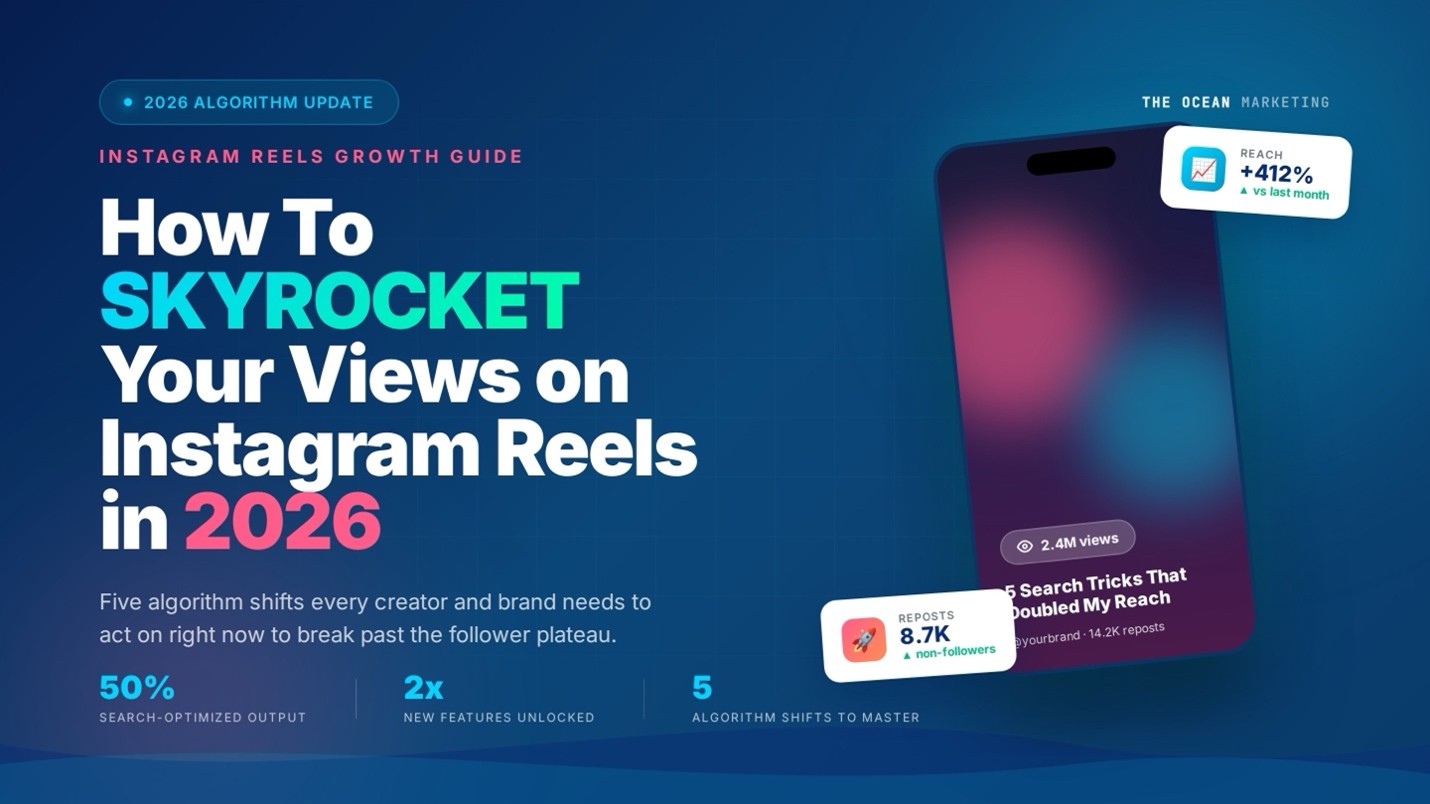
You spent hours filming. You nailed the hook, edited the cuts tight, picked the perfect audio, and posted at the time every guru on the internet swore was the magic hour. Three days later, you check the analytics. Two thousand views. Most of them from people who already follow you.
If that pattern feels familiar, the problem is not your content. It is your strategy. Instagram has quietly rolled out a series of algorithm and feature changes in 2026 that reward creators willing to adapt and quietly bury those still posting with 2024 habits. The platform is no longer just a discovery feed driven by trending audio. It has evolved into a search-and-recommendation engine, with built-in A/B testing, repost-driven distribution, and metrics that prioritize reaching strangers over preaching to your existing followers.
Whether you are a creator trying to break out of a follower plateau or a brand using Reels as a top-of-funnel growth channel, understanding these shifts is essential. This blog covers the five algorithm changes you need to act on right now, plus exactly how to apply each one.
Key Takeaways
- Search content drives long-term views. Roughly 50% of your Reels should be built around keywords your audience actively searches, not trending audio.
- Linking Reels and Trial Reels are underused. Linking creates “view trains” that keep viewers on your profile, while Trial Reels A/B test new ideas against non-followers without risking your main feed.
- Metadata is now a ranking factor. Captions, descriptions, hashtags, and on-screen text help the algorithm understand and route your content correctly.
- Reposts outweigh likes. A single repost (Story share or DM share) signals stronger recommendation value to the algorithm than dozens of passive likes.
- Non-follower reach is the metric that matters. If less than 50% of your views come from non-followers, you are not growing, you are recycling.
The 5 Algorithm Shifts You Cannot Ignore in 2026
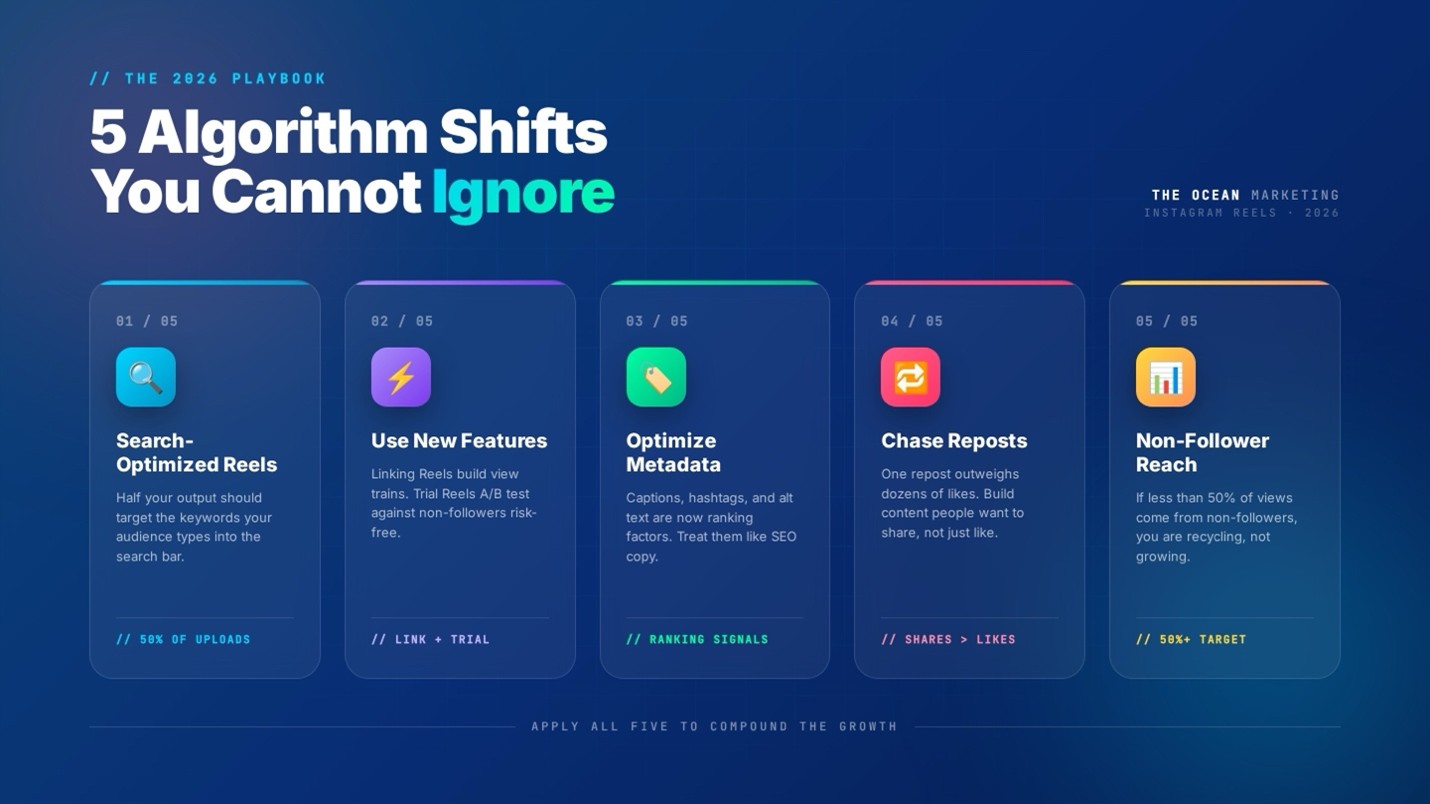
Instagram’s 2026 update is less about cosmetic tweaks and more about a fundamental rewrite of how content gets discovered. Here is what changed and what you need to do about it.
1. Build Search-Optimized Reels (And Make Them Half Your Output)
Instagram’s search has matured into a real discovery engine. Users now type queries like “easy chicken recipes for beginners,” “how to start a podcast in 2026,” or “best skincare for oily skin” directly into the Instagram search bar, and the platform serves Reels that match those exact phrases.
That changes the math. Roughly 50% of your content should be built for search intent rather than trend chasing. Trend Reels still earn quick spikes, but search Reels keep pulling views weeks and months after publishing.
How to apply it:
- Identify the questions your audience actually types. Use Instagram’s own search auto-suggestions, Google’s “People Also Ask” boxes, and tools like AnswerThePublic.
- Place your target keyword in the first three seconds of your hook, in the on-screen text, in the first line of your caption, and in two or three of your hashtags.
- Treat each Reel like a landing page that needs to rank. Specificity beats generic every time.
This is the same principle that drives traditional SEO performance, which is why our search engine optimization team applies the same keyword research framework to social content for clients. Search behavior on Instagram now mirrors Google behavior, and the brands treating it that way are pulling ahead.
2.Master Two New Features: Linking Reels and Trial Reels
Instagram quietly rolled out two features in 2026 that most creators are still ignoring. Both are doing heavy lifting for accounts that take them seriously.
Linking Reels
You can now connect related Reels into what creators are calling a “view train.” When a viewer finishes one of your videos, a linked Reel queues up next, keeping them on your profile longer. The signal this sends to the algorithm is powerful: your content is bingeable. Bingeable content earns more reach on the next post and a higher follower conversion rate.
If you already publish series-style content, link the episodes. If you do not, start. A three-part breakdown of one topic almost always outperforms three unrelated standalone Reels.
Trial Reels
This is essentially Instagram’s built-in A/B testing tool. Trial Reels are shown only to non-followers. Your existing audience never sees them, which means you can experiment with new hooks, formats, and topics without diluting your main feed’s performance.
Use Trial Reels as a free roll. Test variations of the same idea: hook A versus hook B, vertical talking-head versus voiceover, fast cuts versus slow build. Whichever version performs best on cold viewers gets promoted to your main feed. Whichever flops, you delete, and nobody who follows you ever sees it.
3. Treat Metadata Like SEO (Because It Now Is)
Captions, hashtags, alt text, and descriptions used to be afterthoughts. In 2026, they are ranking factors.
Instagram’s algorithm now reads metadata to figure out who your Reel should reach. If your video is about home workouts but your caption is a vague inspirational quote, the algorithm has no idea where to send it. The Reel underperforms, not because the content is bad, but because the metadata is starving the system of context.
A few practical rules:
- Your caption’s first sentence should restate the topic clearly. Save the storytelling for sentence two.
- Use 5 to 10 hashtags that mix broad and specific. One or two big tags (#fitness), three or four mid-tier (#homeworkouts), and two or three niche (#noequipmentworkout2026).
- Write descriptive alt text. It improves accessibility and gives the algorithm one more signal to work with.
- For brands publishing at volume, AI tools like ContentBuddy can generate captions, hooks, and keyword suggestions at scale, which keeps your metadata consistent across hundreds of posts.
The same discipline that drives our content writing work applies here: clear intent, tight keywords, no wasted words.
4. Chase Reposts, Not Just Likes

The engagement metric Instagram now weights most heavily is the repost. That is when someone shares your Reel to their own Story or sends it via DM.
Likes are passive. Comments are useful. But a repost is a personal recommendation, and the algorithm reads it as the strongest signal that your content deserves to reach new audiences. One repost is worth dozens of likes in terms of distribution. To understand the broader engagement hierarchy, our breakdown of Instagram likes, saves, shares, and which one matters most goes deeper into how each signal feeds the algorithm.
To earn more reposts, build content people want to associate themselves with:
- Useful frameworks (“the 3 things every freelancer should do before raising rates”)
- Strong opinions or hot takes that align with your audience’s identity
- Surprising stats or insights that make the sharer look smart for posting them
- Relatable observations that make people think, “This is so me, I have to send it to a friend.”
Stop ending Reels with “double-tap if you agree.” Start ending them with “send this to someone who needs to see it” or “save this for later.” The instruction matters.
5. Optimize for Non-Follower Reach
Open Insights on any Reel and look at where your views came from. If more than 50% are from non-followers, the algorithm is actively pushing your content out to new audiences. If less than 50%, you are mostly serving the people who already know you, which means you are not growing. For a deeper look at how reach translates into measurable performance, our guide on what accounts reached means on Instagram explains the metric and why it sits at the center of any growth strategy.
Two metrics inside Insights matter most:
- Retention rate. What percentage of viewers watched to the end? If this drops below 60%, your hook or pacing needs work.
- Skip rate. Where exactly are people swiping away? Instagram now shows you the second-by-second drop-off. If you lose half your audience in the first three seconds, your hook is the problem. If they leave at the 15-second mark, your middle is dragging.
Treat these numbers as a feedback loop. Every Reel teaches you what to fix on the next one. Creators who ignore Insights tend to make the same mistakes for months. Creators who study them iterate quickly and grow fast.
Common Misconceptions About Reels Growth in 2026
Misinformation spreads faster than algorithm updates. Let us clear up a few myths still circulating.
Myth: Posting more often always increases reach.
Fact: Volume without strategy hurts you. Two well-targeted Reels per week outperform seven random ones. Quality and intent beat quantity.
Myth: Trending audio is the most important factor.
Fact: Trending audio helps for trend-style content, but search-optimized Reels using regular audio often outperform trend posts in the long run.
Myth: Hashtags do not matter anymore.
Fact: Hashtags still matter, but their role has shifted from discovery driver to context signal. Use them for clarity, not visibility alone.
Myth: Buying engagement boosts the algorithm.
Fact: Bought engagement is detectable and actively suppressed. It also damages your repost-to-like ratio, which now weighs heavily in distribution decisions.
Why This Matters for Personal Creators and Brands
Understanding these mechanics is not just academic. It changes how you should plan, post, and measure.
For Personal Creators
If you are building a personal brand, the search and reposts shifts are your biggest unlocks. Search content compounds over time, meaning a Reel you post today can keep pulling new followers six months from now. Reposts expose you to friend-of-friend networks that ads cannot easily reach. Lean into evergreen, identity-driven, and framework-based content. Skip the random trend hopping unless the trend genuinely fits your niche.
For Professional Brands
For businesses, Reels are now a top-of-funnel growth channel that operates on the same principles as SEO. Keyword research, intent mapping, and conversion tracking apply directly. The brands winning on Instagram in 2026 are the ones treating it like a search-and-recommendation platform, not a billboard. Build a content calendar that splits search-optimized educational content, repost-bait insight content, and Trial Reels for testing new positioning. Measure based on non-follower reach and saves rather than vanity likes.
Final Thoughts
Instagram’s 2026 algorithm is not harder to win. It is just different. The creators and brands still posting with a 2024 playbook are watching their views shrink. The ones who have adapted to search behavior, used the new features, optimized metadata, chased reposts, and tracked non-follower reach are seeing the biggest gains they have had in years.
Pick one shift to apply this week. Build five search-optimized Reels around questions your audience is already asking. Then test a Trial Reel. Then audit your last ten posts and rewrite the captions for clarity. Compound those small wins, and the views follow.
At The Ocean Marketing, we help creators and brands turn Instagram into a measurable growth channel through social media marketing strategies built on the same keyword research, content planning, and performance tracking that power our SEO work. If you want to know exactly where your content is leaking views and what to fix first, request a free SEO audit or contact us to put a custom Instagram growth plan together for your brand.