Skip to content
Imagine walking into a car dealership ready to buy a family SUV, but the salesperson immediately hands you a brochure for a two-seater convertible. Or perhaps you’re just browsing online for hiking boots, and an ad screams at you to “BUY NOW” before you even know which brand you like. Frustrating, right? This disconnect happens constantly in digital advertising.
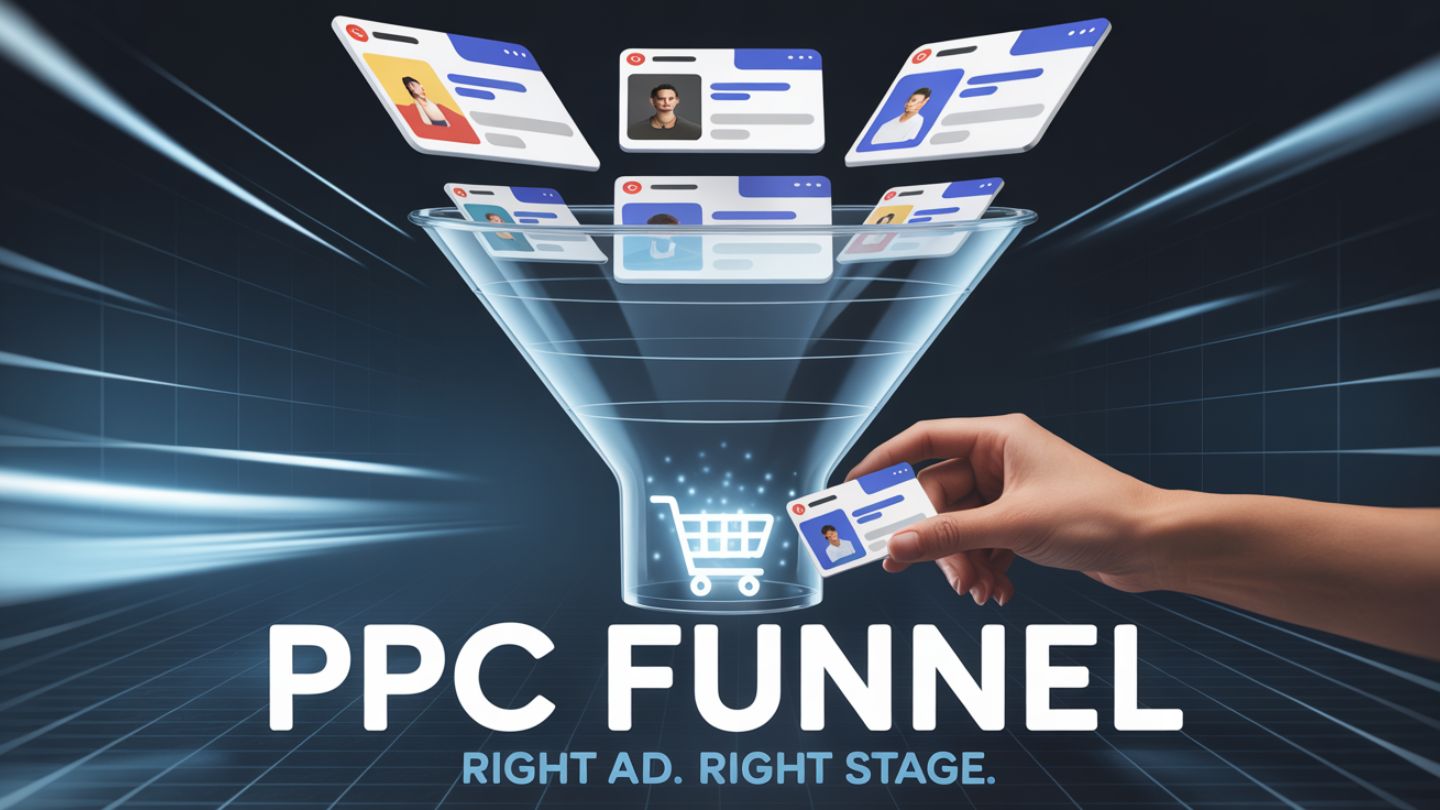
Businesses often treat every potential customer the same, regardless of where they are in their buying journey. They blast the same message to everyone, hoping something sticks. This approach burns through the budget and alienates potential buyers. The solution lies in PPC funnel mapping. By aligning your Pay-Per-Click (PPC) ads with specific stages of the marketing funnel, you can deliver the right message to the right person at the exact right moment.
This blog will break down how to map your PPC strategy to the customer journey, ensuring your ad spend drives real results rather than just noise.
Key Takeaways
- PPC funnel mapping helps match ads to the buyer’s stage, improving relevance and reducing wasted spend.
- Each funnel stage needs different messaging, awareness content first, lead nurturing next, and conversion-focused offers last.
- Remarketing and optimized landing pages connect the funnel and boost overall ROI.
What is PPC Funnel Mapping?
PPC funnel mapping is the strategic process of creating specific ad campaigns tailored to different stages of the buyer’s journey. Instead of a “one-size-fits-all” ad, you create a sequence of touchpoints that guide a user from total stranger to loyal customer.
The traditional marketing funnel usually consists of three main stages:
- Top of Funnel (ToFu): Awareness
- Middle of Funnel (MoFu): Consideration
- Bottom of Funnel (BoFu): Conversion
When you map your PPC campaigns to these stages, you acknowledge that a user searching for “what is CRM software” has different needs than someone searching for “Salesforce vs. HubSpot pricing.”
Why Alignment Matters
Aligning your ads with funnel stages isn’t just a nice theory; it’s a financial necessity. When alignment is off, you risk two major pitfalls:
- Wasted Spend: Bidding on high-intent keywords with low-intent content (or vice versa) leads to low conversion rates.
- Poor User Experience: pushing a hard sell on someone who is just learning about a problem feels aggressive and untrustworthy.
By mapping your strategy, you improve your Quality Score, lower your Cost Per Acquisition (CPA), and ultimately increase your Return on Ad Spend (ROAS).
Many of the factors that influence PPC campaign success come down to this exact alignment, matching user intent with the right message, targeting approach, and landing page experience. When every funnel stage supports the next, your campaigns become far more efficient.
Stage 1: Top of Funnel (ToFu) – The Awareness Stage

At the top of the funnel, your audience doesn’t know you exist. They might not even know exactly what solution they need; they just know they have a problem. Your goal here isn’t to sell. It is to educate, inform, and capture attention.
The Goal: Brand Awareness and Traffic
You want to cast a wide net to attract relevant users. You are trying to spark interest and get them to your site to “cookie” them for later retargeting.
Recommended PPC Channels
- Google Display Network: Excellent for visual impact and reaching users while they browse other sites.
- YouTube Ads: Short bumper ads or educational videos work wonders here.
- Facebook/Instagram Ads: Target interests and demographics rather than intent-based keywords.
Ad Copy and Creative Strategy
Your messaging should focus on the problem, not the product. Avoid “Buy Now” language. Instead, use hooks that validate their pain points.
Bad Copy: “Buy our AC repair services today for 20% off.”
Good TOFU Copy: “Is your AC making strange noises? Here are 5 signs it might be failing.”
Keywords to Target
Focus on broad, informational queries. These often start with:
- “How to…”
- “What is…”
- “Why does…”
- “Tips for…”
This is where understanding TOFU keywords becomes essential. These early-stage search terms help you reach users who are still discovering their problem, making them ideal for awareness campaigns that prioritize education over immediate conversion.
Content Offer
Direct these users to low-friction content. Do not ask for a credit card. Send them to blog posts, infographics, or comprehensive guides.
Stage 2: Middle of Funnel (MoFu) – The Consideration Stage
Now the user knows they have a problem and is actively looking for solutions. They are aware of your brand (thanks to your Tofu ads), but are also looking at your competitors. This is the evaluation phase.
The Goal: Lead Generation and Nurturing
You need to prove you are an authority and capture their contact information. You are trading value for their email address or phone number.
Recommended PPC Channels
- Google Search Ads: Target more specific terms now that they are researching solutions.
- LinkedIn Ads: Highly effective for B2B consideration, targeting specific job titles.
- Remarketing (Display/Social): Target users who visited your blog but didn’t convert.
Ad Copy and Creative Strategy
Shift your messaging to highlight your unique selling proposition (USP) and social proof. Why are you better than the alternative?
Bad Copy: “We are the best software company.”
Good MoFu Copy: “See why 5,000+ marketers choose our platform for automation. Read the case study.”
Keywords to Target
Users compare options. Look for keywords that signal comparison or specific features:
- “Best [product] for [industry].”
- “[Competitor] alternatives”
- “[Service] reviews”
- “[Product] features”
Content Offer
This is the “lead magnet” stage. Offer high-value assets that require a sign-up:
- Webinars
- Case studies
- Whitepapers
- Free templates or tools
Stage 3: Bottom of Funnel (BoFu) – The Conversion Stage

This is crunch time. The user knows what they want and is ready to pull the trigger. They just need that final nudge to choose you over the competition.
The Goal: Sales and Revenue
The objective is simple: get them to buy, book a demo, or sign a contract.
Recommended PPC Channels
- Google Search Ads (High Intent): Bid aggressively on these keywords.
- Google Shopping Ads: If you sell physical products, this is essential.
- Remarketing for Cart Abandonment: Target users who started the process but left.
Ad Copy and Creative Strategy
Be direct. Remove friction. Use urgency and reassurance. Highlight guarantees, free shipping, or limited-time offers.
Bad Copy: “Learn more about our pricing.”
Good BoFu Copy: “Get started today. 30-day money-back guarantee. No credit card required.”
Keywords to Target
These are “transactional” keywords. They signal an imminent purchase:
- “Buy [product] online.”
- “[Service] pricing”
- “[Brand name] discount code”
- “Hire [service provider] near me.”
Content Offer
Send traffic to dedicated landing pages optimized for conversion.
At this stage, choosing the right types of landing pages can make or break results. A product-focused page, consultation form, or demo booking layout should match the exact intent of the search, removing distractions and making the next step obvious.
- Free trials or demos
- Consultation booking pages
- Product pages with “Add to Cart” buttons
- Coupon redemption pages
Connecting the Dots: The Importance of Remarketing
A funnel isn’t always linear. People jump around. They might visit your pricing page (BoFu) and then go back to read a blog post (ToFu). This is why remarketing is the glue that holds your PPC funnel mapping together.
You should set up audiences based on behavior. If someone watched 50% of your video ad on Facebook (ToFu), serve them a lead generation ad (MoFu) on Google Display. If someone abandoned their cart (BoFu), serve them a discount ad on Instagram. This cross-channel consistency ensures you stay top-of-mind no matter where the user goes next.
Metrics to Watch Per Stage
To ensure your mapping is working, you must measure the right KPIs for each stage. Do not judge a fish by its ability to climb a tree, and do not judge a ToFu ad by its immediate sales conversion rate.
- ToFu Metrics: Impressions, Click-Through Rate (CTR), Cost Per Click (CPC), Time on Site.
- MoFu Metrics: Number of Leads, Cost Per Lead (CPL), Micro-conversions (newsletter signups), Engagement rate.
- BoFu Metrics: Sales, Conversion Rate, Return on Ad Spend (ROAS), Customer Acquisition Cost (CAC).
How to Get Started Today
Implementing a full-funnel strategy can feel overwhelming, but you don’t have to rebuild everything overnight. Start by auditing your current campaigns. Are you bidding on broad keywords but sending people to a sales page? Stop that immediately.
- Audit Keywords: Group your current keywords into Awareness, Consideration, and Decision buckets.
- Review Landing Pages: Ensure the destination matches the intent of the keyword bucket.
- Adjust Bids: allocate budget based on value. BoFu keywords usually justify higher bids because the return is immediate.
- Create One Remarketing Campaign: Start simple. Target everyone who visited your site in the last 30 days but didn’t convert.
Final Thoughts
PPC funnel mapping is the process of aligning your ads with each stage of the buyer’s journey, so your messaging matches user intent. Instead of wasting spend on generic campaigns, this strategy helps you guide prospects from awareness to consideration and finally conversion, improving efficiency, trust, and long-term results.
At The Ocean Marketing, we specialize in building high-performing PPC strategies that are mapped to the funnel, ensuring your ad spend drives real revenue rather than missed opportunities. If you need expert help structuring your campaigns or want a professional audit of your current approach, we are here to support you. To maximize performance even further, pairing paid campaigns with a strong organic foundation is essential. A free SEO audit can uncover hidden opportunities to improve landing pages, keyword alignment, and overall funnel performance. Contact us now to optimize your PPC strategy and start driving measurable growth.