Skip to content
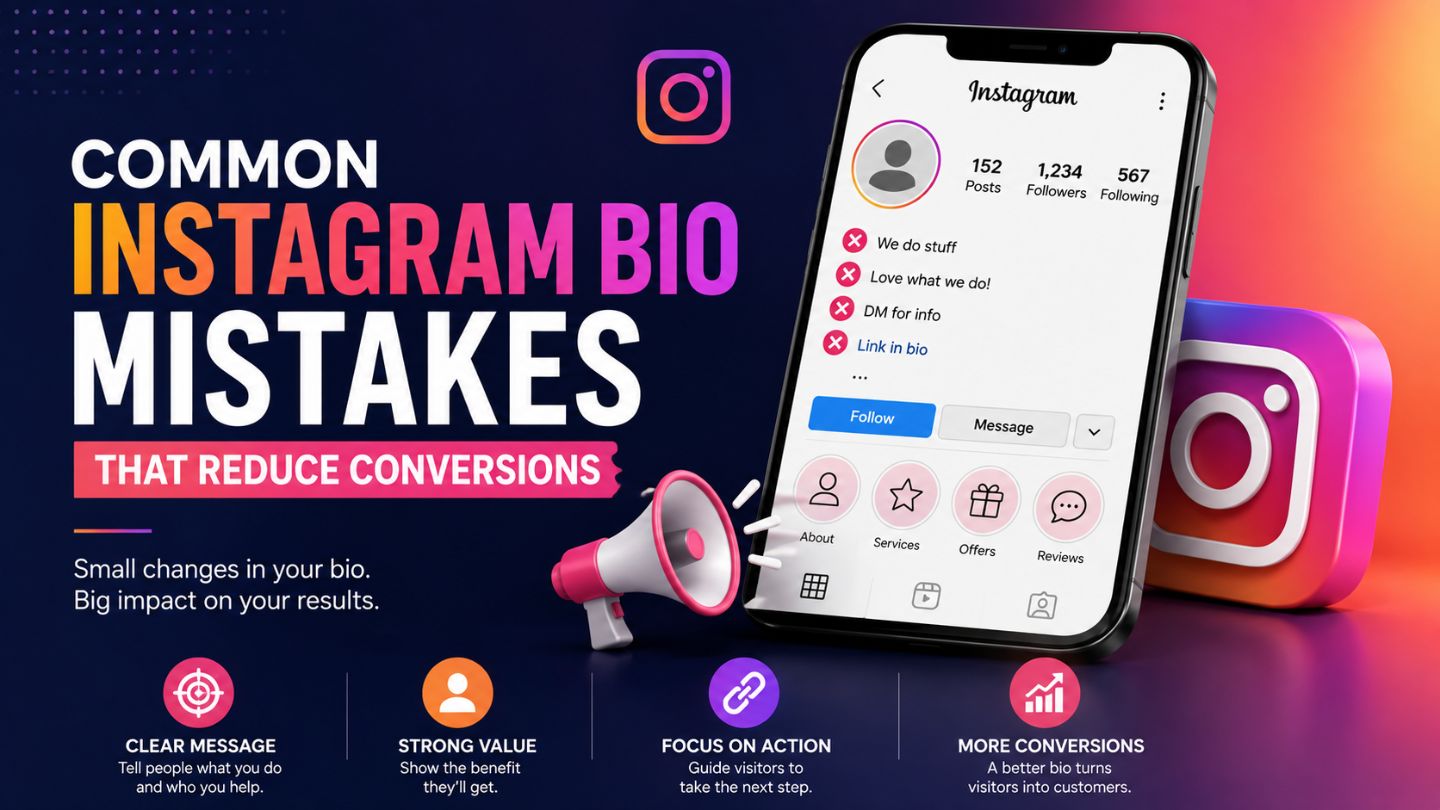
You get 150 characters and about two seconds. That’s the entire budget for convincing someone who liked one post that your business is worth following, clicking, or buying from. Most businesses spend it on adjectives. The bio isn’t a small detail attached to a profile; it’s the conversion point every post drives toward, and the mistakes are remarkably consistent across industries. This blog covers the bio errors that quietly cost conversions, why each one fails, and what to write instead.
Key Takeaways
- Vague inspirational language wastes your entire character budget.
- Describing yourself is less effective than describing who you help.
- Emoji clutter reduces readability rather than adding personality.
- Multiple competing links produce hesitation instead of action.
- A bio without a next step leaves interested people stranded.
Mistake One: Saying Nothing at Length
“Passionate about excellence. Innovating every day. Dream big.” Three lines, zero information, and a reader who now knows less than when they arrived because you’ve actively wasted their attention. This is the most common bio failure and the hardest to see from the inside, because it sounds like a brand voice rather than an absence of content.
The test is brutal and simple: could a competitor use your bio unchanged? If yes, it isn’t describing you; it’s describing your category. Replace every aspirational adjective with a concrete fact about what you do and who you do it for. “Custom kitchen fitting for Victorian homes” beats “crafting spaces with passion” in every measurable way, and it took fewer characters. That shift is the difference between copywriting and content writing, compressed into a single field.
Mistake Two: Talking About Yourself
Bios written from the business’s perspective miss what the reader is doing. They aren’t wondering who you are; they’re wondering whether you’re relevant to them. “Award-winning agency established 2011” answers a question nobody asked. “We help local restaurants fill weeknight tables,” answers the one they’re actually holding.
This is a small shift with a large effect. Lead with the outcome for them, then establish your credibility if there’s room. Awards, founding dates, and team size are supporting evidence, not the headline. Someone who cares that you’re award-winning will find that out later, and someone who doesn’t know whether you’re for them will have already left. This connects to broader questions about why content isn’t reaching the right people, since relevance failures compound.
Specific Beats Impressive
A narrow, precise description attracts fewer people and converts far more of them. Trying to appeal to everyone in 150 characters produces a bio that appeals to no one.
Read More: The Role of Keywords in Instagram Captions and Profile Optimization
Mistake Three: Emoji Soup
Emojis are useful as visual anchors, marking the start of a line so the eye can navigate a small block of text quickly. That’s their job. Used as decoration between every word, they turn a bio into a puzzle, and readers stop parsing it rather than working harder.
There’s an accessibility cost too: screen readers announce every emoji by name, turning your decorated bio into an unlistenable stream. One per line at most, used to structure rather than to embellish. The same restraint that makes long-form and short-form content work applies at 150 characters. If removing an emoji doesn’t make the bio harder to scan, it was never doing anything except taking up characters you needed.
Mistake Four: The Link Menu

Link-in-bio pages solved a real limitation and created a new problem. Give someone eight destinations, and you’ve asked them to make a decision at the exact moment you wanted them to take an action. Decisions produce hesitation, hesitation produces tab closing.
Most profiles convert better when pointing at one relevant destination than a menu of everything. If you genuinely need several, keep the list short and ordered by priority rather than by internal category. Instagram supports multiple links natively now, which removes the need for a third-party page in many cases. Understanding which engagement signals actually matter helps clarify what that single link should be pointing at.
Mistake Five: No Next Step
A bio that describes the business perfectly and ends there leaves an interested person with nowhere to go. They read it, thought “that’s relevant,” and then hit a wall. The follow might happen, the click probably won’t, and the conversion definitely won’t.
One clear instruction fixes it. Book below, DM for a quote, tap for the menu. It feels almost too blunt to write, which is exactly why so many businesses skip it, and exactly why it works. People do what they’re told when what they’re told is what they already wanted. The absence of a call to action isn’t sophistication; it’s leaving the sale unfinished.
Mistake Six: Keyword Stuffing the Wrong Field
Once people learn Instagram indexes the name field, some conclude the bio should be crammed too. It shouldn’t, because the bio isn’t weighted heavily for search, and stuffing it destroys the persuasion it exists to do. You end up with a profile that’s neither findable nor convincing.
Keep the division clean: discoverability terms belong in the name field, where they’re indexed, and the bio persuades whoever arrives. A name field reading “Coastal Dental | Family Dentist” does the finding, and a bio reading like a keyword list undoes it the moment someone gets there. One field per job, and neither is doing both badly. The warning signs are the same ones that mark keyword stuffing anywhere else.
The Line Break Problem
Instagram’s bio editor handles line breaks inconsistently, and businesses either give up and write a wall of text or spend twenty minutes fighting the interface. A wall of text in 150 characters is genuinely hard to scan, so the formatting matters more than the effort suggests.
Three or four short lines outperform one dense block reliably. Each line does one job: what you do, who for, proof or differentiator, next step. That structure is scannable in a second, which is roughly what you have. Writing it as continuous prose asks the reader to parse a paragraph before deciding whether you’re relevant, and most won’t.
What to Do With the Character Limit
The 150-character constraint is doing you a favor, and businesses treat it as an obstacle. It forces the prioritization that longer copy lets you avoid. If you can’t say what you do and who for in that space, the problem usually isn’t the limit; it’s that you haven’t decided.
The exercise worth doing is writing the bio at four hundred characters first, without constraint, then cutting to fit. What survives is what mattered. What goes is almost always the adjectives, the hedging, and the second thing you do that you mentioned because someone insisted. That cut is where the bio gets good.
Testing Without Guessing
Instagram tells you whether your bio works, and almost nobody checks. Profile visits versus website taps is your conversion rate for the link. Follows per profile visit tells you whether the bio makes a case worth committing to. Both sit in insights, and both answer questions people argue about instead.
Change one thing, wait a fortnight, look at the numbers. Change another. It’s slower than rewriting the whole bio on a whim, and it produces answers rather than opinions. Most businesses have never made a deliberate, measured change to their bio, which means most bios are the first draft someone wrote at setup and never revisited.
Matching the Bio to the Traffic

A bio serving people who arrived from a viral Reel needs to do different work than one serving people who searched your business name. The first group has no idea who you are. The second already decided to look you up. Most bios are written for the second and receive mostly the first.
If your growth comes from discovery rather than direct search, the bio has to explain from scratch, and assuming familiarity loses people who never had it. Checking where profile visits actually originate takes a minute in Insights and frequently reveals that the bio is written for an audience that isn’t showing up.
Read More: How to Turn Instagram Profile Visits Into Website Traffic
The Name Field Mistake That Compounds
Bio errors are visible, so they eventually get fixed. The name field error is invisible, which is why it survives for years. Most businesses put their brand name there, and nothing else, which means they’ve opted out of Instagram search entirely without ever making a decision about it.
The field is indexed, and the bio largely isn’t, so the discoverability terms belong there and nowhere else. Brand plus one honest descriptor, readable, not stuffed. The businesses fixing their bio while leaving the name field as a bare brand name are polishing the shop window while the street sign stays blank. Get both right, and they do different halves of the same job, which is what they were designed for.
Writing a Bio That Converts
Instagram bios fail for a small number of predictable reasons: they say nothing at length, they talk about the business rather than the reader, they bury themselves in decoration, they offer a menu instead of an action, and they forget to ask for anything. Every one of those is fixable in twenty minutes. State what you do and who for, in plain language. Give one clear next step. Put your search terms where they’re actually indexed. The content brings people to the profile, and the bio decides what happens next.
At The Ocean Marketing, we help businesses build social media marketing where the profile converts the attention the content earns. Whether you want a second opinion on your bio, help building a content approach that fits your audience, or a free SEO audit to see how your wider presence performs, our team is happy to help. Contact us and let’s get those 150 characters working.